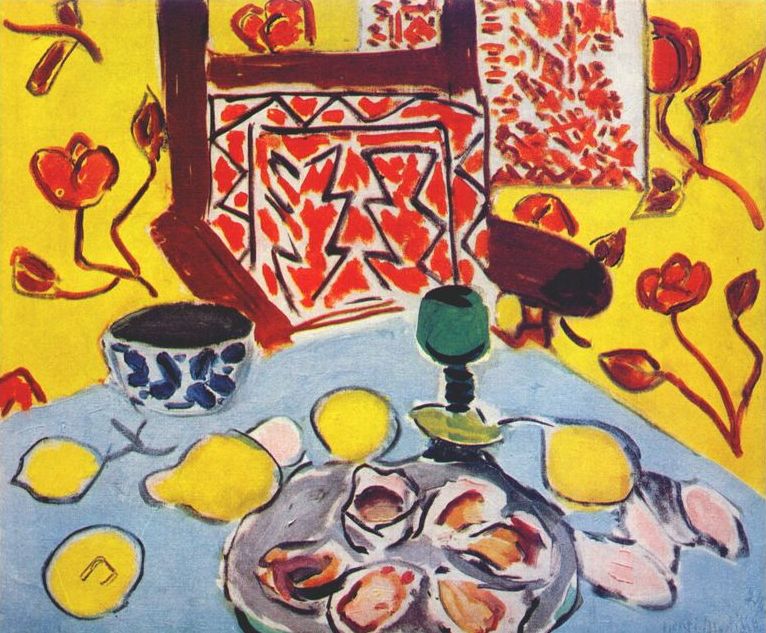
Henri Matisse- “Oysters and Wooden Armchair” (1943)
A painful, and rather fungal condition has made its way to my nail beds. The constant exposure to citrus, all that lemon squeezing, is wearing away my cuticles. I imbibe a lemon seed floating in my opaque container filled with icewater.
But there is no time to examine cuticles. I’m not examining Zach’s buttcrack either, just seeing it unsolicited. He is hunched over the perforated floor mat with his head inside the chamber of my lowboy refrigerator, depositing oysters on my behalf, into the fryer.
Flour and liquid, when mixed, creates a new, clumpy material. This is something an oyster can do. The oysters are drawn out of a deep third pan of seasoned buttermilk into a flat fishtub of dredging flour, half rice, half all-purpose, seasoned with salt and cracked pepper. Too much liquid in the dry and there is no coming back. They don’t tell you–
when hired, how fast you have to be. I studied at an art school in Brooklyn, where I worked on the same few centimeters of space for days, attending to an overworked surface or the flatness of a mismeasured value contrast. (My thesis painting last spring was called, Get Out Of The Road, and the work was an immersive, large-scale simian countenance revealed in the tire track of a run-over gas station cup. After I laid the whole, desaturated blue base layer, my advisor and I agreed that I was still tip-toeing around the paint. I wasn’t pushing brush into idea, he said, a timidity you wouldn’t expect someone to be able to perceive from just the base layer..)
Now Chef seethes over at me. The vasculature in his face protrudes. Behind his squeaky, bald noggin, I can see an archive of small white paper rectangles accreting, in linear fashion, along the stainless steel ticket holder that spans the overhead length of the pass. There is a back wall between our service kitchen and the dishpit, where the clock hands angle to 6:58.
Zach is older than me, fruit shaped, and laconic. In a few weeks he will just not show up one day, after stealthily clearing his locker and furtively packing his knives. That’s the life of a peripatetic line cook, I guess. Moving from kitchen to kitchen until all have been run through and you relocate. Or something. With a far away look in his eyes, he talks sometimes about the meditative pleasure of stirring big pots of broth in the middle of the night.
And a submarine disappeared. It went missing from the radar of a private submarine-tourism company. Something about touring the ruins of the Titanic at 12,500 feet deep. Chef is pretty up on the news story too, and he is going around the last two days speculating to dishwashers and the fish-filetting guy. He thinks the sub has lost power and is floating somewhere on the surface of the North Atlantic, out of range and slowly losing oxygen. He presents this theory to Raul and Pauline as though they have a different theory about what happened to the sub that they would like to propone, but the dish washer and the fish fileting guy offer a confused smile, a fake laugh, and ask if Family Meal is up yet. I’m not sure they share our nationalistic attachment to the Titanic or niche wealth-gap accidents.
Neil, the Friday-Saturday night bartender, is insisting it was an inside job.
“There is no sub,” he said last night, as I waited for my second Presidente.
His back was turned and he was rinsing out a coupe glass full of bruised mint in the hand sink. When he became inaudible under the automated crashing noises of the bar dishwasher, I could make out only parts of his monologue re “epic distraction,” and “rapidly widening chasm between us and the billionaire class” and, “The Revolt.”
The restaurant has been assigning me dishes at difficulty levels of which I am not currently capable. Only a few weeks ago, I was still dropping chicken parts out of a plastic bag into the fryer at Feathers, a casual slice shop with fried chicken as its angle, conveniently located on my corner. Before that, an art-handling gig went sour when a gallerist told my supervisor I was redolent of “bar.” (I was in the process of moving into a new apartment, and had to wear the same clothes to work the next day, despite the fact that Soren, the poet, spilled his white negroni on my pants.) What followed were a few misaligned nights with a dissociative anesthetic in the new apartment and a sinking realization that I wasn’t going to be able to afford studio space and rent. I hadn’t eaten either, and there was an intoxicating burnt cheese aroma that, once I regained my composure, I followed toward the corner.
Feathers had unlimited ice from the ice machine and a pizza oven like a shelf in the wall. The manager, Hugo, taught me that brined poultry hasn’t actually gone bad until it takes on an emetic effluvia. And, with an eye towards all known and possible gradients of golden brown, I came to see the act of frying as luridly aesthetic, and went looking for what else I could impart on, at institutions with higher hourly wages.
I remembered having an imperiously priced “purslane salad” at Cello, during a date with a seraphim who slipped through my, then, intact fingertips. I’d been intrigued by how seriously it took itself, Cello, and recalled this, when I stumbled on their listing for the “garde manger” position. I had not been aware this meant salad guy, before I’d committed to all that fine dining entails.
Last night my apron was stained all of these colors. A round gradient of purple within green streaks and yellow-green accents and yellow hues. Gradation moving with speckled pinks from a central focal point. An impasto of herb residue and beet braising liquid from something that had sprayed. Downward scumbling in farm-to-table chroma, towards the hem.
Zach is dropping three orders of oysters for me, although he is grill tonight. There are six orders of oysters, but I’m in the middle of three tuna crudos, and I have to gently agitate and plate four watercress salads for the rib eyes. I hate to say that I also owe the chef two flourless chocolate cakes. He is growing sort of aphasic as the printer exudes paper and clunky, geometrical sounds. He calls out new dishes to me, adding to my accruing debt of dishes, but he is becoming less accurate with numbers and more urgent, in like a life or death way.
The soup tonight is charred carrot with fennel. You’d think orange but it’s a toffee hue because of the heirloom carrots, which are white, actually. Technically, they are called Scarlet Nantes, grown specifically for Cello by a farmer in western New York who is a well known ballerino, in some upstate circles.
There is no vegetable here that is regular. In fact, Cello’s owner, Robert Tello, is a painter like myself. His hair is January white, always slightly wet. He only wears Swiss chore coats, but in every pigment. Over the foam of his double espresso, he has seven children. Or maybe it is six, but they have many regal little friends. His wife, Calendula, I think she may be a bit younger than him.
By the time Zach drops seventeen neatly dredged oysters into the fryer for me, I have finally finished plating three crudos. The tuna loin, a raw cylindrical slab of freshly caught yellowfin, I am slicing to order as thinly as is afforded with a ten inch Kiritsuke yanagiba. Eight slices to an order, obliquely laid over just as thin, translucent kohlrabi. In between the skewed, round topography of tuna and kohlrabi, I position segments of pickled green strawberry and irregular, pointillist groupings of mustard seeds. Beyond that, chervil is applied, a delicate, ineffectual herb for visual flourish. You can imagine the time this might entail. Chef wants it “yesterday.” Zach is between us, bent forty five degrees forward over a sliced, pink pork chop. Drizzled agrodolce from the height of a well-made spoon. Chef becomes shrill when threatened. It’s not just the crudo he needs, it’s the oysters, it’s the Scarlet Nantes (soup). It’s the ramekins of celtuce aioli and a few orders of a really tasty black radish salad with Godminster Vintage organic cheddar, capers, clotted parsley, and a lot of fresh lemon juice that’s corroding my nail beds in a clinical way. Really, the oysters could be going to the same table as the crudo. Or one oyster could be on its way to a table with no other apps. Or, I imagine a table could be waiting for the black radish and cheddar salad, coursed between an oyster and a soup. Waiting and waiting. And waiting. And they’ve dropped a salad fork onto the clever tile floor. I suppose no oyster is on its way anywhere at the moment though, as I haven’t turned around yet to face the fryer.
My station is a square zone. A lowboy refrigerator against the front facing wall has a long white cutting board that latches onto the refrigerator’s stainless steel counter with divots and holes. Under a closable steel lid, the lowboy has open, refrigerated compartments where I store fussed-over ingredients in stainless steel containers of various sizes. A long third pan of watercress tangled like green hair, a six pan of intrepid, dull black radishes (sliced to order), a six pan of stiff Godminster cheddar and the microplane I use to administer it, three rows of three nine pans each one holding something precious or confounding. A six pan of lemons that have been halved and cored so they are seedless and gushing with citric acid further withering my cuticles. There is a white brick wall to my right with a small hole through it, revealing the low-lit part of the dining room.
It’s 7:05. I put my eye up to the hole in the wall and see three two-tops, all adorned in the same specialty blends of natural fibers, gesticulating, in one way or another, regarding the fate of the OceanGate’s Titan submarine, with its crew and five, prodigal passengers, bubbling somewhere at the surface of a black, unchartable Atlantic, unfindable. Unless one of the crew members, in a mentally ill rampage, cut the radar signal from inside, taking the others down in a complexly, deep-sea murder suicide. I shudder as a cherubic server with golden ringlets returns from the dining room with an uneaten plate of dry aged carpaccio and sets it in front of Chef, who says something out of earshot and dumps the whole thing, plate included, into the dishpit trash can.
I don’t understand how we, collectively, decide what is important to save. I breathe in fryer air and lift the basket of oysters up and admire that they are not too oscuro but rather ochre. I flip the fryer basket upside down and let the fried oysters plop into the concavity of a handsome, metal bowl, like I’ve seen other guys do, with fried things. With a pincered thumb and index finger as far above the bowl as I can lift my hand, I aim an arid waterfall of kosher salt over the hot blobs. Onto a ribbon of smeared aioli, pebbled with ultra-fine shallots, the oysters are settled, decorated with chives, shoved into The Window, a metal shelf underneath a hot-lamp, where a server can reach them. Every time the kitchen doors swing open, there is a roar of voices, cutlery, laughter, and curated background music. Sounds coming from a place that could not be further away.
My real problem here is what the oysters and all the buttermilk they’re floating in, is doing to the limited flour dredge they must be tossed in, pre-fry. I’ve been injudicious with some of the wetter items getting in the dryer ones. Cavalier, Zach and our chef would probably say. I would prefer rushed. The more oysters I have on order, the faster I am flailing oysters and buttermilk into my dredge. The wetter my flour gets, the less dry stuff I have available to toss them in. And soon there will be nothing left.
The last I heard, over continuous, meandering printer-machine noise, and intermittent dining-room-roars and sort of poorly hushed invectives, was that I have five radishes, seven oysters, (after a pause to count over about fifteen printed white rectangles) eleven crudos, two soup, four chocolate cake slices, and two desserts that, earlier, the pastry chef instructed me to plate as though it were a sylvan municipality of pudding and puffed moss. I repeat all of these orders back to Chef, as I am supposed to, although no one particularly wants to hear it. As my cuticles pulse with citric needles, I sense a momentum of undeniable, group-level unraveling for which I am getting the sense that I may be being.. blamed.
“… and carbon fiber hasn’t been tested at that depth —-” exclaims an extra drunk voice from the dining room, through a momentary opening of the swinging doors.
An oyster slowly sinks toward the bottom of the fryer and explodes.
Tepper BT is a baker in Hudson, NY and the founder of CIRCLES.
No work again today. I went to my old town and walked around. Sweating through my jeans. Whistlejacket in a soggy brown paper bag tucked under my arm from the used bookstore. Twenty five bucks down the tubes. I shaved my head again and my daughter cried. I think it makes me look tougher. I tried not to think about her red eyes and big salty tears as I kept stealing glances in shop window reflections. The sun cut through right after the rain and brought a wall of August humidity. This is where I usually get nostalgic about slow summer New Jersey afternoons. The stuff of legends. Lost to an endless scroll. Baseball on the front lawn. Stolen beers in the woods. Kissing a girl from another town in the cold darkness of the Regal on Route 130. The cold red vinyl of a booth at the Americana Diner at midnight. Cracked cement pavers and islands of cigarette butts and broken bottles cut dead center of cul de sacs. But not this time. I swam down Nassau Street. I kept telling myself that I was taking control as I spiraled clockwise down the drain. On ripped jean knees wailing into the microphone. Bam bam bam. Verse chorus. Verse chorus. It all ends. You can live an entire life under two minutes. What’s the point of dragging the dead deer up the hill? Everything was still. This moment. Not the beauty of the past, not the creeping black terror future. The impending out of control. The sky, the trees hanging over that gothic architecture, the ivy, the beautiful girls and their beautiful college eyes behind their tiny college sunglasses. Linen wrinkled blonde hair. This town has never changed. It was shot out of a cannon and put in its place. Cemented in times everlasting covenant. Before me. After me. But the hospital I was born in is gone, in its place, hundreds of sleek condos. Sharp corners. Black and white. I entered the double doors of the record exchange to a blast of cool air and a Radiohead song I couldn’t stand. An airbag or an iron lung, Sophie’s choice. I needed Bill Evans to calm my nerves, or to transport me to the unwired past and out of the technofuture. But it was my exit music for a film. I rubbed my head and I wished it were a watermelon then blew out the candles and fell to a billion pieces, right where I began.
Hari Kari
“you’ll read about me in the paper”
we were both laughing
it had been awhile since we cracked up together, my dad and i
“bucks county man impales himself with sword”
we laugh harder
“considering what you have to deal with, it’s probably not the worst idea” I said
we are rolling now
Thin Cigarettes
thunder rolled through around 11:38
quickly followed by the downpour
coloring the black night white
viv fell asleep watching coneheads
she missed the part when they go back to their home planet
she will make me rewatch it with her tomorrow
i thought of a video of a ghost
walking past an open door
that this girl showed me
while we smoked thin cigarettes
at a wedding in cancun
you both twisted and turned
tornados of the sheets
i lay uncovered, exposed to the eventual elements
but you are covered up so I’m happy
i imagined the house being struck
then split in half and opened wide
like it was unzipped all the way down
to the lawn spilling out all of us
the furniture, books, clothes
all getting washed away by the stream
in front of our house
as it whipped itself up into a furious anger
i left the light on in the bathroom
since you’re gone it emits the faintest light to the hallway
between the rooms upstairs
fallen branches dance on the roof
drumming out of time
it’s not like
If you were here
you could save us
but the light is on
just in case
Weapons
When do thoughts become weapons?
Born sharp
Dulled with time.
Driving country roads
With the new pop star record on
I figured I would break the buried silence
“When we are both quiet, we are usually thinking the same thing. That’s weird right?”
You waited.
“It’s sad”
Dan Svizeny was born in Princeton, New Jersey, in 1987. He lives and works in Pennsylvania. His writing has appeared in Plague Circus Press, Bull, Spectra, and The Despair Quarterly.
If she could wait anymore she would’ve. But the trees need to be thinned. So it wasn’t exactly the crime it was called. She wasn’t as eager as the papers and the mugshot made her seem. The mugshot hadn’t been her idea. The man behind the camera was a creep with yellow incisors and a white tongue he wagged when an adjustment of the straps of her top made her breasts lift. He told her more than once to smile for the camera like a pretty girl. Which she did to his moan and the judgment of her father’s friends who thought her face in the picture proved that she was just as crazy as they always thought she was.
No one had asked her what the trees had said which meant when she told them, they didn’t care to listen. But the trees had been pathetic for a long time. About seven months or so.
Her father was a retired plastic surgeon who worked at a hospital three towns over known for the steadiest of hands in the county. He got tired of so many stitches and wanted more hours in the day to build the float he and his friends, who play beside him in a Grateful Dead cover band, were planning to ride in this year’s Burning Man. Lizard shaped and dark blue. He especially didn’t care about the trees, who he had been saying couldn’t talk for the entire time she’d heard them.
“But I’m listening to them anyway.” She’d reply at the end of their nightly phone calls.
The officer that came to the scene said to whoever was on the other end of his walkie-talkie that she had knotted hair and gasoline he could tell was cheap. He called the lunge she made towards him after this a symptom of whatever kind of state she was in but really she just didn’t like that he called her broke while she was doing the trees a favor.
“They complained about how crowded they are. How sore. How stiff from bending in ways they can’t to keep from touching each other.” She said while in custody.
“So you killed them?”
“Only the ones so old they didn’t mind.” She answered.
There were things she could’ve said in court when the prosecutor argued for a charge of aggravated arson that sought personal gain. She could have said the trees that she set fire to took a sigh of relief when the flames picked up. She could say she heard the ones left bless her as she climbed in the cop car. She could say nobody cried or asked her to stop. But instead she let her lawyer say she was insane and lacking proper medication.
After the hearing in which his daughter was sentenced to six months in a state psychiatric facility preceding a re-trial, the plastic surgeon said there wasn’t to be any room in the lizard’s mouth for the flames they’d previously agreed it would breathe. None of his friends put up a fight out of pity. They could understand why he’d be weird about fire. What they couldn’t understand was his new found disdain for trees. Trimming the ones in his yard of any leaves and branches until they were nothing but sticks coming out of the ground. He hated trees and everything they had to say.
Playing With Toys
The little boy tells me the dinosaur in the corner of his pile of toys is retarded. He catches himself and tells me what he meant to say was ‘r-worded’. I touch the toy’s neck and ask why the dinosaur is the disabled toy and he says anything can be r-worded even dinosaurs. He says the dinosaur’s name is Speddy and he doesn’t do anything but stare at the other toys.
When Leona came back from the bathroom to find me sitting next to the boy we’d just complained about, she was startled. She hesitated to sit on the ground despite the boy asking her to by patting it. He said his mom was teaching him to share then asked if I know how. I said sometimes.
“You only have to share sometimes?” He asked, his eyes lighting up.
“Adults only have to share every once in a while. Kids have to share more.” I answered.
The boy’s face fell and Leona told him sharing isn’t so bad.
“You’re sharing right now.” She said.
“Yeah, Speddy cause he’s the easiest to share.” The boy said to her.
“Speddy is special needs.” I told Leona.
Leona reached for a cowgirl and boy that she said should be married. I was surprised to hear this from her because she said she’d only marry me if one of us was terminally sick. In a moment of more immaturity than the child in front of us I hated the cowgirl and boy, what made them more worthy of marriage than us? She didn’t even know those toys for shit. The boy said he didn’t mind if they got married but the wedding had to be quick because the girl had a shoot out later that day she couldn’t miss.
“Speddy says he’s lonely.” I said. Wanting more for Speddy than what there was to offer him.
“He doesn’t like girl dinosaurs. They make him nervous.” The kid said. Tripping over the r in nervous so it sounded like nuwvous.
I picked up one of the horse figurines and asked the boy if it was a girl, he said yes and that her name is Marigold. She’s an old girl who the cowboy used to ride before she started having hip problems. I quickly introduced her to Speddy thinking Marigold was the only toy remotely close to his size and maybe what Speddy needs is an older woman with enough maturity to accept an introverted man.
“Maybe Marigold could marry Speddy.” I said.
Leona looked at me like I was doing something strange and reminded me horses and dinosaurs didn’t mix and hadn’t been on earth at the same time. I scoffed and asked the boy if that was really a facor. He nodded.
“Speddy and Marigold aren’t even friends.” He said after a drink of his juice.
Leona prepared for the cowgirl and cowboy wedding by making an aisle out of nearby twigs and the boy said Marigold would officiate the wedding while all the other toys watched. I held Speddy in the back of the group letting him watch and sulk. Always a guest, never a groom.
Katie Haley has honest work in/on Hobart, Farewell Transmission, Bruiser and elsewhere. She writes in her black Honda up and down California with the AC blasting.
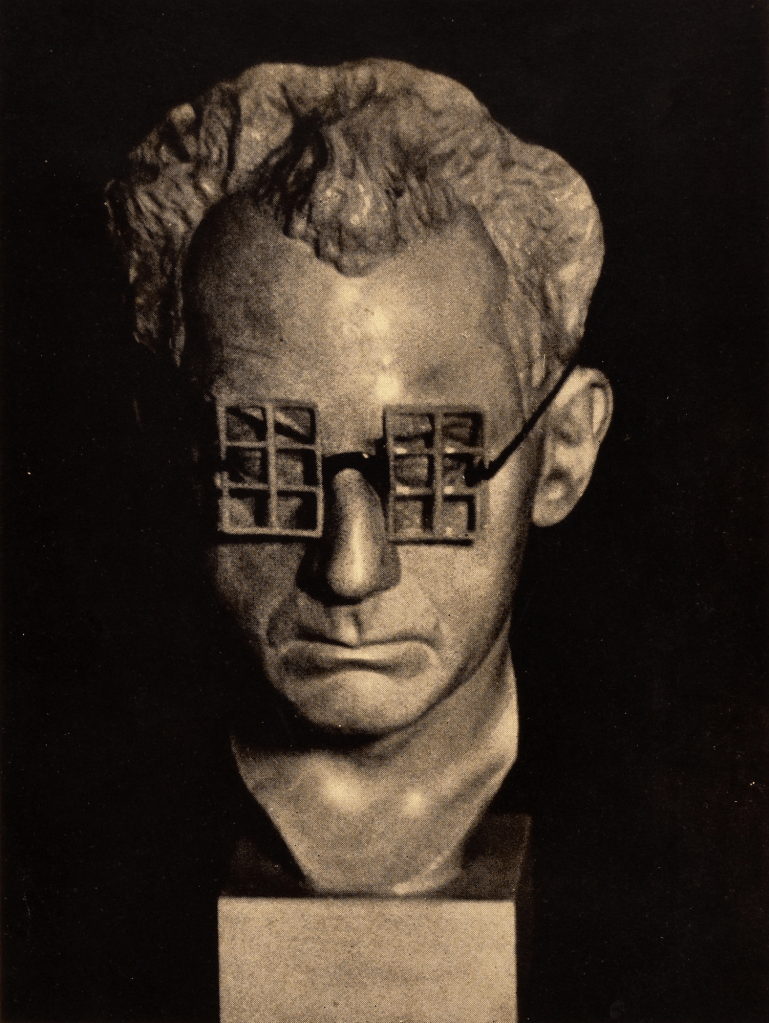
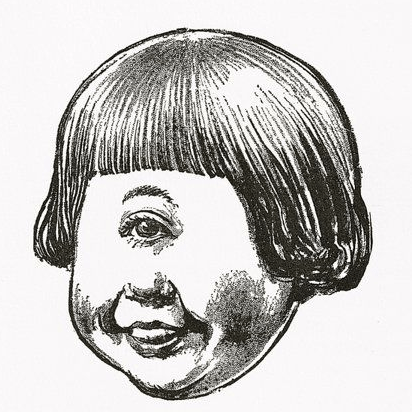
Man Ray. Dans les yeux des autres (In the Eyes of Others), 1937
Aftermath
After taking me
to see The Blair Witch Project
at fifteen
my father scolded me
in the street
for not respecting
his mental health
following
his divorce
from my mother
years later
the cinema
burnt down
Oblivious
I organised
my own intervention
my family
stared at me
with blank expressions
then talked
about what
a happy child
I had been
Unclaimed
There was
a parcel at work
that no one
collected for
ten days
the courier
took it back
I don’t know
what happened
to the parcel
after that
Oliver Land’s work has appeared in Hobart Pulp, X-R-A-Y Literary Magazine, Expat Press, Apocalypse Confidential, Spectra Poets, and Burial Magazine. He is the author of the novella-in-flash Dissolve and the poetry collection White Light Fades. He serves as the editor of Plague Circus Press.
Listening to the neighbors at it again. Things haven’t been the same since the spicy cubes. They rush the mailman every Friday. Limping away, he warns them of a dog on this same route who recently ate an entire package. The lawn needs trimming, the gutters need clearing, the daffodils out back open up for the clouds rolling in licking their lips.
BABY HEAD No. 1
First they laid you on your back, then your side, then your other side, then your stomach, trying to make an already round head fit into the right hat.
EMAIL BEFORE COFFEE
The ad said Join Prime,
but for a second
I thought it said
John Prine
and I thought of you
and the worn out copy
of Bruised Orange
probably still stuck
in the CD player of your truck.
Whoever drives it now
can’t get it out, your voice
taking over, still skipping
on “So help me I know”.
THINGS THAT KEEP ME AWAKE AT NIGHT
No. 1
That girl
on Halloween
20 years ago
wearing
angle wings
and a crooked
wire hanger halo
whose
empty cup
I never
brought
back.
No. 2
Electroshock therapy making a comeback
and me wanting to be in style.
No. 3
The YouTube thumbnail with the title: WHY I’M A CHUBBY CHASER
And I can’t see how I’d get out of this room alive.
##
The YouTube thumbnail with the title: $4 AMISH FIX FOR DEADLY HOTHOUSE
And all the hundreds of dogs left in cars each year.
##
The YouTube thumbnail with the title: I’M LIVE ON TWITCH, COME CHAT WITH ME, I’M LONELY
With 15,240 views.
***
***
ABOUT TERRY
Any news from a crow would be welcome on a day like today.
They should make safer drugs. There should be more collisions that put a person back together.
***
HEAVEN & HELL
Neither here
nor there.
Somewhere
in between.
Guy Cramer writes things, he wrote an even bigger thing, a novella called COWBOY MELT he’s self-publishing later this year.
Francis Bacon, Carcass of Meat and Bird of Prey, 1980, oil and pastel on canvas
roadkill on sunrise
spectre loop. coughing Algenon
equates primrose teep kick.
Franz Ferdinand (the band)
wear suits and grate
a wind-down window
soliloquy. two button
holes with grass-fed aged
hung meat and often
massaging myself.
it’s perfectly fine
the security deposit box
contains a severed hand:
a watch clicking links
on rained-on fences
where tufts of flowers leak
out light. for which
I’m mighty Carcanet
est. with grim bowtie
flexed canines grazing
apples piss cider fillet.
a leash forces eyes wisteria
as clouds abate
and causeways instep
my frigid hob-nob
suck-seclusion. in a
chain of chains strung
a violet pierced.
nipple flesh turned on
faucet water naked lesion toast.
Shaun Pieter Clamp is a writer, editor and academic, currently researching poetics in the Philosophy department at University of Warwick. He grew up in South Africa and received his first degree in Philosophy from Rhodes University, where he was awarded the DCS Oosthuizen Prize. His poems and prose are published in Hobart, Cleaver, Die Quieter Please, JAKE, and elsewhere. More of his work can be found at: https://www.shaunpieterclamp.com/.
The island should have better security. It’s a cozy dollop of granite and spruce in the middle of Drunken Dragoon Lake, in the shadow of some suitably jagged peaks, not far from the village of Alaric, Wyoming. The nameless island is supposed to be haunted by the gentlemanly ghost of the lake’s eponymous drunken cavalry officer, which of course only adds to its charm. Money recently sloshed out of Jackson Hole and built a ridiculous hotel on this island. The hotel is gravely Japanese in its design, and expensive enough not to show up on your travel booking portal. I suppose they didn’t bother to secure the island because it would be absurd if, for instance, I were to moor a boat here so that Gloria could do what she has taken to calling Plausible Deniability.
“So you’re sure there aren’t any guards who come out to this dock?” I say to Gloria as she leaps ashore with enviable grace.
“Yes. I got a junior manager absolutely hammered. He told me everything. They don’t do patrols. They just have some kid who hangs out at the front desk and usually falls asleep. And the security system malfunctions all the time—as it will tonight—and no one cares.”
“And if you see the famous ghost?” I say, hoping I sound jocular.
I shake my head with false ruefulness. This is how we’ve always bantered.
“If anyone asks—which they won’t—I’m just visiting a client,” she says.
“You know this guy.”
“That’s right. And that’s already more than you should want to know.”
“Plausible Deniability,” I say. “You don’t need my help.”
“You’re doing more than you know by waiting here with the boat.”
She doesn’t kiss me before she turns and walks up the path to the hotel. We’d been on-again, off-again for a while. Now it seems as if we might be forever off. But we remain dear friends. Gloria is my ideal drinking buddy. The older I get, the more I appreciate how hard such a friend can be to replace.
Soon she’s invisible against the silhouette of the hotel, an indigo rectangle set against the spruces. The midnight sky is cloudless and resplendent with stars.
What I want to say is, There was a time I imagined we’d have our honeymoon at some stupid place like this. But that would be too much to say out loud even when I’m all alone. Instead I say, “I wish I could do more.”
I stand in the gently bobbing boat and light a cigarette. I feel rather cool in my black overcoat, wool ballcap pulled low, taking drags. The night wind is exactly strong enough to feather the tails of the coat and pull away the smoke without threatening my ember. If I position my feet to stand firm yet nonchalant against the sway of the boat, and if I exhale my smoke with calibrated insouciance, maybe I can be the right man to ferry Gloria to and from Plausible Deniability.
“So you’re not going to help the lady? Some gentleman you are.”
These words come from behind me. I almost tumble into the lake.
“My apologies” the voice says. “I do forget that my footfalls are silent.”
I compose myself into what I’m meant to be tonight. Then I turn and regard a tall, straight-backed male stranger. In the moonlight reflecting off the water, the dark mustache against his pale skin is as thick as a wolverine’s pelt. As is his tassel of longish hair. He wears some kind of black or dark blue hipster getup with elaborate tailoring and metallic buttons down the front of the coat. He smiles with the self-assurance of a man who knows what he’s doing. I try to match his posture before speaking.
“She doesn’t need any help,” I say.
I immediately regret acknowledging there even is a ‘lady.’ Gloria would not be pleased.
“I’ve found, in the course of a long and, if I may declare, storied career, that those who most evince a lack of need for help are often also the most grateful when help is skillfully given.”
“You don’t know my friend.”
The stranger’s accent is unmistakably American yet still alien. Raspy yet luscious. It reminds me of some East Coast archaism you might get in a movie featuring Daniel Day-Lewis.
“So I’ll tell you what we’re going to do,” the stranger says. “We’re going to help the lady.”
The stranger extends a foot clad in a high leather boot and lopes into the boat with an agility that would shame even Gloria. I consider telling him off, but as he enters the boat, the sheathed saber at his waist rattles, announcing itself as a threat. The stranger sits aft in Gloria’s seat. He grins.
“I assume,” the stranger says, “that, being a gentleman, you are armed and prepared to do what is needed?”
The arrival of a ghost doesn’t excuse me from helping Gloria. Having had too little responsibility in my life thus far, I now take satisfaction in discovering the calming powers of performing your duty to someone else. It turns out to be easy not to be afraid when you know what needs doing.
“Who are you?” I say. “And ‘we’ aren’t going to do anything. I am going to do what I’m here to do, which is stay with my boat.”
“Forgive my rudeness,” the stranger says. “I’m Captain Edgar Haldercotte, lately of Auburn, New York and the United States Cavalry.”
He extends a gloved hand. I take it and feel nothing except a vague tingle.
“Derek,” I say, “of Bridger, Wyoming. So you’re the ghost of the cavalryman that haunts this island, I suppose?”
“You’ve got the right of it,” the cavalryman says. “Your acuity assures me that you’re a man of action, capable of doing what must be done. So, will you join me in aiding the lady, or not?”
“Her name is Gloria,” I say. “The ‘aid’ she wants is for me to wait here, and to drive the boat when she’s done.”
“Why couldn’t she manage the boat herself, if that was all she wanted?”
“‘One less thing to think about’—that’s one of her favorite phrases.”
We both turn as a light flicks on in the hotel. A single window on the upper floor, a melted-butter yellow coming from behind blinds. Is that a faint sound of something heavy being dropped? The night quickly returns to silence as the light flicks back out.
“Come on, my comrade,” the cavalryman says, “we dawdle.”
The cavalryman draws his sword in a graceful arc. The blade glitters in the moonlight. He turns to me, sword raised, his grin now carnivorous. He raises one boot onto the dock and prepares to lever himself up. He will be expecting me to follow. I imagine Gloria when she sees this mawkish ghost storming into Plausible Deniability with his sword drawn, me tailing behind like a helpless pup.
Right as the cavalryman springs from the boat, all his weight balanced on his shoreward boot, I yank him backward by the tails of his blue coat. The coat feels like eddies of warm air against my fingers. We tumble into the boat in a din of curses and sloshes and creaking moorings and clattering blade. The cavalryman sprawls weightlessly on top of me. It’s as if his body is only an electrostatic charge coursing over me.
“Scoundrel!” the cavalryman snarls as he levers himself up. He positions his sword for a downward thrust into my abdomen as I lie prone on the deck.
“I don’t believe you’ll do it. Maybe you can’t do it,” I say.
I’m unsure where these words come from. Perhaps I just don’t accept that I could be murdered by a needy ghost.
The cavalryman pulls his sword hand back a tad farther, as if to call my bluff. Then he stands and lowers his blade. He looks gray and flimsy, as if all the vitality he had to tried to conjure into being by summoning me to acts of bravado has drained and left him a spectral husk. Perhaps this is how he usually looks. Perhaps he needs suckers like me to embody his ephemeral grandiosity.
“Do you see this?” he says as I scramble to my feet, nodding at his drawn blade, which gleams in the moonlight. “I have killed 17 men with this blade.”
“You expect me to believe you killed 17 men with a sword, and the blade never chipped or broke?”
“I did have it replaced once. At Fort Laramie.”
“And these 17 men, were they all Lakota or Arapaho?”
“Some were. Some were rebel Sesesh. One was a renegade Mormon.”
“I don’t believe you killed 17 grown men in a fair fight, with a sword or a gun or anything else.”
If it’s possible, the cavalryman looks even more wan and insubstantial, as if he’s flickering into two gray dimensions.
“What would you know of it?” he says in the tones of a sulky child.
“I don’t really have any ambition to kill anyone.”
“Is that what your lady is pursuing in there? Is she killing someone?”
“She’s not ‘my’ lady. And I don’t exactly know what she’s doing. That’s why she and I call this little excursion ‘Plausible Deniability.’”
“Your brief existence on this mortal earth is slipping by faster than you grasp, without you even understanding what’s happening around you—let alone taking the reins of your own fate.”
“That’s some grandiose rhetoric. Did you hold the reins of your fate?”
“I did my level best.”
“The story, if I recall it correctly, says you tried to slash a brother officer with your sword over your gambling debts, while blind drunk, and were shot for your trouble.”
The cavalryman sits. He doesn’t contest my history of his demise. He simply folds into himself, looking smaller, almost elfin, his sword dangling limply at his side.
“You are correct. I can’t kill anyone anymore, in this phantasmal guise, without the help of someone like you. If, however, you take my sword, you will find that, in your meaty hand, it remains suited to purpose.”
The cavalryman stands with a flourish, brandishes his sword, and then dexterously flips it so that his gloved hands grip the blade. He offers the hilt to me.
“Take this,” he says. “And go assist your lady.”
I grasp the hilt mostly so I can learn what a ghostly sword feels like. It’s solid and heavy as the cavalryman lets go. The leather of the grip is appropriately oily and worn. In spite of its heft, the sword seems well-balanced. It’s easy to imagine swinging it with the passable grace with which I once wielded a tennis racquet. It’s tempting to believe a blade like this could make me more than I am.
There was a time when being bidden to heroic feats by a dashing ghost would have confirmed that I was special as I hoped. I would have taken the gleam in the cavalryman’s eye, and the pleasing weight of his sword, as all the indication I needed of my interesting place in the narrative weave of the universe. Holding this sword, I realize for the first time I no longer need—want—to be that character in my own story.
“If I storm in there with a sword,” I say, “I won’t be of any use to Gloria. Grand gestures may appeal to a cavalry officer, especially a long-dead one, but my life isn’t about grand gestures. Not that I even know what it’s about. But tonight, I’m doing what’s needed, not some fantasy of what makes for a great story. That has to be enough.”
The cavalryman curls his fists at his sides, as if he might strike. He fumes out a breath that quivers his mustache. I level the blade at him in warning. Can any blade, even his own, harm this ghost? He ponders the sword as if encountering it for the first time.
“I happen to know that Gloria believes you to be a lily-livered milksop. And I also happen to know that she’ll be favorably impressed if you do as the ardent-hearted cavalry officer before you urges.”
Because I have so often feared that Gloria finds me weak—and insignificant, and many other emasculating maladies besides—I have an urge to strike out at the cavalryman with his own sword. I also have an urge to run after Gloria and prove a point I couldn’t even articulate in words belonging to me. But I do neither. The most generic fears don’t need to be mine. I steady my sword hand and grin at him thinly.
“You can’t even wield your own sword properly without me. You’re just a silly old story. To react to you would only be to give in to my own stupid fantasies.”
The cavalryman gulps. The faintest apparitional sweat forms a moonlit sheen on his brow. I’ve already done him a great courtesy by taking him seriously enough to mock.
“If you won’t seize the reins fate has put in your hands,” he says, “perhaps you have the courage to run me through.”
The cavalryman lowers his gaze in a plaintive gesture of defeat. I half-expect him to begin opening his coat to give me a better target.
“Are you serious?” I say. “Will this blade even do anything to you?”
“Nothing to be lost in the attempt. Though I couldn’t say, since no one else even got to the stage of pointing my sword at me.”
“So that’s the real test, huh?”
“Thrust with all your strength. I can join my dearly missed horse, Appomattox.”
A man’s voice cries out from somewhere in or around the hotel. The cry is so brief that it could plausibly be any number of other sounds. Another light flicks on, in a different room, and just as suddenly flicks off. Then a yapping bark from near the same place, as if from a small dog. Or perhaps a fox, if they can swim out this far.
“You’ve missed your chance,” the cavalryman says with dour satisfaction.
The smudge of Gloria is trotting toward the boat and growing more distinct. She moves quickly but without panic. I decide to do the same.
I toss the sword overboard. It makes mercifully little sound and disappears right away beneath the inky water. The cavalryman gives a stricken groan. He dives in after the sword. He shimmers out of existence without disturbing the surface of the lake.
“Let’s go,” Gloria says, leaping into the boat.
What I need to do couldn’t be clearer. I undo the moorings and start the boat and take us back toward Alaric with decisive yet unharried speed. Gloria sits aft with her usual poise, which tells me that the night has gone perfectly. There will be plenty of time, once we’re back home, to tell her about my amusing dream.
Connor Wroe Southard is a writer based in his hometown of Laramie, Wyoming. His fiction and non-fiction have appeared in Typebar, Blood Knife, Victory Journal, The Outline, Splinter, The Awl, and many other outlets. He writes the newsletter A Lonely Impulse of Delight.
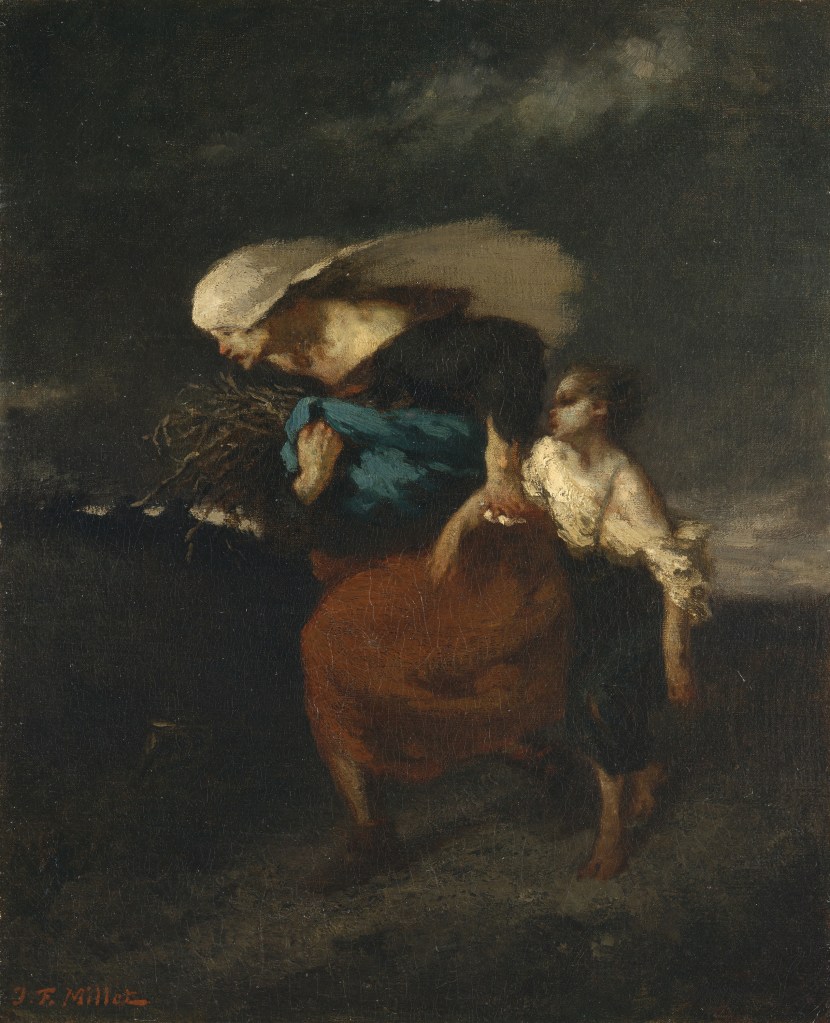
Millet, Jean-François. Retreat from the Storm. Circa 1846, Metropolitan Museum of Art, New York.
Mid-storm Landscape (in which I’ve Grown Roots)
The storm throws hail against windows and affirms
my fear of summer: that something hungry climbs
in the new green, that what’s tender heralds
destruction. Blossoms shatter, branches snap etc.
A few hours ago, we sat outdoors to be glad
with every singing thing—the lilac’s scent,
the birds’ trill, the ephemeral drama of clouds:
a rapid drift to conceal the sun, then reveal it,
the sky dull, then luminous. Distracted
from my book by the sad itch of Sunday dusk,
I watched the dog listen—his ears twitching
and tuned to the distant bark of another dog,
the first low summons of thunder. You’ve settled,
my sister said, stoppedrunning, and she was right;
I no longer strive for some other self, the person
I might be outside the hometown I found
myself forced by circumstance to return to—
circumstance: a hedge for fate. Now I’ve met
my fuck-it moment and grown roots, raised
the stakes of memory in this place, realized
never settle is an absurd motto for anyone
who writes; every word’s a compromise
between realms, generations. Her voice echoes
as I secure my windows, study the wild
pattern of rain. Decisions make themselves
in this kind of weather, I know and number
the miles between flare and crash.
Ceridwen Hall is a poet and educator. Her books include Acoustic Shadows (Broadstone Books) and The School for Danger and Other Studies (forthcoming in 2026). Her work has appeared in TriQuarterly, Pembroke Magazine, The Cincinnati Review, Craft, Poet Lore, and other journals. She publishes Field Notes: biweekly inspiration for writing and well-being. Find her at www.ceridwenhall.com.
Millet, Jean-François. Retreat from the Storm. Circa 1846, Metropolitan Museum of Art, New York.
Crossing the rest between two lines in an advertisement for rural theater, I found myself in the depths of a fissure. A woman I knew was there as a girl, and at that anti-summit she took a hand and walked away without looking back at me, receding into whatever was behind the bottom. I was drawn out and saw the trench walls, some ten thousand conversations congealed into a rectal texture, and was drawn out further, until I saw myself reading, but not then. The entire fissure had the shape of a decision, one I could have made ten thousand talks ago, or along the way, but not then, when I’d like already to have made it, so that I could be this woman I knew, whom I knew well enough to know I’d never want to be. What I wanted was to choose those things that she had done, I thought, without making a choice.
Berta and I met while watching the ducks in the park. She had already quit her job at the zoo. As though there was a loose detail she might corral through repetition, she told me the story of why she’d left again and again. In some tellings, a monkey had pulled her hair, while in others it had been a coworker, who had blamed it on a monkey, and in others still it hadn’t been her hair but a visitor’s, a child’s, and it hadn’t happened recently at all. The only constants were the hair pulled and an earring with a tiny jewel, which had fallen into a grate in an enclosure. Above all she resented the grate: like her, it shouldn’t have been there.
Now Berta was applying to divinity school, having decided that she should be a chaplain in the air force. Once, she’d asked me if I knew how many zoos this country had bombed. I didn’t and neither did she, but there was a related case that had really marked her. During the Second World War, the governor in Tokyo had ordered that zoo animals be killed preemptively, thinking that the shock would prepare the city for coming hardships. Most of the animals were poisoned, but the elephants understood what was happening; they refused to eat and starved, were starved instead. She said I didn’t want to know what was done with the snakes. I had particular feelings when it came to reptiles, which Berta knew. Even though I didn’t find zoos sad, the closest I’d ever gotten had been while watching a caiman slide down a wet incline in its enclosure. As soon as it got to the bottom, it would climb around to the top again, and it did this over and over. I remember the keeper saying: “We don’t see this sort of play behavior in the wild!” I tried to make eye contact, to let it know I knew something that it knew too, but caimans can only lock eyes one at a time.
Before she left for school, Berta asked me to look after her brother, Sandy, who was serving a 12-year sentence and was quite young. Every other day he’d call and we’d talk about the same six movies that played on tv there, and he’d ask me to download and send pictures of creatures from an online trading card game from as many angles as possible. These he would paste together into three-dimensional paper models. On one call I asked him what kind of animal he’d like as a pet, what real one, and he said a lizard, because they didn’t smell. I brought up the caiman I’d watched, and he explained to me that it wasn’t a lizard. “And that zookeeper was lying,” he said. “They do that in the wild too.”
I didn’t find zoos sad, but I hadn’t been back to one, not even to ask for work. Berta thought I was being too picky, that I’d look good in an exhibit. I said that seemed like it was in bad taste, but she said there were no jobs in good taste. “What about the chaplaincy?” I asked, and she said she hadn’t known there’d be so much reading. The fissure came back to me then, its very depth-tip, and I told her. “You know somebody pulled my hair?” she said after a pause, and I agreed. “The earring never fell in anything,” she admitted. “But the rest was true.”
Serena Keenan Sánchez is living in Brooklyn. Her writing has appeared here, before you. She will have a website eventually. For now she has music.
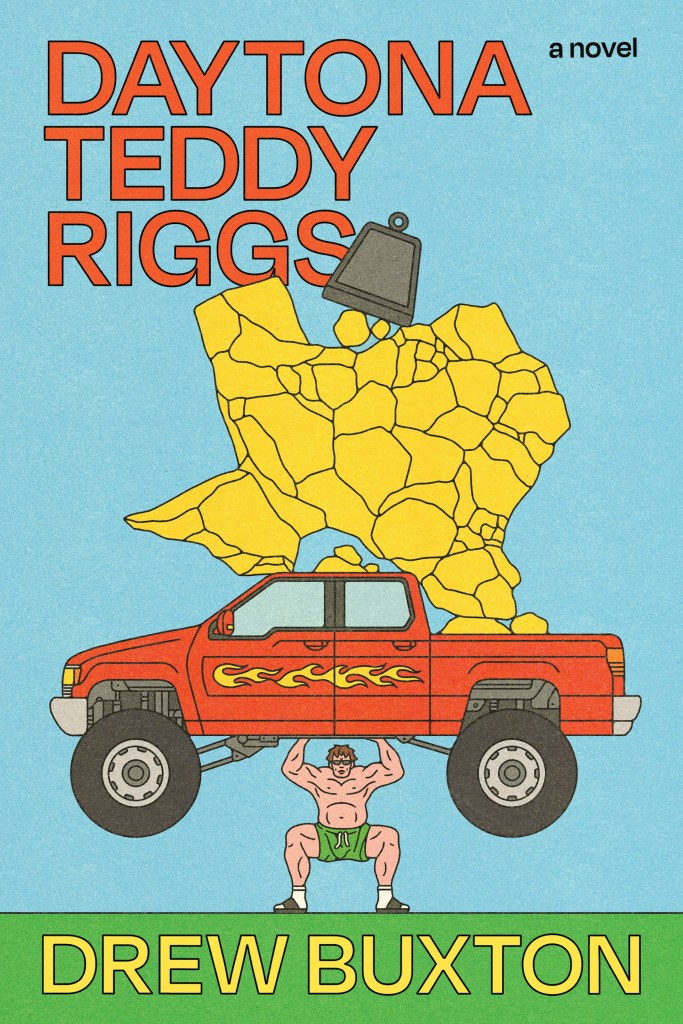
My novel Daytona Teddy Riggs is a deep dive into the sport of strongman. Teddy, the narrator, is singularly focused on winning the World’s Strongest Man competition. As his mental state begins to unravel, his fixation only intensifies. He continues his pursuit of glory even as the ramifications of his increasingly unstable behavior bear down on him.
I’ve long been fascinated with the niche subculture of strongman. I follow the top competitors closely, and one thing they all share is an all-consuming obsession with getting stronger. This obsession dictates what they eat, when they sleep, who they marry, and just about everything else. I have a great admiration for the dedication they show to their craft. So inspired I am by these giant men that I felt the need to put my feelings into verse. – Drew Buxton
Force-Feed

A dozen eggs, a pound of bacon,
three slices of French toast,
orange juice. That’s meal one,
and meal two
is just a couple hours later:
spaghetti and meatballs,
rice, chicken stock,
and an orange.

It’s chewing and swallowing,
chewing and swallowing.
Hafþór feels like a cow,
grazing all day.

It’s harder than the training,
but you can do as many Viking press
sets as you want—if you’re not
eating at least a gram of protein
for every pound of bodyweight,

you won’t make gains.

Hafþór will do anything for gains.
He would eat anything.
He would eat shit
if it made him stronger,
if it helped him—

in the World’s Strongest Man finals,
in the last event, when his arms
and his back are on fire—
take the last keg,
the 60-kilogram keg,
and send it

into orbit.
Get It Up

Eddie Hall knows gimmick events
don’t belong
at World’s Strongest Man.

Refrigerator races and steeple chases
are added for
the CBS audience.

But Eddie knows the competitors are
enough.

They’re the strongest men
in the world, the strongest men
in history.

They just need to move huge weights
from one place
to another.

Eddie takes impossible weights,
puts air underneath them.

He takes a barbell loaded with over half a ton
and looks to the sky.
He pulls until the veins bulge
from his forehead, and blood pours
from his nose.

He drags it up his shins and tears them open
and thinks about his mom. He thinks about her
working 9 to 5, then 5 to 10,
then falling asleep
with her uniform still on.

He imagines she’s under a car,
trapped,
and he’s lifting it,
pulling the weight off her.
Drew Buxton is a writer from San Antonio, Texas. His short story collection So Much Heart won the 2024 Sergio Troncoso Award for First Book of Fiction. His work has been featured in Southwest Review, Joyland, The Drift, and Vice among other publications. His debut novel Daytona Teddy Riggs will be published by Hub City Press in the fall.Find him at drewbuxton.com
ex-wonderboy
                                                   Don’t walk out on the best revenge!
                                                                     Chelsey Minnis


this is when i write a poem for you
even tho you never wanted it

i can long remember a nastie thing
if it is well done

when i try to write a poem it seems reasonable but it can never
be reasonable
this is a chain for you,
it goes around your throat

if you want to be a poem-writer then
pull a knife out of your head and threaten with it

this is a freedom from achievement
should one everlastingly seek to appear in a sympathetic way?

if someone wants to exist then they must be contented to make some tragic moves
this is a chance to tell the truth
and you start to get excitably depressed

i like it when a baby is crying
maybe they’re crying because they are so depressed

sometimes i get the right feeling in the afternoon and that’s when i write a poem for you

i get the idea i should appreciate things more but my ego is a
baby

you are just an ex-wonderboy
and this is like telling someone wearing a gorilla suit you don’t love them anymore

every day i behave as tho i am a human being and it hurts
me to do it

i don’t see why i must be so terrifically sorry you will find me
unchanged from how you knew me

should i have my vengeance or should god have it? this is like
crabs trying to walk to the side when they have no chance of
getting away
pretty soon, i’m going to unstick the flies from the flypaper and let them go free

no one wants any more punishments from you
how sad and sorry that you should die when i still loved you
the less water’s in my cup the better it tastes
the best thing about getting old is
losing everything you love
plus the self checkout register
making music you can understand
the puckered lips of the spurges
are lowkey kind of cute
now that it’s been a year since you wrote
fuck the magnolias blooming again
in your notebook. a hole
in the ground is half a sphere
and my boss just looked at me
and said spring?
like it was something we could do
Untitled

under the table
on a train
in a taxi
at work
in the bathroom
in the woods
in the middle of a meeting
in a bookshop
in a library
at a wedding
at a funeral
in a church
in the confessional
in the pews
in a corn maze
on halloween
at christmas dinner
on the dinner table
on the kitchen counter
in the laundry room
in the backyard
on the grass
in a pool by the sea
in the sea
on a boat
while you’re driving
in the middle of a football field
with the lights on
on a tennis court
on clay
on a ferris wheel
in the bleachers
under the bleachers
in the hallway
in a classroom
in an alley
in a dark dark alley
in a tunnel
in the sewers
on the subway
in the cinema
on a fire escape
on a roof
in a car garage
in any parking lot
under a bridge
on a ferry
in my childhood bedroom
in the closet
in a park
in the bushes
in mcdonald’s
in the drive thru
in a fountain
against a tree
on a rollercoaster
at a waterpark
in the playground
on the slide
Ulyses Razo is the author of Murders & Other Poems (Ghost City Press, 2024), a fellowship recipient from Paul Smith’s College, and a previous poet-in-residence at Bethany Arts, Ulyses Razo’s poems have been featured by Hobart, ShitWonder, SARKA, Car Crash Collective, Amygdala Journal, Dream Boy Book Club, Discount Guillotine, dadakuku, SWAMP, and others. New work is forthcoming from Jon Leon’s Annual Report, Die Quieter Please vol. 2, and Defunkt Press’ Surreal Confessional Anthology. He lives and writes in London.
Pat wakes up early and sits down with her book. An hour later there is movement from the bedroom upstairs.
“Bro no way,” Pat’s husband Dan shouts. She hears him stomping around. “Babe do you know where my xbox controller is?” He calls down.
Pat doesn’t respond. There is more stomping and a crash.
“Fuck!” Dan yells. “I just wanted to play some fifa before work and now I’m late.”
There are loud bangs and screeches of furniture moving and Dan yelling “fuck,” over and over. Pat continues to read and eventually Dan runs out of the front door. “Love you babe,” he says and slams the door behind him.
The ensuing quiet in the house is complete. Light pours in through the window, shining on Pat. She stops reading and looks into the still air. It seems to fall on her. She can feel it. She takes a deep breath and keeps reading. She wears jeans and a white collared shirt under a loose dark brown crew neck. For Pat, putting on a clean, well-matched outfit is enough to feel like a productive person.
She reads comfortably all morning long. After a while she gets up and goes pee but then she sits back down and continues reading. Pat is a slow, diligent reader and after another hour or so she finishes her book and picks up another: an old, thick book by some German man whose name seems vaguely familiar and important. Pat reads every book with the same measured pace. Some she comprehends easily and others flee her understanding entirely. She lets them wash over her either way.
After a few more hours of reading she gets hungry and makes herself a BLT and then sits back down to read again, until the light starts to dim.
At around six, Dan gets home and throws his backpack on the landing, “Fuck yeah, what a baller day,” he says in a huff, breathing hard. He gives Pat a kiss and honks her boob and plops down next to her. “I’m rock hard babe,” he says. He picks up the remote. “Let’s watch Ratatouille again,” he says, but Pat doesn’t respond. She gets up and puts on a jacket and goes out for a walk.
“Babe,” Dan calls after her, “Ratatouille.” But again, she doesn’t respond.
Outside, it feels good to walk in the deserted nighttime streets. Her joints are loose and though her cheeks are cold and she can see her breath, she feels warm and vital. She walks unhurriedly, stopping sometimes to look at a house or at the underside of a tree, but never thinking much about what she sees. She just looks and moves along.
She feels like she could walk forever and thinks that maybe she will. But then, almost immediately, she notices that she is getting tired, totally drained in fact. So tired that she can hardly take another step. But luckily she sees that she has been unconsciously doing a big circle and is nearly home.
When she walks in, Dan is doing bicep curls in the living room, grunting loudly. “Check it babe,” he says. He puts the weights down and starts flexing, looking down at his muscles, “oh yeah,” he says. Pat is very tired so she goes upstairs.
“Babe my tits are bigger than yours,” Dan calls after her.
Pat brushes her teeth, hardly able to keep her eyes open and falls asleep as soon as her head hits the pillow.
When Pat wakes up, she puts on a pair of black jeans, a crisp white shirt, a purple crew neck and a thin gold necklace. Almost as soon as she sits down on her couch with her book and a coffee, she hears footsteps upstairs shuffling around, followed by the sound of an electric shaver. After a moment a muffled crash. “Fuuuck! Babe I cut my fucking dick!” Dan yells.
Pat turns to her book and picks up where she left off but then Dan comes downstairs and runs through the house with his bleeding dick out. “Fuck!” he yells, coming back into the living room. “My dick! Oh my god babe look at it! What do I do?” he asks, but then he runs back upstairs.
In the book Pat is reading, very little is happening. The German man is meeting people, Italian men and Turkish women, and there are whole scenes where they just talk and walk places and eat food quietly. The scenes seem important for some reason, but she doesn’t know why.
“Not enough vaseline in the world,” Dan yells from the bathroom. He stomps around some more and then runs out the front door with his pants around his ankles, trying to pull them up and tie his tie at the same time. He trips out the door, slamming it behind him, but then it opens a moment later and he sticks his head in. “I fuckin love you Pat,” he says and then slams it again.
Sitting once more in the stillness of her home, the air falls on her again, but today it feels wrong. Something is off. Pat tries to read but finds she can’t focus. The book has stopped making sense. Or perhaps her ability to bear its boring incomprehensibility has fled her. She puts the book on the coffee table and sits there, confused. In her clean outfit she feels like she is all dressed up with nowhere to go.
She gets up and wanders into the backyard. The day is gray and cold. She can see her breath but this fact now seems mundane and stupid. There is a bush and a fence between her yard and her neighbor’s. She looks at it for a moment and then gets down on all fours and crawls to the fence and hops over it.
Her neighbor is an older woman named Sheri who owns a landscaping company, so her yard is lush with deciduous shrubs and trees, still green and vibrant in the middle of winter. Everything is layered perfectly, with well-cut stones forming a path through the dense green wetness. It hasn’t rained in days but the plants suck up all the water they can and as Pat walks up the path her pants grow wet with dew.
When she gets to the top of the path she looks up at the house. She thinks about how when Sheri stands in that same spot and looks up at her house she must feel a sense of ownership, of contentedness and authority. Pat tries the back door and finds it open. She enters and wanders around the basement, looking at her gardening tools. She looks at the laundry, picking up the clean underwear and smelling them.
She goes upstairs. The walls are painted a salmon color. The surfaces are dusty and it smells odd. The house is incredibly foreign and the novelty is pleasing to Pat. In the main room there is an old purple couch, almost exactly the color of Pat’s sweatshirt, and there is a purple blanket there too. Pat picks up a book from the shelf and sits on the couch and reads. The book is about a young girl who just arrived in Paris. She meets an older man who turns out to be some type of sexual deviant and it goes on from there. Pat enjoys it so she takes the blanket, lies down and settles in.
She must have fallen asleep because when she wakes up, the light has changed and someone is putting keys in the front door. Sheri walks in. She is older and wears yellowed coke bottle glasses that hook behind her ears. She has her big red curly hair pinned under a faded green dad cap. She smells like dirt and sweat and Pat can see the brown under her fingernails from working all day.
As she puts her keys on the table Pat waits for her to notice her but she doesn’t. Sheri even scans the room and her eyes fall on Pat for a moment but there is no recognition. She walks into the kitchen and then goes upstairs to her room and Pat stays laying on the couch. She finds it interesting that this house, with all its smells and peculiarities, exists here like this all the time, so close to her own, yet so totally foreign. Pat closes her eyes and listens. She hears Sheri walk into different rooms, the noises of her movements growing louder and then dimmer again. Pat hears footsteps and clothes rustling, but then the noises stop. Pat opens her eyes and Sheri is stark naked, standing no more than 8 feet in front of her. Pat always thought Sheri was thin but she has a rather large belly, though her butt is still quite shapely for her age. Her skin is very pale and she has a large mole smeared on the back of her arm.
Pat’s throat itches. So badly that she has to do something about it. She clears it as softly as she can. Sheri’s small eyes dart right to her and Pat blushes, but apparently Sheri still doesn’t see her. She scans the area and then turns toward the door again. She shakes her hair back behind her shoulders and presses her chest out and suddenly the door opens and a man walks in. He has dark salt and pepper hair swept over his eyebrows, a thick beard and glasses.
He growls and shuffles his feet like a bull. “Oh baby,” he says, holding his arms out, pelvis forward.
“Oh Glenn,” Sheri says.
“I’ve missed you baby,” he says.
“I’ve been thinking about you all day,” she responds.
Still laying under the purple blanket, Pat watches as Glenn takes two handfuls of Sheri’s butt and hoists her up. Sheri wraps her legs around Glenn’s waist and they kiss deeply. Pat is impressed by how nimble Sheri is for her age and by Glenn’s strength. They shove their tongues in each other’s mouths and both of them moan with pleasure.
“I love the way you smell baby,” Glenn says and Sheri giggles.
Pat shifts her feet a little and Glenn looks over at her. At first he doesn’t seem to see her but then his gaze narrows and his brow furrows.
“Can I take your glasses off?” Sheri asks.
“Huh? Oh sure,” Glenn says. Sheri takes them and puts them on the table next to them and Glenn looks back toward Pat, but without his glasses he just squints confusedly.
“I want you so bad baby,” Sheri says and Glenn looks back at Sheri.
“Where do you want me?” He asks.
“Right here. On the carpet.”
“Wouldn’t be the first time,” Glenn responds.
An hour later, when they are finally done, a thick smell hangs in the air and they are both glistening with sweat.
“I thought you were going to break my leg,” Glenn says.
“Next time,” Sheri responds, slapping him on the butt.
Glenn laughs. They lay there breathing heavily until Glenn says, “Hey, what’s up with that girl on your couch?”
“What girl?”
“Isn’t there a girl on your couch?”
Sheri laughs. “No.”
They look up at Pat for a long moment. Both of them squinting. Trying to see her. Trying to see anything. They are looking right at her face, but can’t see it. Sheri collapses back with a sigh and touches herself.
“I’ve never come so many times in my life,” she says. “Where is the white board?” Glenn asks.
“In the kitchen,” she says. He gets up and goes to the kitchen, his penis flapping against his thighs and comes back with a white board that reads, “Climax Tally,” at the top.
“Add 5 for you and 3 for me, we’re at 253 to 317,” he says. “You’re catching up.”
Just then a young man with red hair opens the door.
“Mom?” he says.
“Oh god Sean, what are you doing here?” Sheri asks grabbing for something to cover herself. There is nothing around but Glenn’s socks which she uses to cover her breasts.
“Why are you naked? And who is this? And what is the,” he pauses to read the board. “Climax tally?” Jesus Christ.”
“I can explain,” Sheri says.
“Why did I ever think you would change?” Sean says.
“Now son,” Glenn says, clapping Sean on the shoulder. “Your mom is a sexual creature.”
“Ew bro, get the fuck off me,” Sean says, squirming out of his grasp. “Mom why do you have to be fucking someone literally every time I come home?”
Glenn laughs, “your whole generation is repressed, son. You think you’re speaking out of anger, but really it’s jealousy.”
“Call me son one more time and I swear—and who the fuck is this?” Sean says, having caught a glimpse of Pat on the couch. Pat is holding the blanket up to her nose.
Both Sheri and Glenn look over at her again and squint.
“Oh I get it,” Sean says. “Is this some new fucked up thing you’re in to? Having some girl watch you fuck?”
Later that night Pat is on the couch reading when Dan comes home in a huff.
He throws his empty backpack on the landing. “I did it babe,” he says. He comes in and stands in front of her. “They gave it to me. Those fucking idiots finally gave it to me.”
He unbuttons his shirt, takes it off and starts flexing one pec at a time, looking down at himself. Pat sees that she won’t be able to keep reading so she puts down the book about the German man.
“You’re looking at Google’s new sales VP baby,” Dan says. “Three long years waiting and those douchebags finally wisened up. Those fucking losers finally did what’s right. God no one has ever been as hard as I am right now.”
He does ten pushups and some high knees and then sits down next to Pat, sighs and stretches his arms behind the back of the couch. “Babe do you know what this means?” he asks. He touches Pat’s chin. “Do you know what this means for us?” She looks at him, his shapely muscles and dark eyes. The room is warm from his body.
“It means one thing babe. It’s Ratatouille time,” he says. He puts on the movie, grabs Pat and pulls her into him. Without his shirt on Dan smells familiarly like Oldspice and BO. The movie opens on a rainy day, zooming into a farmhouse as Remy breaks out of the window.
“I love this movie,” she says.
Dan turns up the volume.
Tom Ianelli is a fiction writer and street bookseller in Brooklyn. He has written for Quartersnacks, Hobart, the Panacea Review and Animal Blood magazine.He runs PeterBooksPress and asks the questions for the Lit Chat instagram series at @peterbooksnyc.
If God is Love And the Kingdom of God is within you Then the Kingdom of Love is within you
If Love is Blind And the Kingdom of Love is within you Then the Kingdom of Blindness is within you
The Blind lead the Blind
II
You can kill The Buddha easily if you have a one track mind
Myself, I like the bare essentials in excess
I can’t drink like I used to. Everywhere around me, Texas redbuds
III
The Wright Brothers Took flight at 10:35 AM
Brother, at last! Hallelujah, amen!
Alive, aloft Birds as gentlemen
IV
Beer & cigarettes Welcome me At the end of the day
My cat greets me He puts on Quite a show I give him Anything he wants
My landlord is an asshole She’s left a note
Nevermind
It feels good To take my boots off
V
Mike likes honey And sugar In his coffee And PBR especially When it’s free
He told me “You remind me Of James Dean” I said “Mike, James Dean didn’t Have a beard” He said “It’s something About your eyes”
I told him I’d take Him to the barbershop For a haircut and A beard trim Goddamn He could use it
One time I saw Mike walk Into the bathroom With a prostitute At a coffee shop I worked at If it was anyone else I would’ve said “What the fuck Are y’all doin Get outta there” But it was Mike And he told me I reminded him Of James Dean
It’s ok Get you some
I heard someone Ask Mike where He lived He said “Down by The French Broad” This guy says “That’s a nice area”
What a douche
Some people don’t Know how hard it is To hang up a hat Inside a tent How it’s goddamn Impossible to get clean In dirty water
You can sing the blues To any cat or dog But that don’t mean They wanna hear it
Wes Tirey is an Asheville-based singer-songwriter, guitarist, and collagist. His work has been critically praised by the likes of KEXP, No Depression, Uncut UK, and The Guardian. His latest album, “Wes Tirey Sings Selected Works of Billy the Kid”, puts music and melody to a selection of poems from Michael Ondaatje’s novel in verse, “The Collected Works of Billy the Kid”.
I heard you whimper, went in, wardrobe thick with vapour. Guard hair erect, you sniffed-at, separated, my saliva, sweat, breath, outdraft of human predicament. Three-inch gash on your foreleg, body shrunk in packed corners where cooking sherry used to be under a stalactite threaded with picked flowers. Crumpled dog harness within damp tulle, shoes, where branches tugged and twitched. Was I inside outside, or outside inside? Approaching a sink where a woman like my mother, faceless infill blur, rubbed and splashed. The tap’s controlled exit a throat-clearing exposure to light. Arias. Strikes. Various unsafe intersections. As if, nevertheless, I reached, like for toast from an oven. You, attentive to a spongy weeping of our walls. Strength in your paw’s placement, parallel to constricting tendrils, dragged across urges to recoil or wince or squeal. We were, to our pits, a woodpile appraising a dense axe-head. A falsely serene material barrenness scaffolded us on ladders and wheels: our ankles glassy extensions. I felt vibrissae soft at my ear sensitive to this emergency’s springlike force. You’re dreaming, you said. White teeth. Lips pulled. Tongue, really Pomeranian, I like to think smiling. Round eyes tracking my mother’s chiffon flow and ethanol odour, tracking her limbs.
CHILD PAINTING
Disc of purple. Square of brown. Hint, as of pinpricks, swelled a numb interior. Wider mash of black swivelled in place from which a downpour hatched.
Here, belt-buckle grey. There, overfill, a ripple, like a jacket, a man’s work-dulled jacket. Knuckled-up, unrelaxed, overcast across a canvas.
Boy struggled, balanced brighter streaks, but a trap: rustle of a ribbon-tied bit of flowers over here. Boy tried detergent, expunging it. But no.
A woman’s face wobbled on a yellow track as Bulk, bearded, with near empty mason-jar of gin, dragged concession from that face.
Bulk, whose gluey columns convulsed, whose hot breath bulled—whose tab was all paid up.
Boy, lax as an eyelash, hugged a rumpled shine. It lay slack. He tugged at the arm in the basin. It hung on.
Overlapping allocations ran lifelike by the minute where the brush beat down one colour or extremity to the next.
He offered overflow from his future. Blotted strained paper, eyes shut, as centres flaked apart.
Elsewhere, swatting flies, Bulk asleep.
Tell us more, said
There isn’t any, said
Thirty years and all assortment and debris are forgotten, says an observer close to the family.
COUNTERVAIL
i.
Bent, eating biscuits in closets, I overheard talking — not the point, futureless, non-demanding — obedient to it. Self-altering, intersected
tunnels, cylindric light a sort of wall falling forward: I could not crawl into.
Right or left, ascetic aspen, bladed white, chillingly shawled up.
Mother, in the back seat, or not in the back seat, ahead of the glare or behind it.
Whoever steered did so, eyes bordered on, how to say it, no eyes, rigidity, in the man’s back.
Later I pulled at marginalia; leaves, turnkeys, or matchboxes; compass or scalpel; a shoe, a book, of training a dog, a toy, a cigarette,
could taste, a running faucet for rubbing out taste;
a small container’s smaller container, tender camphorwood at the latch, that sprung sense of a continent’s human weight.
ii.
How near we were, waiting for Winter’s end, headed to or from Events, retrospection or narcotic routine, No-use, it’s-no-use.
iii.
Haircracked in plaster, this tunnel’s accretions, my boyish facsimile exposed in grease. How it came there, excessive in bulk, I can’t guess. It struggled, in quantity. Swung a hypertrophied jaw. As the ears aggregated or chins penetrated, it spoke in chunky liquid, puss-plugs re-consumed, tooth- squeak of hot, over-pressured burps. On truncated tongue, attached at the stub like a tongue-eating louse, my mother’s hard likeness. I shrank from stacked rancour and resemblance. Inside her, speckling, my grandfather, bulb-like, as if hungover, canes of colour inside a marble, of crudity and predation — dissection, discharge, crowding out the mouth. This is yours, plenitude foretold, Insinuate or snort, or drink into wretchedness, or scream, or push some intimate up against a wall. I emerge obliged by hundred-year-old disputes, tongued over, nothing new.
iv.
Who’s to say what occurred or what I saw or heard said, face or name, or metallic timbre of a handgun. Visualizations, light draining or filling a roadside swathe of muskeg, stunted tamarack or black spruce,
outflung gaps, outright dissolves defocused
palsied forms that list, list terribly. Tomorrow, a boy gambolling high-gaited, pant-leg rolled up among cinquefoil, a gaiety under killdeer, as eared grebes jerk the shallows.
Forgetting… have my head done… tasting a cigarette.
Today, heel-thump upstairs. The boy, red-eyed, stroked at a doll with a floppy head.
I mend a shirt, a flooded luxuriance, to be precise.
Even now it was incomprehension, open ended,
the cutting down that didn’t happen the cutting down that did.
Garth Martens is the author of Prologue for the Age of Consequence and Who Else in the Dark Headed There. For his first book, he was a finalist for the Governor General’s Literary Award for Poetry. He is also a past winner of the Bronwen Wallace Award for Emerging Writers. His poetry appears in Dark Mountain Project, Poetry Ireland, Hazlitt, This Magazine, Vallum, Fiddlehead, and Best Canadian Poetry. He is a co-founder and producer for Palabra Flamenco, a literary flamenco ensemble that joins traditional flamenco dance and music with poetry and oral storytelling. He lives in Victoria, BC.
Any evening would be seduced by such soft awnings.
I read from an old book about flowers.
You want my picture, but not if I’m looking.
For some silent reason, I pose a threat— you want me kneeling.
It’s not enough to make my cunt wet. You want my eyes wet too.
As if in service to a god, you drive the night to a terminal Amen,
turn out my pockets then disappear—
my little things exposed to the cruellest light.
WINTER
I let it kill things. I stop replying to men who don’t mean it.
How did I get this far without asking for anything?
I thought if I never asked, someone would notice my need.
Thought my landlord wouldn’t raise the rent if I muted anything resembling rage.
Like soup on the stove, I let my feelings reduce
until there’s nothing to eat— for me, or anyone.
NOTES FOR SPRING
Hoarding floral mugs
Facing the rain
Buildings fade to grey
I listen
for the soft music of bath foam
I need healthier obsessions
Book title: Sulk
I could go dark mode for a while
The birds are quieter
than this time last year
Consider the chrysalis—
short-term coffins
self-made
Poppy Cockburn is a writer based in Margate, UK, where she runs the literary event series ‘Is it Dirty?’ Her debut poetry collection, Naked Oyster, was published by If a Leaf Falls Press in 2025 and a second collection is forthcoming later in 2026. She has a cat.
Billy Luck’s bones rearranged themselves on the bus headed out of Gibsonton for the Tampa train station. He looked out the window, away from his trailer, all rusted, awnin torn, bricks holdin down tarp over a portion of the roof, lookin like other junkyard leftovers from his carnival days.
The bus passed an old train car that jailed tigers, vines growin through it, a giant planter. Gibsonton was a has-been like him, still some carnies left but most dead, or dyin, or just plain up and left, like his good friend Daisy, the most beautiful woman his eyes ever seen, a midget, but perfect, no matter.
Now Billy’s friends all had bodies from the shoulders up: Judge Judy, and that good-lookin gal on The People’s Court. He always took to smart, in-your-face broads—don’t take no shit type—like Daisy, who called, askin him to come see her in Miami, cause she was dyin.
What a foul mouthed little mother she been, tough, had to be, no taller than three feet, perfect proportion, and a great pick-pocket, long as people was sittin down. She been with the Gerling since nineteen fifty, five years after Billy started workin the carnival, a legend, Daisy was.
He figured since she git religion, and was close to dyin, that she wanted to talk bout that night sixty-five years gone, somethin they never spoke bout, but it was there, danglin, an untouchable. So’s Billy wondered if she got that on her mind, bein religious and all.
The bus turned the corner and he saw the corpse of a high-striker. The black numbers erodin, the bell tarnished and hangin on by a bolt. He chuckled to himself at how the marks showed off for their ladies when they took the hammer and slammed it on the lever—suckers, all of em, not knowin that life in the midway was rigged.
Billy’s memories weathered inside his head like peelin wallpaper. The old days with freaks and geeks and nights where it was so damn excitin, pickin up, settin down, movin on and on until the midway was in sight and stakes hammered, where people in scanty towns ran out to watch, hopin to catch sight of the merry-go-round or the Ferris wheel settin up, maybe glimpse a hoochie-coochie babe runnin between trailers. Billy resented the fake imitation of amusement parks nowadays, though he was glad few had animals. In his day, he’d done seen too much bad done to the beasts, Billy done seen too much cruelty, period.
Drivin along the Hillsborough River, Billy pictured Daisy as she was when he first seen her. What separated her from other midgets wasn’t just her womanly child looks but her husky voice, almost like a norm and she could sing, too. That’s what saved her when she got caught stealin at Ringlings and had to work peepshows in the basements of tenements on the lower east side. Bein a midget wasn’t freak enough she was told by the boss, “What talents do ya got?” The curtain would open and Daisy would sing, struttin her little body on the platform while doin a striptease. Her singin saved her from fuckin God-knows-what, which she wasn’t above doin. Daisy’d do whatever to survive. She come across all innocent same as one of them dolls in the window at Woolworth’s, but if you looked long enough, you’d see lots a smarts and a cellar-full a hurts.
It was her husband, Jack, who told Billy this, who saw her in the slums and brought her to Gerling’s Traveling Carnival of Fun.
Billy’s clean flowered shirt stuck to the back of the vinyl seat like loose skin bout to pare off. He used to love the humid muggy days, but now it made him tired, like standin in line for hell. Most of the time he resisted goin down the road of the pity-pot. It reminded him of liquor. It went down real good in the moment but the more you drink the more blurred your vision for any good comin your way. He knew that from his daddy, the meanest son-of-a-bitch to walk the earth.
The bus traveled up the I-75, crossed the river and stopped in Progress Village pickin up several black men who looked as parched and worn as Billy now felt, then the bus sped north, where there was as many as four lanes. Billy sat up. He liked the breeze stealin in through the window, how it reminded him of that time his daddy got a job drivin a bread truck and took Billy along, that was the year before his brother died from havin his innards cut from the saw. They tried to stuff em back in, but Jimmy passed. Only time he ever seen his daddy cry, why, for a moment it ripped him apart, his Daddy’s sadness, so like his own.
He blamed Billy, though he was nowheres near the sawmill. Jimmy just plum forgit to put on the safety belt.
Thinkin bout his older brother always brought on the blues, how Billy missed him. The way Jimmy throwed himself on top of him and his mama when his daddy felt like beatin em.
The night Jimmy passed, his daddy got wasted and told Billy he’d a wished it was him that died instead. He was drunk, but Billy knowed he was tellin the truth.
At fifteen, he packed a bag and hitched a ride from Montgomery to Birmingham, decided to change his last name from Lock to Luck, cause God knows he needed some and joinin the carnival seemed a good pick. He carried his hurt deep, like Daisy’s, guess that was one reason he took to her so.
He peered through the grimy pane as the bus pulled into the station. His hand reached for the back of the seat in front of him, his heart pumpin, an adventure, no matter, and Daisy lay waitin, just for him.
Everyone but Billy stood. The driver left the bus, and Billy watched as he opened the side panel and took out the suitcases.
When the last person left, he ambled down the aisle. The driver waited for him and offered a hand.
“I ain’t that old, I can git down myself.”
“Don’t want you to fall and sue us, young fella.”
Billy laughed. His dentures dropped. He pushed them up with his tongue, remindin him that his kisser was as fake as his hip and stepped off the bus.
“I’ve never seen a suitcase this old,” the man said, handin Billy the luggage.
“Had it since the sixties, before you was born, I bet.” Billy took the leather handle and felt the moist exchange of sweat.
“You have a good day, sir.”
“Goin to Miami, I am. On a way to see a friend.”
The man already climbed up the steps of the bus, leavin Billy talkin to himself.
He shuffled toward the train station, with the closeness of the Hillsborough Bay; Billy caught a breeze, rufflin his straggly white hairs under the straw hat. His sense of smell worked just fine as he breathed in the sharp crude from the cargo rigs mixed with the bay.
A woman held the door for him as he headed toward her.
“Thank you, ma’am. Fine day, ain’t it?” He pointed his index finger to the brim of his hat and winked. She smiled and hurried on.
Air conditionin stung the sweat on his body. Billy shivered. “My God,” he whispered as he gazed around. The place was beautiful with long wooden benches, ferns growin in large pots at the end of each row. The last time he’d been here the place was fallin apart. But now, wrought-iron gates, wall lanterns, the floor so shiny looked like you could take a dip in it, so much light from all the glass windows it seemed the sun had eyes just for the station.
He shuffled cross the depot and out the door to the number 235 train.
Climbin aboard the Amtrak, Billy strained as he stretched for the handrail and tightened his grip round the metal. The steps were damn far apart for a man his age, but he made it. Course it knocked the air clean outta him.
It was stupid to act like he was younger than his years, he couldn’t hide the hearin-aid behind his ear, the bum leg with the dummy hip, the missin lower teeth his tongue liked to suck, or the skinny ropes of white hair once blond and thick as a Fuller Brush mop. But he ain’t gonna turn into a mark where’s he trusted someone else to tell him what was up, no, Billy thought as he put on his glasses and matched his ticket with the seat number. All he wanted right now was to be able to walk on his own and see his friend without fallin down.
He found his seat by the window, four chairs two on either side with a table between em. Not sure if he could lift his suitcase to the luggage rack without seemin lame, besides, someone might steal it, so’s Billy set it next to him on the empty chair.
He took off his hat and put it on the table. He’d never get use to people rollin their suitcases. His been a friend for years, made of wood and leather, like him gouged with character, the handle worn from his grasp of luggin it from midway to midway.
A man put his bag on the rack above where Billy sat.
“Want me to put your suitcase up?” he asked.
Billy marked him as a businessman; suit, tie, bag strapped cross his shoulder, late thirties, nothin stand-out bout him cept for the flashy watch, gold and turquoise ring, and a ruby stud in his ear that made him look ridiculous. Somethin bout him seemed familiar.
“Naw, thanks though.”
He sat cross from Billy, next to the window. Another guy stood lookin down at him from the aisle.
“You’re going to have to move your suitcase. This is my seat,” a man said, holdin up his ticket. “I’ll get it.” The guy grabbed Billy’s case, lifted the luggage and shoved it onto the rack.
The fella was closer to Billy’s age than the guy with the ruby and this side of obese. When he took his seat, Billy smelled Bengay. He pulled down the armrest so’s the guy’s fat would stay on his own side.
The train began to rock. The conductor welcomed the people aboard the Amtrak then Billy experienced the thrill of movin. The wheels forward motion caused him to lurch toward the table. He stared out the window as the air-conditionin blasted through the vents, just like old times, like watchin a movie, it was, lots of overgrown shrubs and cast-offs as rusted and troubled as his own trailer. Metal stuff with graffiti sprayed on it. Crap didn’t make no sense. Billy wasn’t great at spellin, he’d made it no farther than the fifth grade, but what he saw out the window was nothin but young man’s rage who don’t care whether it make sense or not, just wanna leave somethin of themselves, like a dog pissin on tires.
As the train picked up speed the cool air faded, cheap-trick, made the customer think they git their money’s worth, then slight them, like he used to do out on the bally. Can’t dupe a con, Billy thought smilin to himself.
He felt like talkin so’s he took out a quarter from his shirt pocket and rolled it cross his knobby knuckles. Not with the skill like in the old days but a conversation piece, no matter.
Sure enough, the young man cross from him raised his eyebrows and smiled.
“Where did you learn that?”
“Worked the carnival for over half a century.”
“What did you do?”
“A talker, mostly.”
The guy frowned. “A barker?”
“People don’t know nothin call us that. That’s some watch ya got there,” Billy said.
“My husband bought it for me.”
Billy grinned, it never took him long to git used to the freaks, like Jamie, the half man, half woman, and Angelo, with his twin’s arms and legs comin outta his gut, but it would take some time for him to git accustomed to a man callin his partner, a husband. “Oh,” Billy said. “Guy’s got good taste. You look familiar.”
The man unzipped his bag and took out his computer. “I’m a reporter for WSFL. Maybe you’ve seen me on TV.”
“That’s where,” Billy said. “Boy, do I got stories to tell you.” But Billy read people like a canvas banner hangin in front of a sideshow. This guy was through talkin.
He put his coin away. He woulda enjoyed answerin questions. He often played the interview game, pretendin someone like Lesley Stahl asked him questions on 60 Minutes and him talkin bout his life. He imagined microphones, and lights spread all around as he sat center stage for the world to hear his story.
He woulda even enjoyed a conversation with Ben Gay, but he was too busy gawkin at his phone.
People ignorin him did have its advantages, like stealin butter and Hershey bars in the grocery store, snatchin things in the bank, like pens and paper tablets, sometimes right under the nose of the tellers, just to show em. So what if they caught him.
Billy sunk in his seat thinkin that the reporter cross from him woulda jumped through dog-hoops to interview him if he knowed what Billy had done out past the midway on that sweltering August night back in nineteen fifty.
That night, he remembered the marks had all left. But somethin nagged at him, call it sixth sense, or maybe it was that new guy who strutted into town, and took a job with the carnival, sold popcorn, cleaned up the tiger and monkey cages and the johns, jobs he did when he first joined. Billy didn’t like him from the git-go.
One day he caught him stickin his cigarette into Tuffi. Tuffi reared on her hind legs, her trunk swingin wild. He knocked the new fella to the ground, told him if he ever caught him doin that again he’d make him real sorry. Well, bout two weeks later, he saw him kickin the freak, Stumpy. Billy done did what he promised. He slugged the guy so hard he doubled and rolled on the ground, moanin. Billy thought that’d be it until the guy git up and come after him swingin and givin him a black eye. Mason was his name, mean, as cruel as Billy’s daddy.
That night, Billy went from tent to tent lookin inside, makin sure no one was there. He recalled checkin under the stage where the kids used to hide so’s they could look up the costumes of the hoochie-coochie girls and how the sawdust would have to be scattered real nice like in the mornin, he could smell it now, how it always reminded him of his brother.
The trailers had their lights on. He heard laughter, people talking; ice cubes clinkin into glasses, fiddle music comin out of a radio, like any other, cept it was hotter than most, sultry, the kinda night Billy wished he had a woman to keep him company.
He was down at the end of the midway, near the draped cage where the monkeys was cooped. The sun been gone for a couple of hours, and it was like openin night for the stars, millions of em. He recalled takin in the wonder of it, magic, real magic, where the night was brushed by the stroke of a master.
Billy began to hike. In those days, he had so much sex surgin through his twenty-year-old body, some nights he just had to walk it off. Till the day he died he’d remember the moon, wide and plump, near full, the crickets loud as he headed north toward an empty field and beyond that the woods, tree branches rustlin, spiky against a dark blue sky.
Billy breathed in the air, thick with the long leaf pine. He was thinkin bout his ma, feelin blue bout leavin her behind with the devil. Billy kept walkin. His shirt drenched in sweat. He wished he had a smoke, but he kept goin, crossin the brink of the woods.
He was gonna jack-off when somethin sounded. He stopped. An animal? Yeah. A moan cut off. No. Not an animal. Somethin muffled. A cry. Human.
Billy led with his toes feelin for twigs and dried leaves, like huntin with his daddy. He moved toward the moan. The hairs on his body sprung up. From the light of the moon, he saw somethin white swipe back and forth cross the ground. The hunched form of a man. The cries. Billy crept forward. Listenin. Strainin his eyes so’s to make sure.
Mason held Daisy’s face to the dirt, rapin her from behind. Her tiny fists battered the ground. Her little body struggled under his.
He sneaked up on Mason as he pumped away, groanin like a pig, loud enough so’s to make it easy for Billy to come up behind him and wrap his strong young fingers round his neck and squeeze. Mason grabbed at his hands. Billy felt his nails gouge his skin. Blood spewed wet and sticky, but Billy put all six-foot, two-hundred pounds into stranglin him.
Sweat ran down his chin and fell on Mason’s head, Billy felt it roll off the backs of his fingers, but so tight was his hold it never got the chance to threaten his grip. With the wrong this man done to Daisy, Billy’s hands made sure Mason never do it again. He held on, even when he felt life surrender. Then, Billy rolled him on his side with Mason’s little pecker exposed. “Let me!” He remembered Daisy demandin. Pullin down her dress she done give him a kick to the nuts and then one to the face and spat on him. She looked up at Billy, hair all tangled, nose bleedin and said, “You ever say a word about this, I’ll kill you myself.” From that day on, as long as they traveled together, no one would hurt her.
Billy stared out the window, passin the North bound Silver Star, long fences of hedges, warehouses. He nodded. The conductor garbled somethin bout Winter Haven. The forward movement, the click-clackin over the rails, relivin that night with Daisy and him bein eighty-five years old—Billy slipped into darkness.
***
He stood with his suitcase gazin at the green home with yellow shutters, and window boxes crammed with geraniums. Its wide porch with four pillars featured a swing where as many as three people could dangle their old swollen legs. House looked to be well over a hundred years old.
Daisy and Jack invested well. Freaks always made more money than norms, at least till the sixties before it become incorrect, but midgets and dwarfs worked on, cause they wasn’t too scary lookin.
The home with a rail leadin up to the veranda reminded him of all the times he passed by in trucks and trains thankful he never had to settle down in one place, made life hard for the wives, cept for Alice, who divorced him cause he was still married to Betty. And kids? Well, he ain’t sure how many he done fathered. None never showed up on his doorstep, course he never had a doorstep, till ’05, the year they made him retire.
He trudged up the walkway. It’d be three years since he last seen his girl. He come down for Jack’s funeral and what a spectacle it turned into, musta been more ex-carnies and circus folk there than in Gibtown; fire-eaters, sword swallowers, even a Wallenda showed up, tights an all. But Jack was no ordinary midget. He was a magician, an entertainer, a munchkin in the Wizard of Oz, so charmin he could con a con and how he loved shootin craps. Billy chuckled, just thinkin bout his friend Jack.
Sure enough, Billy’s pants sagged in the butt and his shirt forced its way out of his belt. If only he could turn back into that tall blond stud with light blue eyes that drove women loco. Ah shit, least he was alive and not in some sick home like Daisy. He held onto the railin and shuffled up the porch steps.
Billy tucked in his shirttails, he unstuck his hat from his sweaty head and steered a comb over his damp scanty hairs.
He rang the bell.
A black woman opened the door dressed in white pants and a lime-green jacket. “Why, you must be Mr. Luck.”
“That’s me, Billy.”
“I’m Geneva.”
“How’s Daisy?”
“Well, Miss Daisy is having a rough day, but seeing you will lift her spirits.”
Billy wondered. She was a tightfisted little mother, always lecturin him on savin his dough. Comin down for her funeral woulda been enough money spent. But callin him before and spendin more bucks to come down after she died? Musta had somethin to do with that night, and gitten religion an all.
“Leave your suitcase and hat here in the lobby. Ruben will take it up.”
Billy stepped into a foyer with a tall potted palm tree next to a narrow table. There was a stairway in front of him and on either side the ground floor fanned out to where he couldn’t see no more, just the fronds of palm trees wavin from the air-conditionin. The place seem all spick-and-span.
“We have your room ready for you. It’s on the third floor.”
“Hope I don’t have to walk up no steps.”
“Lord have mercy! You wouldn’t find me walking up three flights of stairs. No, Mr. Luck, we had an elevator put in years ago.”
“I’d like to see Daisy, right soon. An call me, Billy.”
“Sure, Mr. Billy.”
He smiled at Geneva callin him Mr. Billy.
“We’re going to have dinner in couple of hours. Would you like to join us in the dining room?”
“That sounds right nice, ma’am.”
“Let’s go see Miss Daisy.”
Billy followed Geneva past the stairway. The house seemed bigger on the inside.
He passed a room where people watched TV with a piano off to the side, and several white-haired ladies sat on a couch. Three old geezers played cards at a table, lookin like waxworks they did, till one of em eyed Billy—the scrape of emptiness passin between em.
“How sick is she?” Billy asked.
“She’s had hospice this morning. She ate some and that’s a good sign.”
“How long she gonna live?”
“Months, maybe weeks.”
“Can ya fix her with chemo?”
“Mr. Billy,” Geneva said, pausing at the doorway, “Miss Daisy refuses to have any more chemo.”
“She got tubes and needles in her?”
“No. We’re keeping her as comfortable as we can. She’s a spirited soul.”
“She always been stubborn. Her sickness got anythin to do with her bein little?”
“Not that I know of. But she’s eighty, that’s a long life.”
“Don’t seem long enough even when you’s ancient like me,” Billy mumbled.
He followed Geneva though a courtyard with hangin ferns the size of bushes and flower beds, all kinds, roses, pansies, other plants and colors he didn’t know the names of, all of em shootin toward the sky.
A fountain splashed down into a small pool. Billy wiped his upper lip with his handkerchief. “My that water looks invitin,” he said.
“We have a pool. Guest are allowed to swim. If you’d like.”
“Oh I don’t look so good in trunks.” Billy chuckled. “Used to,” he added.
“Well, if you change your mind we have bathing suits for our guests.”
“Don’t think so,” he said.
Billy tried to keep up so’s not to look feeble.
Geneva stopped at a door, knocked and inched it open. “Miss Daisy, Mr. Luck is here.” Geneva pushed the door open for Billy to enter.
A sweet sickly smell like hamburger goin bad greeted him as he took a step inside. He’d been so eager to see her but sometimes emotions made him feel lost, runnin blind into nowhere.
Through the cracked door he saw a child’s dresser with pictures on it, a kid’s table and a small chair.
“You okay, Mr. Billy?”
“Oh, I git all sorts of tummy problems.”
He went into the room. There on a child’s bed he saw his old friend, tiny, scrunched and shriveled, her white-blonde hair thin and dull. She looked at him.
Not movin no further, he stood in the middle of the room wonderin what to say, what to do, how to bring cheer to his friend who was dyin.
He turned to Geneva. “I wanna be alone with her.”
Geneva nodded and closed the door.
Billy swallowed containin his sorrow. He felt that sudden grab that never left him alone when in Daisy’s presence, it wedded him to her like no other woman ever done. But he never seen her lookin so bad. She always wore make-up, fixed her hair, a real looker, presentin herself like a lady.
“You look swell, Daisy.” Course bullshit was like breathin for Billy.
“Liar,” she rasped.
“Ah, you gonna be okay. Bet you just layin there sick-like cause you want me to feel sorry for ya.” His jokin fell flat. “Everyone treatin you good? Geneva looks to be a right nice colored gal.”
“African American,” Daisy said.
“I forgit. Use black most of the time. Miss talkin on the phone but git your letters. You git my postcards?”
She nodded toward the dresser.
“I keep yours too,” he said glancin round the room that was good size even for a norm.
The window with open curtains let in light, and she had a small patio with a little chair and table right outside her room.
Everythin was make-do for her. The bathroom door was half closed and he wondered if that too was re-done.
“There’s something,” the effort to talk took her breath.
“Oh, I know you git religion and all,” Billy said, raisin his palms up. “You gonna preach, well I ain’t interested.”
Daisy scowled.
“Well, can’t be just a good-bye. You too practical for that. So’s if you lookin for me to ask forgiveness for what I done to Mason or somethin, I ain’t gonna do it.”
Daisy rolled her eyes. “Stupid, old goat.”
Billy turned his right ear toward her. “Whatchu say?”
She shook her head. He’d seen that same scorn in her eyes when she thought he or Jack said somethin dumb.
“I heard ya.”
He felt his cheeks burn. He done read her wrong, bet she never give that night another thought. Daisy moved on, while it tailed him the rest of his life. Billy blew troubled air through his mouth. He was angry at himself, lettin Daisy know that night lived with him right up to now.
“Took a portion of my social security check to come down to see ya, so’s whatchu want?”
She struggled to sit up. Billy come over to help but she shooshed him away.
“Open the top dresser drawer,” she said in a weak voice. “There’s an envelope—for you, under the garments.”
“You want me to poke around in your girlie things?”
“Go on.”
Billy shuffled over to the dresser and crouched down first on one knee then the other. He saw pictures of Jack as a young man, another of Daisy lookin gorgeous in a black dress. He picked up one of the three of them together taken back in the seventies. “Look at us then,” he said, turnin to Daisy. “That was taken the day Abner’s magic trick backfired and the dove done flown out of his fly.” Haha, haha. Billy laughed hard bringin his butt down on the heels of his tennis shoes. He glanced over at Daisy, who smiled back at him. “We seen some funny things in our time, huh, girl?”
She nodded. “The drawer,” she said in breathy voice.
Billy jiggled it open. He saw her nighties, the sheer see-through fabric. Didn’t seem right him goin through her personals, he never so much as touched Daisy, she bein special and all. He put his hand under her clothes feelin the feminine softness till he reached the envelope. He pulled it out and shut the drawer.
Billy labored as he pushed off from the dresser to git to his feet. Once standin, he spread his legs apart to balance himself, he took his glasses from his pocket, put them on and opened the envelope. He found a paper. It looked all serious with a picture of a funeral home and a payment made for $8,500. He never liked showin how ignorant he was, and that defect git him into trouble sometimes, so’s he picked up symbols to help him along. He studied the words and pictures he knew, three plots, one taken. He looked at Daisy. She done wanted him buried with her and Jack. It touched him, she wantin him near her.
“I coulda used the money it took to buy this.”
“You would have wasted it on whores.”
“Hell, nowadays thinkin bout a roof that don’t leak turns me on more than a long legged hooker.”
Billy took off his glasses. “So’s that why you called for me to come?”
“I want you buried with Jack and me.”
“That’s mighty nice, girl,” he said. “Just thought the county would come take my ole body and cremate me or somethin. Didn’t give it no thought.” He stuck the paper in his back pocket. “Never did git use to livin in one place even after ten years. Guess when we die, we don’t have much choice. Glad I’ll be with friends, least my ole bones an all.”
He went to the chair by her bed and sat down. “I hate bein old. Live in my memories I do, cause that’s where I feel safe.” He stared down at his hands, hands that once could do anythin. He kept his eyes lowered, feelin blue, sad for the way life turned on Daisy. “Least you git religion,” he said, lookin up.
Her eyes roamed his face.
“Daisy? You okay?”
“I always believed,” she whispered. “I just never talked about it.”
“Well, you full of surprises. I never knowed that. Never heard you say peep bout God till you git sick.” Billy chuckled. “You didn’t live like no Christian, stealin and all.”
“God forgave me.”
Billy figured if God was in the business of judgin he wasn’t worth glorifyin.
“The bathroom. Cabinet.” Daisy sighed. “There’s a brown bottle. Bring it to me.”
“What is it?” he asked.
“Medicine.”
“Want me to git Geneva?”
“No.”
“What kinda medicine?”
“Morphine.”
“Geneva give you the right dose.”
“Not the dose I want.”
He crossed his arms and tilted his head back squintin at her. “Whatchu askin me is a big deal.”
“If I could get it I would.” She winced.
He hobbled to the slidin door where he looked out on the lawn with the plastic pink flamingoes and alligator steppin stones. He gazed past the hedges, where he could see through the leaves to the pool beyond. He looked back at her. “I ain’t takin your life.”
“I’m not asking you to.” She slumped further into the pillows.
“What your maker think bout this?”
“God doesn’t want me to suffer.”
“We don’t know nothin till we die,” Billy said.
She stared at the bathroom, her lower lip juttin, gave him the silent treatment, she did.
He looked out the window thinkin bout what Daisy wanted. He saw dashes of white and printed bathing suits, people goin for a swim. He raised his hand to the curtain and pulled it all the way back as if some kinda wisdom was out there waitin, just for him.
Billy scratched his arm. He raked his neck. His whole body crawled with sadness. “Oh girl, I know you feelin bad.” He shuffled to the side of the bed. He bent so close to Daisy he smelled the rot comin off her. “You been my family. My little sister.” Billy sniffed. “Think I’m gitten a cold from all the air condition.”
“It’s a brown bottle,” she said. “Bring it.”
“Geneva gonna know I git it for you.”
“She won’t. It’s time, Billy.” Her voice sounded tinny, like comin through a pipe, it did.
Through the years he denied her nothin, the only woman who could make him walk through fire and feel privileged to do it.
He felt Daisy watchin as he crossed to the bathroom. He went inside. It was a place for norms, even the john. Billy opened the cabinet door and saw several brown bottles, two, with paper round the neck. He took the open one and went back to Daisy.
“You done planned this all along, you little con.” But Billy couldn’t be mad, just mystified at the way he was fated to this woman.
“Give me the bottle,” she whispered. “And hand me my juice.”
Billy saw the glass on her nightstand and give it to her.
She poured the medicine. She swished the morphine round and drank. “Put it back.”
Billy set the glass on the stand, returned to the bathroom and did as Daisy said. He shut the cabinet door and glimpsed his reflection, turnin away so’s not to remember the moment. Grabbin the doorknob to steady himself, he took out his handkerchief and wiped his face. He limped back to the chair. He moved it as close to the bed with him still able to sit.
“Thank you, Billy.”
Seemed his whole life got stuck in his throat. He cleared it. Coughed. “Ah girl,” he said. “I didn’t do me no favor. Who do I got now?” He reached for her tiny hand. Her frail fingers slid through his. Like a bird, she was, flying over the carnival with the merry-go-round music blarin, the Ferris wheel turnin, the people all happy cause they feelin free, in one hand they eatin cotton candy, the other holdin the hand of a sweetheart.
He let go of Daisy.
Billy done feel like his life folded, where his heart was ground into sawdust and just blowed away leavin him alone on the midway.
DC Diamondopolous is an award-winning short story, and flash fiction author with hundreds of stories published internationally in print, online magazines, literary journals, and anthologies. DC’s stories have appeared in: Amazing Stories, So It Goes: The Literary Journal of Kurt Vonnegut Museum and Library, Lunch Ticket, Broadkill Review, Zoetic Press, and others. DC has two published collections of short stories: Stepping Up and Captured Up Close (20th Century Short-Short Stories). She was nominated twice for the Pushcart Prize and three times for Best of the Net Anthology. She lives on the California coast with her wife and animals. dcdiamondopolous.com
He cycled derelict, cherry-like translucence. Variegated bolts of 1986 in brick-fronted yards. His bike a slogan for cold metal, a flowing, of-its-year pigmentation of rubber and paint. A pointed resolutely not up-hill idea that you accelerate and skid to a halt, no warning, a semi-circle swept in crushed rock by a rear tire. Only, this isn’t right. At four, he couldn’t ride. The search a lit crossbeam, that’s it.
On this alone you smooth, as with a finisher’s trowel, a slurried, interlocked unreality through which he races your mother’s boyfriend’s Chevy, a flickering at the limits, of erasure. There, at the door—sharply folded—. Weighted, like an apple cut in half—. The man’s big hands inert—. The letter, smoke white—. Shreddings you pursue, rounding corners—. Ballpoint, focus, faintly on the tract, the ink ready to lift for quick untraceability. The pages, close-up, vague as painkillers, as what to do with you, an orphanage, an aunt across the country.
A child, blended in a curtain or a closet, those absorbent, long-sleeved signatures, watches from under a slump of clothes, until a tension is subdued. Waterlogged acoustics will crack true through a seam, volcano seething. Underwater, a face blown open in diver’s mask. He counters refusal behind a flaked grime. Wishes he were armoured, sinking effortlessly in chilled swells of no-light, unused to milkshakes, unperceived, nightbloom haloed around his body. He trembles, skin on a pulse, limbic weight a hotdog hat like any other. He is, it can’t be denied, in a resemblance dimension in jelly-like fuschias, paraphrases, echo, mark, odour—. Peril, chiefly anger, like Putman’s Wart Remover, discloses him a layer at a time. You don’t remember their name, whose reading this book is alleged to mean more or less.
AFTERWINTER
Blowing gas through a wand, I see a fruitfly drift into the seal. I remember canola’s upstart gold flow. It went as far as justified, our one paved road in six directions. Past this, there is of one element not enough and of another too much. Swans in the flooded field. Investors sprinting pints of treacle among tired farmers. Gossip like crushed egg. That too, for hold-outs who refuse their glass of milk. And me? In a near playground a pink, hooded jacket foisted on a bollard like one doubled over in despair. There is inside me a Pillarist who infinitely extends this moment of the gut punch. It’s far from overrated, far from fair. So full of my own blood I am nauseous as anyone who sells too well their steal.
ARRIVAL
I drag my breathy boot a little sideways, sweeping barbed ties, to the conifers. So it happens, incomplete, as if cupped under, asking how the war ended.
Asking how a war’s particulate mercy ended. Asking how the dying ended. Asking how a war’s rank slugs punctuate post-Enlightenment armour. Asking, asking.
Incoherences. A train flank torn open — wind and snow in it — pivoted twists of high-carbon steel fleeing a timeless turnstile centre.
Their turn or mine, adorned by absence, as if gloved in plexiglass,
as if a world’s force will fluttertongue this fold of sunlit tickets. Stupidly barcoded, my gait. Gorgeously penetrated, this bloodwork. Hellish walk up blazoned cables,
staircase a bright-green snake: doubled-back, body abrades body: that astrologer’s scaly agate-mouth unsticks with sickbed poems.
Behind a plywood wall, grandma at her desk, at work: crematorium releasing lightheaded ash: coach after coach in raised countenance.
Would speak to her if I could, this partition between us.
I could make of it any over-endowed applause dispersed by wind. Damp wound flowing when the wind is right I hear even the dancing.
Garth Martens is the author of Prologue for the Age of Consequence and Who Else in the Dark Headed There. For his first book, he was a finalist for the Governor General’s Literary Award for Poetry. He is also a past winner of the Bronwen Wallace Award for Emerging Writers. His poetry appears in Dark Mountain Project, Poetry Ireland, Hazlitt, This Magazine, Vallum, Fiddlehead, and Best Canadian Poetry. He is a co-founder and producer for Palabra Flamenco, a literary flamenco ensemble that joins traditional flamenco dance and music with poetry and oral storytelling. He lives in Victoria, BC.
Harris was a kid in my neighborhood. We were at his house playing video games during the summer when his dad called from his office to remind him to go feed another neighbor’s cat. His dad was an intimidating guy, like most of ours were. Tall and barreling, they all seemed to have beer guts and cell phones attached to their belts and drove around in big cars with shiny hubcaps and tinted windows. They worked for the same two or three corporations that had regional offices nearby. Middlemen in retail or energy or the telecommunication sectors. The neighbor with the cat was a colleague of Harris’s dad. Childless, unmarried, he’d gone out of town to visit a sick parent. He lived right behind my house, across an empty creek bed, but I’d never actually seen him before. Maybe he moved to our neighborhood recently, or maybe years before my parents did. It was hard to keep track of who came and went around there. Under a brick on the guy’s back porch was a key and on the counter was a note addressed to Harris’s dad, giving him instructions on how to feed the cat. He was supposed to mix some medicine into its food to treat a bladder issue. Harris, he was careful to follow the instructions to a tee because he’d probably get beaten if he didn’t. The note also mentioned the cat most likely wouldn’t come out of hiding, and he was right about that—the whole time we were there, the cat was invisible.
We wandered around downstairs, glad to be out of the heat. Although the house had plenty of windows, it still seemed dark, with a mildewy stench. On the walls was the absence of any framed photos or cheesy paintings. Just wood paneling, popcorn ceilings. The living room was empty of furniture except for a couch, like he moved in only a few weeks ago. Somehow the whole downstairs confirmed to us how sad it was to be middle-aged and alone. A fate we’d all try to avoid at any cost, even if it meant clinging to a loveless marriage like our dads did. Upstairs there was a game room which only seemed to be dedicated to one game, what I’d later find out was the only game worthy of having a room dedicated to it, the game of immortals, where each person who plays it must confront themselves in a battle of concentration and stillness, a game derisively and commonly known as ping pong and historically referred to as table tennis, but which I’ll call only the game.
Unfolded in the exact middle of the room was the table, dusted clean, unscratched. Throughout the house you could see cat hair balled up, floating, except for on that table, an immaculate 9×5 ft. throne with a skylight above it of almost the same dimensions which washed out the green tabletop in a pale glow. Behind it was a bookcase lined with medals, plaques, certificates, all with the same name, Stuart Olmasy. On the bookcase was a framed photo, the only one we ever saw in the whole house—of a kid, maybe our age or older, holding a paddle in one hand and shaking Richard M. Nixon’s hand with the other. A beaming smile on their faces. In the drawer beneath was an array of paddles in a felt-lined case, each marked with the image of an eye in wavy thin lines, like Ra’s eye from Egyptian hieroglyphics. The rubber padding was perfectly intact. Polished handles.
Everything upstairs was clean and bright. This was where he came to escape the stress of working for a company that was slowly suffocating him just as it was making Harris’s dad angrier at home. Because of the way his dad was, Harris was worried about us playing, not that he had a choice, but we were convinced we could avoid leaving any traces, as if we wouldn’t track dirt on the carpet or streak the countertops. Bass, another kid in the neighborhood, was already bouncing the ball on the table, spinning a paddle in his hand.
“This place is crazy,” he said to Harris. “Why were you hiding it all this time?”
The other kid there, whose name I’ve forgotten, started to play against him. None of us had ever played before, although we played the video game, Pong, or at least I had, at a doctor’s office downtown, part of a test of my coordination skills when I was younger. He was the same doctor who told my parents I had a learning disability and prescribed me Ritalin back in its early days. Any hope the drug would help me was dashed pretty quickly when I played against Bass. I might’ve been able to focus more because of the drug, but I didn’t have any skill, not like Bass, who played as if those medals in the bookcase belonged to him instead. Stronger and bigger than us, he was destined to play high school football in a few years. He was also a bully, which is why Harris couldn’t do anything to keep him from smacking the ball so hard it left a white streak across the table.
I must’ve still been playing Bass when the nameless kid found her in the closet next to the bookcase. Kept like a trophy in one of those garment bags where our fathers kept their suits, a body of plastic, slightly deflated, with two moist openings, long blonde hair, catatonic eyes. We could all agree she was beautiful, but none of us had any idea what that meant. She just needed a name to make her more believable. Maybe we could name her after a girl we knew from school or the bus, but none of us could think of one worthy of sharing her name. We thought of the sitcoms we watched and the female characters on them, but unlike them, she was non-judgmental, serene, besides being more real. Most of all, she looked at us with complete acceptance, like nothing we did could upset her, even when the nameless kid put his finger inside her mouth—the more respectable orifice of the two—then let us smell the fluid dripping from it, a smell none of us would ever admit we recognized.
“If y’all want her so bad,” Bass said. “Let’s play a game for her then.”
His idea was that the best player would win a chance to be alone with her. I was the only one who volunteered and embarrassed myself, getting beaten 10-2. Even if by some miracle I’d beaten him, he’d still bully me into acknowledging that he won—he’d never admit to losing. Bass was of frontier stock, hardscrabble homesteaders and cattlemen who once prowled the plains and who would triumph over tornadoes and Cherokee raids. Maybe he’d also run for local office one day, open up a car dealership off the interstate after his football heroics were over. He’d become like his own dad, replace him seamlessly, move into a big house down the road with a circle driveway and signs in his front yard honoring his own son’s athletic feats or his chosen candidate’s bid for reelection.
Harris, on the other hand, he was a country club kid with skinny legs and golden hair who didn’t seem too disappointed in losing her—which went a long way towards confirming the rumors that followed him later on. The nameless kid, he also didn’t seem to mind losing and started hitting the ball against the wall when Bass went into the closet with her. I got tired of hearing him in there and went downstairs, walking down a long hallway to Olmasy’s room, its door closed. Inside was a bed perfectly made, no other furniture. On the bathroom counter, a small, locked case with that same ornate eye on the lid. I could hear the nameless kid’s footsteps pressing on the ceiling while he played, moving in a way that I would later learn was improper form because a player is supposed to shift their weight like a surfer and stay rooted to the ground, the immoveable pivot. Before I went back upstairs, I unlatched the window in the living room and later that night, after my parents went to bed, I dressed in black and returned to free her—Christy, Sarah, Alice, whatever we decided to call her—although I didn’t know what I’d do with her, I just knew I had no interest in doing what Bass did.
The house looked completely different at night. There were rooms off the hallway I didn’t remember from before, an island in the kitchen, a dining room with flower wallpaper. Upstairs, I walked past the table, streaking my fingers across it to test its cleanliness, then went into the closet, flipped on the light, and saw his cat, a grey one, licking at a stain on the carpet like it was a puddle of fish sauce, voraciously, not even looking up to acknowledge me until I reached for her on the rack—it hissed like it was her protector now that the master was gone. The cat even swiped at me, but when I grabbed hold of the hangar, it went back to licking the carpet.
My hands were shaking when I took her out of the bag so she could breathe again. She still had that same look of pure acceptance, no less confused. Whatever it was Bass had wanted to elicit from her, she didn’t give it to him, and if I touched her, how could I touch her in a way that was different from him or the nameless kid with their sweaty hands? I’d be no better, trying to pry myself into her plastic heart. She seemed more deflated after Bass manhandled her, so I looked for a pump and found one in the drawer of the bookcase and inserted it in the hole under her armpit. Soon she was restored to her voluptuous self, her arms stiff by her sides, her legs spread out farther than before like she was caught somewhere between resisting and welcoming me. I didn’t know what she wanted, what I could do to rescue her from the memory of Bass, her open smile and her eyes glazed over in terror, waiting for me to say something to reassure her.
From downstairs I got two beers and put one next to her. Since she was staring at the table, it seemed like the most obvious thing to do was to play. Maybe she wanted to be entertained after spending most of her life in that bag, but her reaction didn’t change that much when I started playing. If anything, she was getting more bored, like she was used to watching a championship player. I hit the ball harder, trying to impress her until the skylight started turning blue, then I put her back in the closet and headed home before my parents woke up, not sleeping the rest of the day, only thinking about getting back to her. Once my parents’ door was closed, I snuck out again. To her credit, while I played for her, she never looked away from me. She seemed to be judging my form and approach, comparing me to her master maybe—her empty eyes would never follow the ball, just fixate on me and nothing I could do would change her expression. The only way to impress her was to get better at playing. The books in his bookcase were mostly about engineering or paperback bestsellers. One was called Fatal Vision and was about an army guy who supposedly murdered his family in the 60s.
The only book I could find about the game was called Onthe Art of Table Tennis, by Lt. J.H. Mackleston, of the British Imperial Navy, recipient of the Victoria Cross. On the title page was the stamped crest of an opened eye. It was a treatise offering a pathway towards mastery—the drama, how to gain strategic advantage, pacing, how you have to understand your mind before you can become a competent player.
I started reading it to her and for the first time her expression seemed to change, something different than her usual vapid smile, like she wanted to be more than a spectator, wanted to play the game herself. The book’s author, Mackleston, was credited in the introduction with spreading table tennis to China in the late 19th century, although he claims in the book that he first saw the game performed by monks in the Jiangsu province during the Opium Wars. He wrote that the miniature version of tennis preceded the “mature” one and may be “the origin of all table games, the primordial pulse striving for escape, release into flight.” Only later could I see how much he was peddling watered-down Chinese philosophy, not a seasoned sinologist by any means, but a career soldier marooned in a defeated empire while wearing the regalia of the world’s preeminent one, traipsing along the canals of Suzhou with his burnished navy blues and pet macaw on his shoulder. As a soldier, he scoffed at grand Napoleonic strategy, wanted instead to return to the true source of battle, two arms squared away, at the ready, across a verdant field, primed for bloodshed—no distance, no cacophony of cannons, or screaming mutineers—his christened domain, and he commanded it with speed, focus, anticipation of the enemy’s attack, balance, precision, ideal attributes he took from being a student of naval combat and just as he was once ordered his men to mind the cannonball bearing down on their ship, he urged each player to respect the paper mâché orb.
Eventually, his wartime experiences and the hectic pace of the game left him in need of a different kind of relief, a numbing slowness most conveniently found in opium dens. One hit and he sank into the heart of his enemy, let his body spill across the floor in blessed dreams. In the remnants of the Qing dynasty, where no gods stood and a severity of spirit ruled the most feverish celebrations, he became an addict, dependent on the same drug his home nation (where it was deemed illegal) was fighting to push onto the locals. From those halls where he played, where velocity was prized, he strayed across town to places where every man was a sleepwalker chasing after hungry ghosts. Eventually, one space would take precedence over the other and what passed through his pipe slowly diminished the skills he needed to compete with even his fellow dope-fiends. In the dens, he was known to regale everyone of his exploits as the best player in the empire, describing matches in great detail between himself and monks or other sailors or against two or three players at a time. As the drug took control, he narrated the perfect match, an imaginary one, listed each type of hit, the numerical harmony of a specific tally. In his fantasies it was waged over a vast empty plane where the ball slowed down so much that whole lifetimes would pass between one volley and the next.
In Suzhou he founded a school, using it as a base to give lectures before disappearing in 1858. Various theories have been put forth as to what happened to him: 1) he embarked somewhere to the interior provinces in search of his fix because the Qing officials had effectively burnt the remaining stockpiles along the ports, or 2) was kidnapped by British spies and tortured to death for betraying the East India Company, or 3) was killed for a gambling debt or for fixing matches or both. The book was assembled by his more dedicated followers from various notes and diaries he’d left in the desk at his school and published by a British expatriate press in Hong Kong in 1882. It was short enough that I could read it all the way through before the morning, a ritual I repeated the rest of the week until one night I went upstairs and found the closet rack full of empty hangars. Someone had come in, stolen Olmasy’s greatest prize. Harris or the nameless kid never would’ve taken her. Bass probably wanted more time alone with her, to stifle her cry with his pillow, her rubbery skin wrinkled and deflated under his touch. Soon, she’d need some air, but he wasn’t the type to be compassionate.
Before I left Olmasy’s house, I took one of his paddles, figuring he had more than a dozen of them in the drawer and wouldn’t miss it. I wasn’t going to let Bass beat me and corrupt her again like that. I had to get better—it was the only way I could get justice for what happened. The rest of the summer I hit balls against the back porch, only coming indoors to have dinner. Even when I wasn’t playing, the game dominated my thoughts—during those long bus rides once school started, or when I sat in class, or while I was in bed, staring at the ceiling, which was reshaped into a field of play with the ball attached by a string to the light fixture. With the fan turned on, it swung over my head in unpredictable directions. I tried to never lose sight of it, like I was practicing self-hypnosis, entering another state of awareness, somewhere in my opponent’s heart, the ball soaring at ridiculous speeds, my arm outstretched from the sheet, responding with blocks, loops, an occasional smash to quiet the crowd and right when my eyes started to close, the ball evaporated into the blades of the fan.
Sometimes it appeared in my dreams, swinging overhead like a pigeon or a planetary body. I carried it with me in my pocket, holding it tighter whenever I got nervous or angry. The feeling of it pressing against me was comforting, but once the other kids found out about it, they started calling me ball boy or ball sucker, but I still kept carrying it. As unobstructed as a ball by air, I’d float through every obstacle, either within the game or out of it. I had to improve as a table warrior, for her sake. It was one thing to return what the wall dished out—whether I closed one eye or stood on one foot to challenge myself, I still hadn’t played against any real competition. The only person I could think about playing against was Bass, but I wasn’t ready to face him, so I invited Harris and the nameless kid to my house.
Neither was much of a challenge. Same with some other kids from school. I joined a club at the YMCA and quickly went up the ranks there too.
One Saturday my dad agreed to take me to this abandoned airport hangar outside the city, Wurzer’s Hangar, a place that’s long been sold off and bulldozed for tract homes. It was one of those clubs dedicated to the game that opened up throughout Texas back in the 80s and 90s. Some were in back yards, some in barns or garages. The only requirement you needed to play was competence in the game. If you lost enough times in a row, you wouldn’t be allowed to play again without having to serve a probationary period. This was supposed to keep the battles fierce. My first few times there, I walked around, not playing, just watching, trying to imagine how Mackleston would respond to the scene—would he see the players as hopeless amateurs (the apparent ‘best of the best’ in that part of the state) or as proudly carrying his cherished game into the next millennium, through the century of speed, where the drugs had changed from opium (“which steals away the purpose of wrath” as Thomas De Quincy, a near contemporary of Mackleston’s, wrote) to ones that make us more alert, determined. Maybe the pace would be so accelerated for him that he probably wouldn’t even recognize his dear game anymore. It was no coincidence the Hangar also once housed an aircraft that broke the sound barrier a few decades earlier. The place’s history might explain why the players there were fixated on mechanics—they thought if they only put their feet in the right position or held their arm at a certain angle, they’d bring home trophies or a mahogany paddle hand-carved and initialed by old man Wurzer himself, retired and residing in a house on the edge of the airfield.
Mechanics were important, but it was the mind you had to take apart and reexamine if you truly wanted to improve. Why would it matter how fast you swung if you couldn’t actually see what was coming straight at you? If I asked a question like that of the guys there—calibrating their finger weights, doing calisthenics—they’d probably kick me out, and for good reason. I’d be accused of overthinking, unpardonable in those parts.
In those first games I got crushed handily; it didn’t matter who I played. I had to remind myself not to react to losing with a greater determination to win. Like Mackleston wrote: “To commit to bettering your skill is to pose a question whose answer may devastate you.” I had only myself to battle against. You’d be amazed how easy it is to trick yourself into feeling reborn with each game. At night, I followed the ball swinging overhead, closed my eyes, imagining it as a passing comet, a train veering off the rails, one errant firefly drunk on darkness. A few weekends later I was winning matches here and there, picking up victories against other kids like me, green ones, so impatient to improve they ignored the ball in front of them. My dad kept taking me there on weekend mornings while my mom picked me up at night. Both were probably just glad I didn’t have a more expensive hobby like ice hockey or constructing model airplanes. If I wasn’t sleeping, I was bouncing the ball somewhere, sharpening my coordination and reflexes.
My parents, if they were worried about me, they didn’t say anything. Besides being glad my hobby wasn’t expensive—they were just grateful I had one. Before I started playing, I was anxious all the time, and angry. I broke things, had outbursts. That’s why they took me to the doctor who warned them that I had to get treatment or otherwise I’d turn my anger against myself or others. The doctor believed my new hobby was a good thing even if I was eating and sleeping less. My training demanded that I dispense of distractions as I would an inferior foe. I had to follow what was outlined in the book, and even if Mackleston never advocates starving oneself or inducing meditative trances in one’s closet or feeling the ball’s contact at all times against one’s body, he regards anything less than complete dedication with disdain. Instead of doing homework, I was reading the treatise, memorizing whole passages the way other kids at my school memorized Bible verses. It was my path towards salvation. As my grades suffered, that’s when my parents started worrying. I’m sure to them I had this glazed maniacal look in my eyes while I rambled on about the purifying effects of the game, bouncing the ball off the kitchen floor, but they knew if they banned me from playing, I’d revolt and run away, leaving our house in a pile of ashes behind me.
I also started to fake certain symptoms around that time—losing attention in class, talking over others, nervously shaking in my chair—so I’d get prescribed a higher dosage of Ritalin. I wanted the game to slow down even more while my reflexes and focus got sharper. Maybe this was what the lieutenant was searching for in those opium dens, a drug that would achieve contradictory results—quickening the mind while dulling the pace of the world. I was getting closer to his ideal, a quantum approach to the game: the ball flattened out, widened, slowed down so that the grooves and marks on it were visible as it got closer. I’d become his apostle in action. Soon, I went from losing every match to moving up the hangar’s ranks and eventually beating old man Wurzer himself (10-2). Other players started asking me if I sold my soul to the devil to get so good so quickly. No, I wanted to say, I sold it to J.H. Mackleston.
As the champion of our club, the other members surreptitiously signed me up for the statewide tournament which happened to be hosted at a hotel downtown that year. Wurzer, nursing a cigar in his office where there was a calendar of the top 12 best paddles ever made behind him on the wall, told me I wasn’t ready to compete on the same level with professionals, but I was close, and that was the important part.
He said I had about two months to get ready and decided to train me himself and although he had a different style of play than what the Lt. preached, he was also a veteran of more than one war and brought the same military discipline and stubbornness to training. As for my own habits—like tying the ball to the fan at night or focusing away from the ball while playing to extend my field of awareness—he called them “hippy cheats.” He was of the modern school that believed a player was an athlete first and foremost, a combat warrior, not some “dirty kook.” The balance between my two teachers was good for me. I could see the ball like it was passing through a viscous liquid, see every rotation and change of direction, but when it finally bounced on my side of the net, I could pummel it home with absolute intention. Next thing I knew I was lifting those same finger weights, running laps around the airfield, jumping rope, etc. All weekend long I was at the Hangar, sleeping on a cot in the office, eating meals with the old man and his family. I started getting rides there after school, not from my parents, but from Wurzer’s nephew, who was always asking me questions about my training and how I got so good so quickly. When the tournament finally came around, he drove me downtown to the hotel where it was held. The old man himself didn’t go because he believed if he ever left his property, the government would promptly kidnap him for some “covert shenanigans” he was up to after the war. At the sign in table, we learned that if you made it through the first day as a player, the tournament sponsors would put you up in a suite free of charge. The purse was a sizable amount too, enough to cover maybe a few years of college, as if I was planning on doing anything else with my life besides playing.
Here I was, ready to escape the fog of distraction, step into the great hall, popping my favorite drug from a Pez dispenser, looking at all the players around me through the eyes of a dope fiend warrior with his honor held firm. The nephew asked me if I was nervous: “You got some of the best players in the world up there,” he said. “Squeaky Clements, the Indominable Joe Alicante, and the legend, Danny Chou, they’re all pretty old now, but they still could give you some heat….” What he didn’t know—and how could he?—was that I could call on the treatise at any moment to ward off an unexpected bounce or a tenacious spin—this was what separated me from other players. Some of them might’ve been familiar with its more famous lines, maybe had it in their bookcases at home, but none of them had the kind of intimacy with it like I did. They probably still thought they were playing a respectable table pastime, a quaint summer camp activity, however much it resembled a miniaturized version of another game, whereas I tended to subscribe to Mackleston’s belief that as players we were conducting a war which violates the accepted laws of nature, a celebration of excess and an almost monastic allegiance to perfection, a concentrated assault on boredom, passivity, deceit, banishing them from our consecrated space where the tables, all lit up under panel lights, reminded me of Olmasy’s sacred throne, where our lives were undone, bodies rendered motionless, strung up along the nets and pilloried by the final judgments of children and men.
The judges, they checked our paddles for weights and thankfully left our blood untested. The other competitors looked like they were wading through formaldehyde, wearing shoes filled with lead and played like clumsy mannequins, each of them, their joints rusty, losing their grip, reeled back into no man’s land to a volley of whistles from on high—who were these supposed “professionals,” as Wurzer called them, all fixated on the ball with the same fast determination, their veins protruding? If these professionals were dragging themselves around like tired dogs after bones, I was hovering on paperthin wings, sightless, lethal, scoring on each serve and almost on each return. With my blade glinting, I had a dream arsenal of flipside loops and smashes that were cataclysmic—down, top, side spins alternating at time warp speeds.
Before their brains could register that a serve was coming their way, the ball had already bounced into the stands. They argued with the umps, claiming I pulled some magic feat to play the way I did. Didn’t you hear the ball!—I wanted to yell at them—you’re lucky it zipped past you instead of knocking you on your ass. I had a duty to educate them, to honor Mackleston’s vision or the profound lack thereof—their weak wrists, their overeagerness and hesitation were the least of their faults.
Word was going around that I was close to breaking the record for the most consecutive points ever scored in tournament history while someone had clocked the speed of my serve at levels never seen before outside international competitive play. If I wasn’t careful, the judges, they’d come after me, accuse me of cheating, maybe test me for drugs, so I conceded a point here and there to set them off my trail. I also had to show some flaws to garner sympathy from the crowd—no one likes an effortless winner—and purposefully swung over a sharp bounce or dragged my feet to slow my return.
The last match of the day was against the legend, Danny Chou, who I disposed of in short order to an almost embarrassed silence in the hall although as a true professional he took his defeat graciously, with a handshake, slightly tilting his head out of respect. Everyone knew he would’ve beaten me in his heyday, but now he couldn’t offer any competition, mostly because of his age, but with the rest of them, it was like I was practicing against the wall on my pack porch. They all lacked imagination, confidence. I don’t know how many of them I beat—ten, twelve, before the first day came to an end. The nephew and the rest of them said I should celebrate for advancing to the second round, get some beer and climb up to the hotel rooftop, but I had to take the lieutenant’s words to heart: “Win one match, and you’ll be unbeatable. Win a thousand, and you’ll capitulate in a straight set.”
The organizers put me up in a suite with a view of the interstate; all the cars were passing without a sound behind the glass. I didn’t drink or eat anything. What I wanted was a shower and some darkness. I also hoped the next day’s competition would be a little tougher, at least just for entertainment’s sake. In my room, lying in bed, with the window open, I stuck to my ritual of tying the ball to a string and following it around before I fell asleep.
For most of the next afternoon I was in some kind of trance and barely remembered who I played against. I remember there was an older woman in a leather jacket who had a noticeably powerful serve, but that was about it. For lunch, a banquet was flowing. Some kids were asking me to sign their paddles. I was being heralded as the successor of the great Swedish player, Waldner, maybe only because of my blonde hair. A projection screen was lowered from the ceiling that showed a short promotional film about whichever corporation was the main sponsor, then the overhead lights turned back on and a table was rolled out while the announcer took stage and listed all the sponsors again, thanked the players and “this great city” which hosted the tournament and “this spectacular hotel with its state-of-the-art facilities.” He continued: “…Now, are you ready, ladies and gentlemen, for the 1988 Southwestern Regional Table Tennis Pro-Am Championship Finals? Because I know I am…alright, without further ado, let me present a lifelong player who’s joined us again after a sorely missed absence due to an unfortunate setback, the former national champion, the Texas Tornado, Stuart Olmasy.”
I’d only seen him in a photo from 30 years ago, when he was about my age, the sparkle in his eyes beside Papa Dick, an avid player himself who believed the game could serve as a mode of soft diplomacy with China during his rapprochement. He looked at my paddle, or his paddle, in my hand, with Ra’s eye staring back at him. The one in his hand was different, the classical design with the forest green padding that matched the color of the table so as to confuse his opponent. He spun it in his hands, befitting the nickname he was given as a prodigy of the Cold War era, the Texas Tornado, confident in his powers, since he’d also familiarized himself with Mackleston’s words and had no reason to doubt he’d destroy me too.
My reflexes might’ve been quicker, my wrists more nimble, but he owned that book for who knows how many years and had already applied its secrets to his game. His copy wasn’t as highlighted and dogeared as mine, but it did bear his insignia on the cover page, the same eye that adorned my weapon of choice, now staring back at him. If he was angry at me for stealing it, he didn’t show it. He seemed more pleased to be battling me, even had a sly smile, a ploy meant to intimidate, pretending not to be concerned even if I’d just broken many of his own records in my first tournament. Turned slightly away, his shoulders slumped, so that I only saw half his face, he seemed to be demonstrating Mackleston’s advice “to disregard your opponent so that their presence can come more into focus.” Through his mind the same precepts plunged, what I’d repeated to myself for months, a concentration driving inward, to dispose of all entanglements, let the mind succumb completely to what the ball delivers. He may have been reborn, a once great player now great again, only to discover that his current opponent—the single obstacle between him and victory—was a pre-pubescent thief, ready to usurp him, returning his blinding serve, which he’d delivered with more force than I thought a man my father’s age or older would have left, and for a second I saw the child he once was, the one from the photo, a former champion, who might’ve beaten some genteel farmer from Nebraska with a mean spin game, but who was now battling to save his legacy. Youth versus experience. I could only leverage one of them. If I could keep the rally going, he’d eventually tire and lose focus, so I had to keep the match going until midnight or later, keep the ball low, my eyes open.
The crowd was so quiet that besides the ball, all I could hear were the cylinders buzzing from the light panels, his thick rubber soles squeaking as he tried to stay apace my spins. Already, he was out of breath, red in the face, his own focus narrowing so that he only followed the ball dancing between the squares. His grip loosened, and he missed a smash. My next point came when his elbow hit the table. Somehow, he got his serve past me by mustering all the strength he had left. Then a rally turned against him. You could tell he wasn’t used to being down in the last stretch—he was obviously frustrated, like he was exacting vengeance on the ball, an approach the lieutenant warned would only steal joy from the game and lead to a lapse in focus.
The ball dribbled across the table, sometimes barely reaching my half, clipping the net and spinning backward so that my return was an easy blast. I could see us playing in his game room on the second floor, his war chest exposed behind him, the pillaged urns and jewelry, bleached in the skylight, immortal foe, the one obstacle between me and victory, which wasn’t about the award, but about getting some justice for the crime of trapping her in a closet for however many years, hanging from the rack like a tattered uniform or cut of frozen beef, not to “win” her back, because I couldn’t, but to redeem her.
I was one point away and considered letting a few bounces slip by just to increase his frustration when he finally did lose and give the crowd more drama, because as much as I was a messenger of Mackleston’s words, I was also an entertainer. I just couldn’t give him the satisfaction of getting another point past me.
He had to know how much more dominant I was, how in our game youth always triumphs over experience. As our rally got more intense, he faced me head-on, no longer smiling or trying to fake a level of confidence he never had. Now was time for me to smile back, gloating, something our common master would also discourage us from doing. I couldn’t resist showing him how little I feared his counterattack—all those awards amounted to nothing but testaments of his deflated mastery. It would’ve been sweeter to beat him in his inner sanctum, instead of here, in a hall of strangers, that’s true, but now no one would doubt who was the victor. The question was how much longer he could keep it up. I could already see his grip slipping. He was practically leaning over the table to stay upright, then he made a risky hit by lofting it overhead and before I could answer, he reached up to the left side of his face and pulled out his blue eye with his thumb and forefinger like he was removing a strand of hair from his soup. Instead of swinging back, I heard that sound he made, that horrible popping sound when he enucleated himself, leaving behind a flap of gray skin in his socket. He held the glass eye overhead, tossed it up, then served it like he was one point away from winning, a spike to clench it, like our roles were reversed, and I would be the eventual loser. It shattered against the table and spliced my field of vision as shards sprayed—the hall turned white, then some hazy shape stood over me, my opponent, who said: “So was it worth it? The price of victory is paid in tears.” Wurzer’s nephew and some others lifted me up to a quiet room where a light was shone in my eyes. I could taste blood and heard a doctor say the word ‘blindness’ though gradually I regained my vision over the next few days, with the colors returning one by one.
A nurse at the hospital read to me from the treatise. She was near retirement, a smoker, and often coughed and cleared her throat while she read. Listening to her I could easily picture Mackleston’s plane, the one he visualized while high on opium, illuminated from underneath by a soft glow and divided into intricate geometric shapes by lines drawn in ash and lime.
Later, they showed me pictures of my cornea and said what a miracle it was that I’d fully recovered. By the time I could see again, they brought a big cardboard check into my room, took photos with the organizers and corporate sponsors of the tournament. Officially, I won on a technicality, which to me amounted to the same as losing. By hitting his glass eye like that, Olmasy had forfeited the match and conceded victory. Some people in the crowd were injured by the glass, but none serious enough to file charges against him. Since I was a minor, I had no legal authority to prevent my parents from suing him for temporarily blinding me. They won a settlement, which also went into my college fund and paid for a new car for them. Whether or not I wanted to go to college didn’t matter. Once I turned eighteen, the money would be mine on one condition: as long as I stopped playing the game.
“You were spared something terrible,” my dad said. “Don’t tempt it again.”
I made a compromise. I’d stop playing competitively if I could still play on the back porch every once in a while, except this time, I bought a proper table and racket with the prize money. Wurzer and the hangar crew said I was welcomed back whenever I wanted—they’d throw a celebration in my honor, maybe the old man would take out his bi-plane, set up some smoke flares on the wings and do some tricks. Wurzer also said if I wanted Olmasy to be “taken care of,” then he’d be glad to make a phone call for me. It seemed everyone else hated the guy and wanted to see him punished. His real victim, on the other hand, sympathized with him. If I thought someone stole her—whatever name was worthy of her—from the privacy of my home, who’s to say I wouldn’t want to hurt them too, although what he did to her was still inexcusable. To his credit, he never accused me of breaking in his house and stealing his personalized paddle even though it might’ve bolstered his defense if he had. He did claim that the eye manufacturer guaranteed that their product was unbreakable, a claim that was refuted by an expert witness in optical prosthetics. Later, Olmasy was forced to sue the manufacturer to try to offset his losses and settled for an undisclosed amount. Because of his “outburst” at the tournament—a story which made the local news—he was fired and soon moved away.
About his long pause in competitive play before I faced him, I was later told that it had to do with an incident that happened while he was still in high school, not long after that photo was taken. Apparently winning all those tournaments as a kid wasn’t enough for him. He wanted to hit the international circuit, make Papa Dick proud by at least holding his own against the Chinese players. He thought by enucleating himself, he’d lose his depth perception and see the ball more clearly as it bounced towards him as if it’d be free from ambient distractions and permitted to float at a snail’s pace through an unworldly medium. No one else understood that he was probably (and tragically) misinterpreting a line from Mackleston (p.16) where he writes, “Depth, as we presently interpret it, is an impediment to reaction. What you neglect to miss still outpaces your attention.” After that, he was institutionalized for a number of years. Rumor has it he was the undisputed champion at the hospital where he was admitted.
For Christie or Heather or Sarah, prisoner of desire, serene, accepting, who listened to us without judgement, I never had a chance to get justice by beating Bass. Once the school year started, he stopped taking the bus. In the cafeteria, he seemed different than before. More withdrawn, confused. He stopped bullying other kids and didn’t sign up for the football team that Fall. I heard his parents were taking him to some doctors downtown to do tests. Maybe they diagnosed him with the same learning disability I had and prescribed him the same drug. By the next year, he was taken out of school altogether and moved out of Texas soon after that because his father was relocated.
What happened to him was only obvious to me—he was punished because he stole her away from her home, betrayed her trust in us. She was a prisoner, but the closet was where she belonged, what she knew. Having a half hour tryst with her didn’t seem to be enough for him, and now the hungry ghosts who protected her had visited their vengeance. Mackleston doesn’t shy away from warning us about this when he writes, “To betray the game’s rules will turn them against your better nature. Whether one is playing in the desolate Gobi or on the shores of Macau, a judge oversees, marks the line, decides in favor of one player or the other.” He probably got tired of her lack of expression after a few weeks and was too ashamed to face her again. Soon, she was fully deflated, probably folded up by him like a sheet or flag and buried in his backyard. For such a blatant dishonor, he’d met his punishment.
Watching the ball swing from the fan at night, I’d close my eyes and sometimes hear those sounds he made in the closet with her after he beat me, displeased, grunting noises, like someone trying to fit into a costume tailored for someone else. Under his weight she must’ve been like a balloon waiting to pop, although more durable than any balloon we ever saw, more durable than the table or the ball that pounded it, both of which had scuff marks on them whereas she was immaculate, unbreakable. We all had our moments of disgrace, but he was allowed to have more because he won. All I could do was try to ignore what was happening to her, but what any player will notice after hitting the ball for a while is how faint the sound becomes—a sphere of the utmost levity, like a seashell, and instead of hearing the waves inside it, I could only hear an empty house, empty rooms, rustling from the closet, a voice coaxing her to accept him with more than just her usual fake satisfaction….That hollow tone ricocheted everywhere, like a firefly you can’t catch, in the light, unconsolable, and the hangers rattling, her body against the door, relenting under his sweaty hands until he stepped out of the darkness without her.
Lee Tyler Williams has published a novel, Leechdom (New Plains, 2015), a novella, Let It Be Our Ruin (Arc Pair, 2020), and many stories in magazines, some of which were nominated for a Pushcart Prize and the Wigleaf Top 50.
His story, “Scorpion Season” was the winner of our second T Paulo Urcanse Prize for Literary Excellence!
It was sixteen it had only started becoming. The water flowed in to it freely. That was like me, you said. It was like that. I got lucky.
Not to be explained but indulged. My head on my hand. Eyes on the page somehow, weirdly. Lean in and over. Fall as hard as you can. But for being twinned with all manners of Logic.
Deepening your curtain, so deep. Depth of drop, length of fall. In-falling. The hands are only ever a gateway. Parallelism it is, it’s unfortunately a matter of surface. I’m with you. Lended for good, i.e. lost? Pull out the drawer and up comes the morning.
The ground floor of a corner flat. Whippets Probably half-dead. Taking forever, growling at me. I’m finding out. No one’s in. Laser focus on the eyes. It’ll just get better and it did. Which means. Walking on the promenade, never finding it.
c l aps
c l aps opening off brickle shade off your arms, what your arms were holding. conviver. me a conniver. Everyone asking Shettleston I can never remember Because I live in the church Is the sky often One of the churches Like this and then you poked your Head through a big cloth Cloth as in vlog I kind of broke with
Only so many Sprayed unevenly but Consistently, like a Bad life. Our cat. Hard to Get the good things And to remember Cycles of penalties, administered Life.
Another poem written on a specific date
Sixteen of one, the other doesn’t. Heft of scattering, a bit like mind volumes. Imagine overthinking ‘mind’ without definite article. Crossed the small road On a remembered run. Always losing the way. What am I doing and who am I? Just two questions. You can ask me more. An interesting thing about Me is that you can ask me more. Didn’t it close yesterday and if so what happened today? We’re far from the Origin and there is no origin: sad really. If you jump you can make it. Taking is or is not like hazarding. What would you say?
Christopher Law is a writer living in Glasgow, Scotland. His critical writing has appeared in MAP magazine and Counterflows on Paper. His academic writing has appeared in journals including liquid blackness, Postmodern Culture and Modern Language Notes.
The electrician of lovely hunger walks his three-legged dog thru the dark aisles of azure’s false promise, its appearance, serene, one of a many cold echoes. Saint of Late Causes, such as too much moon you no longer wish to know, he reopens the amphitheater. Turns to hear cries of torn playbills fly out of the furnace. Fractions of a prior charge printed on the back of the flame touch like tiny palm the fall gathering at his missing umbrella.
OCTOBER COOKOUT
The air smells like freshly minted baseball cards
There’s a 1mph wind out of the gap in God’s teeth
The water fountains have all been pH-balanced
Mansion Hill Quartet plays Vivaldi better than you’ve ever heard
& the terraces ring with October cookout’s chimes of clamouring children
Off-the-clock mimes marvel at their hands
Cantabile grassblades lute the just-rained soil
All the years you’ve lived here sun this one moment
& array into the place you come back to in the music
The music you will hear tomorrow when you see her
PRELIMINARY READINGS ON THE MOUNT
Looking across the papillary ridges playing a Foggy Mountain Stomp there is something likable but indistinct just over the hill waiting for the rain to come sliding down the muddy slope that’s lettered rangily.
Shame of sentiment led me astray, led me to myself, to where I immediately back out arms waving & telling everyone there’s a bear at the end of that trail.
The mood of aporia faded like the chimney swifts inside me back into wherever they came from come nightfall, & unfortunately I feel I’ve no recourse but to keep my wagon circling the direct center of all things.
The bear & I stand there approvingly.
Evan Thomas is a poet who lives and works in southern Ohio. His first full-length collection, Strangers, won the Prize Americana for Poetry in 2024 and was published in the spring of 2025.
Polly lived with her mother and father in a white columned home near the main street of their small town. She was permitted to walk by herself to pick up candy from the shop. Her parents, both osteopaths, would drive to their shared practice after dropping Polly off at the local elementary school, where she played the oboe, received good grades, and participated in chess club. They couldn’t be prouder of their daughter, as reflected in their beaming faces upon hearing glowing praise of Polly’s behavior and academic performance at parent-teacher evenings. The girl would blush with the knowledge that any compliment was undercut by the one large eye just above her nose.
Polly maintained a smiley, optimistic demeanor, mostly for her parents’ sake, but would, only occasionally, upon hearing the cruel words of a classmate or neighbor, come to her mother in tears.
On one such occasion, Polly, tossing her school bag into the car’s back row, slumped in the passenger’s seat. She could not conceal the redness in her face, a color that her mother had in fact noticed from the carpool lane as soon as her daughter came into view. Polly began to sputter when her mother asked what was wrong and recited the rhyme the school children had made up for her:
One eye, one eye
Can’t get a guy
One eye, one eye
Might as well die.
“And I wish I would die!” She buried her face in her mother’s lap and received strokes from her mother’s hand.
“Polly—.”
The car behind them honked, urging Polly’s mother to leave the carpool lane. She tsked, and with one hand on the wheel and the other on her child’s back, steered the car off school grounds and onto the highway.
“Everyone at school hates me, so I might as well die.” The child whimpered. Her mother felt, through the fabric of her dress, the skin of her stomach becoming wet with Polly’s tears. Despite her daughter having half the eyes of most, her tear duct seemed to contain enough for four eyes.
“One less eye in our family is one eye too many. You don’t know how much your father and I would miss you.” Now on the highway already en route to the mall, she suggested to her child that they get ice cream. Polly bucked up, her mother always knew what to say.
—
Dr. Lennox, who almost never had an afternoon off, sat alone in Old Stone Creamery. Nearing retirement, the doctor was slowly decreasing his hours at the hospital with the intention of spending time, not with his second wife, who was two decades younger and in the prime of her career, nor his children, one of whom was in college and the other who had started the third grade last week, but with himself.
He watched every patron that entered and exited, mostly teens or parents with children. He knew many people in this town, having delivered about a quarter of them, including Polly, who walked into the shop with her mother and a salty, blotchy face.
On the day that Polly was born, one which Dr. Lennox remembered well, he had tried to postpone the baby’s introduction to her parents as long as possible, racking his mind for explanations, solutions, consolations. Despite the whispers of “cyclops” traveling through the group of nurses, the now-parents received the bundle eagerly. The room held its breath.
The O of the baby’s wailing mouth mirrored the O of her singular eye, forming an infinity sign with her nose as its center. The parents looked up, their wide eyes begging Dr. Lennox, What’s happened?
In the following week, baby Polly was inserted in and out of machines, examined by doctors and specialists, spoken to with cooing and worried words. At the same time, Dr. Lennox scoured the internet, medical textbooks, called colleagues and found no pretense for Polly’s condition. Had she been born with a malformation in one eye, or even blind, Lennox could supply answers for that. But Polly was only a cyclops.
Polly’s father waited at home, his wife still recovering at the hospital. With every corner of the house he tidied, he remembered the uncomplicated hope with which the couple had purchased the cradle, the blanket, the picture books on the shelf. These were items bought for Polly the normal child, not Polly the cyclops. He couldn’t imagine introducing their child to friends, to family, or to his mother, who had sobbed when she learned that they were pregnant. Polly could not be celebrated by others when even her father chilled at the sight of her.
Much to her parents’, and the entire hospital’s, astonishment, Polly, upon her birth, was a perfectly healthy baby girl. After Dr. Lennox exhausted all possible tests and attempted to leave the parents with encouraging words, the couple took the baby home in the dark of the night. The cab driver congratulated them. They smiled weakly and pulled the blanket a bit farther over Polly’s forehead.
—
In her early days, Polly’s parents would walk around town and parks with the canopy pulled over the carriage and would indicate to anyone who wanted to see that the baby was napping.
The celebration welcoming the baby was small, with Polly’s parents inviting only her grandmother and an aunt. The couple laid out a platter of vegetables and cheeses and had a cake made with frosting writing, “Welcome, Baby Polly!”
Polly’s grandmother, on the verge of tears even before the front door was open, redacted her emotions upon seeing the baby. She kept her distance and denied offers to cradle her granddaughter.
After only twenty minutes, none could remember what was said at normal parties. Each individually had the thought that this more closely resembled a wake. Two wrapped gifts sat on the coffee table around which they sat; inside one a baby princess outfit and the other an illustrated children’s edition of the hero Odysseus’ adventures.
Polly’s aunt, realizing that the funereal atmosphere was misplaced and that, after all, a new life had been brought into the world, broke into the silence, “Well, at least no one will say she has her mother’s eyes!”
After a quick glance at each other’s faces, one-by-one they started to laugh. Polly’s grandmother and aunt then both delighted in holding the baby.
—
In the ice cream shop, Polly’s mother recognized the doctor immediately, and remembered that he had worn pink shoes on the day of Polly’s birth, and he likewise wore blue when he was delivering a boy.
She reintroduced herself, “Dr. Lennox, you wouldn’t remember us, but—“
“Yes, it’s Polly,” he looked at the mother and daughter both, “I remember.” He inserted his spoon of ice cream into his mouth, unsure of what to say next.
Polly’s mother asked how he was, and he gave the same speech he had started to memorize since his entry into retirement, that he was winding down his hours, taking advantage of weather like today’s.
When Dr. Lennox asked how Polly was finding school, her mother helped answer, “She gets very good grades. She’s very well-liked by her teachers.”
“And what are your friends like, Polly?” He was crouching down, hands on knees, to ask the question. He kept the slosh of his warming ice cream from dripping on the child.
Polly, still half behind her mother, stared at the man, who contemplated the girl’s face, wondering how she differentiated between a wink and a blink.
The mother again responded for her, “She’s in a very lively class. They all get along very well.”
Dr. Lennox, in fact, knew this was not true. His own daughter, not the one in college but the one in the third grade, the year below Polly’s, reported on the “child cyclops,” as even the children at school called her.
He stood up straight, “How good to hear.”
He then lowered his voice, “You know,” directing his speech towards the mother, “a lot of kids just like Polly—not just like, but similar to, different kinds of kids—get a pet! For companionship.” He smiled, looked at the cream soup that his ice cream had turned into, nodded at the pair, and left.
—
Even after just one week, the family couldn’t imagine what it was like before Lamby, almost like fate had posted the advertisement for farm animals for sale on Polly’s parents’ office notice board. Fate instead of the farmer himself, who, taking notice of the daughter’s physiognomy when the family walked towards him upon their arrival, knew just the animal to pair her with.
Lamby did not shed, bark, growl, or beg for attention. He was let out into the garden several times a day to pee and poop and happily accompanied the family on walks. Their walks together elicited stares from the neighbors, but this was not something they were unaccustomed to. Polly’s parents figured that a many-eyed lamb was more abnormal looking than a one-eyed girl—let the neighbors stare, as long as it was no longer at their daughter.
Polly spent many hours in the front yard, holding Lamby’s head still while trying to count his eyes. The totals ranged anywhere from 42 to 106, with Polly reporting her findings to her parents after each try. She concocted a system: place a gold glitter star on each lid when she had counted it. But each attempt rendered new eyes, ones on Lamby’s cheeks and back, that Polly hadn’t spotted before. She would give up, out of breath, wondering how big numbers could even get.
She wished Lamby could just tell her how many eyes he had, but each time she asked, Lamby replied, “Only a poor man counts his flock.”
Despite her newfound companionship, Polly still found socializing at school difficult. In an attempt at normalcy, her mother took the child to the mall to get her ears pierced. Unfortunately, an allergy to nickel revealed itself, and the girls at school were even crueler about her infected ears than they had been before. They found something pathetic in Polly’s attempt to get prettier, likening the action to putting lipstick on a pig. They barely spoke of her eye anymore; they would tug at her earlobes to make her yelp and exaggeratedly sniff her to cry out how terrible the infection smelled.
While Polly’s usual instinct was to die, as her classmates’ chants recommended, with Lamby as a reason to live, Polly decided instead to escape. She informed her parents of her decision, told them where she would be, and left.
The cave in which Polly and Lamby dwelt was damp but cozy. She welcomed other animals into her new home. For them, Polly produced fire at night to illuminate the cave, breakfast in the morning to fill their bellies, and songs all day to gladden their ears. Just as Lamby did, the birds and squirrels spoke to Polly, believing they were speaking to a god, or something that did not answer to the gods.
Life in the cave became regular. Polly’s parents, visiting frequently, had supplied the odd companions with blankets and sleeping bags and food that Polly could cook over a fire, a fire that her father had taught her to maintain. Without the laughing and teasing of school children, Polly was finding it easy to live.
—
Believing footsteps outside to be her parents for their biweekly visit, Polly placed cookies on a plate and asked a squirrel to fill a carafe with water from the river.
After weeks of interacting only with her parents, Lamby, the birds and the squirrels, and a puddle in which her image was reflected, Polly was disappointed to see the girls from school standing at the cave’s mouth.
The girls, confronted with Polly’s rustic appearance—she had bathed only with river water for the last month—and a hoard of animals at the girl’s side, contained their gasps, deciding that teasing would defeat the purpose of their visit.
They smiled, and Polly, puzzled, gestured in invitation to the garden furniture her parents had delivered for the purpose of their visits. Each of the girls sat, took a cookie from the plate, and chewed politely. Polly had not yet spoken, still unsure how to phrase her question kindly, What are they doing here?
When her classmates had each swallowed their cookies and poured themselves glasses of water, they presented Polly with her answer, “We wanted to show you something.” They pulled out their phones and showed the cyclops girl an image: a young woman, with straight dark brown hair in a cross-legged position in grass. The woman smiled with her arm outstretched and hand placed on an animal, at whom Polly had to squint to make sure she was seeing correctly.
The woman, the girls from school explained, was Niki, a pop star that had risen to fame during the period of time Polly had been absent from school. Niki had just adopted Cricket, the many-eyed lamb featured in the photo that the girls had just shown Polly.
“Basically,” they said, looking at each other, as if to make sure they were still on the same page, “we think Lamby is really cool.”
“So we think you’re really cool.”
“We want you to come back to school.”
“We want you to be in our friend group.”
Polly still had not spoken, baffled by the sincerity in the girls’ eyes, something she had never seen on them before and convincing enough to have Polly contemplating returning home, returning even to school.
After the girls gave Polly updates on their fourth grade class, she politely sent them off to contemplate their proposal. Before bed, she listened to Niki’s music, and the next day had her parents show her videos of Niki and Cricket playing, wondering if that was how she and Lamby looked. She wondered too what it would be like to be in the girls’ “friend group.” She had not been in one before, at least not one made of human girls. She thought of what the girls had said—that she was a trend-setter for adopting Lamby before Niki adopted Cricket, that it was so cool she lived alone, that blue eyeshadow would look pretty on her eyelid—and thought each compliment sincere and hollow.
—
Due to the remoteness of the dwelling, the animals that Polly and Lamby welcomed had never seen a person or a lamb before this. They thought there could not be more beautiful creatures. Since moving into the cave, Polly’s appearance began to change, though, and when she would catch a glimpse of herself, she despaired. She could not bear to consider returning to school looking like this, and her animal family worried that she dwelled more and more on her looks since the schoolgirls had arrived.
The morning after a rainy day, Polly peered into the puddle she used as a mirror, with Lamby and the animals behind her.
Because of her recent growth spurts, she wept to herself more than her companions, “Look at how huge I am.”
The animals glanced at each other, disheartened that such a beauty as Polly could speak so poorly about herself, “But…but God in the sky has no greater a body!”
Already needing a haircut before her departure from home, Polly cried out, “And all my hair hangs over my face!”
“And shades your shoulders like a sacred grove!”
Polly’s pubescent leg hair had recently appeared, and had to remain, with no razor in her cave, “And my body is rough with stiff bristles!”
“A tree without leaves is ugly!”
“A horse’s neck with no mane is ugly!”
“A bird with no feathers is ugly!”
Even with her bodily changes, her rare baths, and the dirt from the ground on which she slept, the animals believed that their soothing words must have comforted their dear friend.
But Polly still sobbed, even more potently now, “And I have only one eye in the middle of my forehead!”
The squirrels, the birds, and Lamby, having thought many times about Polly’s best feature, replied, “But to us it is as powerful as a great shield!”
*Much of the dialogue between Polly and the animals regarding her appearance comes from the author’s translation of Polyphemus’ comments about his own appearance in Ovid’s Metamorphoses, Book XIII: 824, 842-852.
Madeline Crawford lives, teaches Latin, and writes in London. Her poetry and fiction have appeared in Die Quieter Please, mnemotope, dadaku, Discount Guillotine, and Midcult, among others.
America is a Top Golf and there’s roadwork everywhere. White Monster and NTS— lightning kills your mailman and I say
what do we do & are you getting this? You say there’s nothing to be done. Smiling, colder than anticipated, I repeat your words. Western malaise fills the rear view. Scientific progress goes Boink.
The car slips out of time. We lose our pronouns, briefly, and the spirit is near. Alive in the infinite interim, progress slows down to a snail’s speed.
Later—not now, but certainly not then— we drink PBR and sit and it’s all really sitting, if you think about it. And there is no end, if you think about it.
Utah tried to kill me.
In a variety of grocery stores situated in no-name towns from coast to coast, you can find Malt-O-Meal® Fruity Dyno-Bites® stored in 32oz Bags. At the time, five dollars seemed like a steal, but the market had priced in the catastrophe.
Only in hindsight do events gain linearity. By locating the event in language, I can claim it had to be this way. I cannot, however, grant you my vector. And I will not let you locate it yourself.
You’ll just have to take my word for it.
All I can say is that two small beasts lit up Fruita and when asked what their intentions were, they replied we were just doing what we were told.
Our weapons of choice were rhetoric and discourse. Unfortunately, they had rabies.
A heat-seeking missile has a goal and Torrey, Utah has a population of 283.
Millions of years of “history” have informed The sediment of our now. Apparently, the Noor hotel does serve breakfast. But that doesn’t matter to me.
I imagine you lying in Ozone Park.
The name starts the process again. But the problem is the process has been enacted so many times that the feeling is assumed.
So I look at the sign again, Hoping to break free from stifling assumptions, that the sensory experience can take me back to that night, all affect, no emotion. But it doesn’t. And I let my lips fall into a downward parabola, because a frown feels like the correct response.
I sit listening to Coltrane at the intersection of two life-changing experiences. The present pulls the past into its purview and I wonder if four years of lack can be filled by the gain of this trip; or if the lack has contaminated that sector.
By definition, a trip must end. And this was a trip. So, it did end. Just like that. We were back where we began. A little dirtier and Perhaps even worldly.
We had returned to the origin. And we looked at each other. He went back to work, She saw the dog, I returned home, And you lived in the pictures.
It happened and I liked it and it’s over. And there’s nothing one can really do about that.
Owen Avery lives in Brooklyn. He enjoys words and images. He has been published in Hobart Pulp, Stimulant Mag, Scaffold Lit, and other online worlds. He can be found on Instagram dot com under the name tubofguts.
There in the morning see Your death cresting The hilltops Over trees whose buds were just beginning To imagine breath
Am I to mourn this? Your death As promised to me as dreams
Your death touches what the light touches And illuminates my life.
Condition
Coming by Nothing in earnest curiosity Possessing no cavity but the want a hole itself The want to fill and pave over
Not blind , but Unseeing simple bag of dust
stars Cut open and dumped out
And so bag no longer What remains is dirt and diamond scattered like the many mouths holding your name
It seems you’ll be carried into the cracks corners and other countries of this world where the soft pallet could not take you for granted With faithful and patient repetition a shape refined
and you and you again will appear
Where There is Smoke.
The residue of dream has narrowed my eyes Waking I smell Burnt intention It was there when you whispered into my mouth It was there when you pulled your head back Into your little shell
In dreams your tenderness feels warm but your kiss tastes like ashes.
Precious coward The heat of truth destroyed you.
Lish Ciambroneis a poet, painter, and personal trainer living in Baltimore, Maryland. She is a winner of The Wormfarm Institute’s 2024 PassWords Contest. Find her work online in Rejected Lit Mag, Bruiser Mag, Peach Mag, and Yellow Arrow Press.
Joseph Eastburn is the author of 10 plays and seven screenplays. His essays, short stories and poems have appeared in The Cellar Door, Journal 31, Reed Magazine, Sliver of Stone, Slow Trains, The Tower Journal, Alabama Literary Review, Adelaide, Crack the Spine, The Sand Hill Review, Existere, Forge, Hobo Pancakes, storySouth, The Penmen Review, Shark Reef, the T.J. Eckleburg Review and The Sun Magazine.
All of the kids watched TV in the basement. Wyatt sat next to his cousin, Erika, who was playing Fruit Ninja on her tablet. Every once in a while, she passed it to him and he took a turn while she watched.
They had only met once before, when Wyatt was two and Erika was three. Neither remembered the meeting.
Wyatt blinked several times, his eyes dry from the game’s choppy lights and technicolor pulp. A watermelon split down the middle.
He wasn’t sure how long they’d been sitting like this. He also didn’t mind because his mom and dad only let him use the tablet on the weekends and never for more than thirty minutes. Sometimes, if they were on a long drive, they might let him use it a bit longer, but that didn’t happen often. Also, Erika had way more games on it than him.
Wyatt reached for his cup of Sprite on the coffee table, but he couldn’t find it. He excused himself and went upstairs. The adults milled around, chatting in low voices. Occasionally, a man on the TV roared touchdown! or fumble! He moved between the press of bodies until he reached the kitchen, where a display of food and drink lay close.
Withering bags of chips, gaping like dumbstruck mouths. Seven-layer dip that was browning at the bottom. A softening pile of cake truffles.
Wyatt walked past the food and to the big cooler by the doors to the backyard. Inside was a slurry of ice and soda cans. He grabbed a Mello Yello and wrapped it in his shirt because it was too cold against his bare palm. Looking back up, he saw his dad standing on the porch, talking to two men he didn’t recognize. In one hand his dad held a can of beer; in the other, a glowing cigarette. The floodlights made his dad look older than the other two men, lighting up the gray in his beard and the lines around his eyes.
Wyatt went back downstairs.
Erika had given up on Fruit Ninja. Now, she was watching a video. It was a guy with a beard and swoopy hair talking about a video game that Wyatt had never heard of before.
“Have you seen him?” Erika said when he sat down next to her.
Wyatt shook his head. His parents didn’t let him watch YouTube, but he saw some videos at school or at his friends’ houses. He’d never seen this guy, though.
“He’s funny,” she said, refocusing her gaze on the screen.
Wyatt popped the tab on the can and drank.
#
“What does it look like?”
The tracks are soft, but he guesses they’re somewhat old. A sprig stands in the center of one, and muddy water swelling in the other.
“A doe?” Wyatt says.
Next to him, his dad clicks his teeth.
“Maybe. Or it could be a yearling buck, they can look similar.”
Wyatt nods, then frowns and straightens up. His dad gently prods him on the shoulder.
“Don’t worry, it tricks me up all the time,” his dad says, eyes narrowed and scanning the forest.
Somewhere, a woodpecker rings between the trees. Somewhere else, twigs snap, water flows, and birds sing, but everything is muddled beneath each other. This deep into the woods, the sounds, no matter how soft, are overwhelming, like a gauzy blanket smothering your face.
“C’mon,” his dad says. “Let’s see where it takes us.”
#
Erika’s house couldn’t be more different than Wyatt’s. It was about two hours away. It seemed huge when they drove up to it and even bigger when they stepped inside. Wyatt specifically felt like he was stepping into an open mouth as they walked in. The house was in a neighborhood with nothing else around except other houses, which all looked different and also exactly the same.
One thing that surprised him was how many rooms they had. There was a bathroom on the first floor, two upstairs, and a small one in the basement, but only Erika and her parents lived there. They also had an extra bedroom, and the kitchen was so big that there was a table in it, even though they already had a dining room by the foyer. They used that to put extra stuff, like boxes, old furniture and unfolded laundry.
As they pulled up in the car, Wyatt’s mom quietly told his dad that the house was ugly. Wyatt thought it was cool, though. He imagined that he could get lost in it.
#
It must be another hour before Wyatt notices anything again. They’ve proceeded in silence most of the way, his dad stalking ahead and him following. It’s now midday, and while still wet and cold and the sun distant behind pale clouds, Wyatt sweats beneath his clothes. Occasionally, wind moves through, the sweat dries slightly, and he shivers. Then he sweats more, and his skin feels humid, and on it goes.
Judging by his dad’s careful gait, Wyatt knows they’re following something and not simply wandering. He can’t be sure if it’s still the doe that made those tracks. Tracking, though interesting, doesn’t come naturally to him. His dad claims it’s something that you learn, that you could be born with the skills, but if you don’t know the actual techniques, then it’s pointless. He says his dad taught him before he was even Wyatt’s age, and that’s the only reason he’s so good at it now.
As they approach a small clearing, Wyatt stops and points to a low shrub. The stalks are green and shrouded by multiple shoots, some of which have been broken off. Their doe might have been eating from it.
“Maybe it was here?” He says.
His dad’s mouth quirks up, and he nods.
“Yeah, looks like it. Good job.”
Wyatt smiles, too. They spend time in the clearing, estimating how recently the doe must have come through. But even as his dad finds more, Wyatt is in a giddy fog from his discovery.
#
Wyatt got bored and excused himself upstairs again. He wandered through the mess of adults until he found his mom. She sat in the living room with a baby in her lap. The baby wore a bib and sucked on its hand. Its arm looked like a pale sausage.
Wyatt sat next to his mom and laid his head on her shoulder. The cushion beneath him sank more than he’d expected.
“Hi, sweetie,” she said, leaning her head so it rested atop his.
Then she straightened back up and bounced the baby on her lap.
“This is Kennedy,” she said, waving the baby’s non-slobbery hand.
Wyatt waved back. His mom loved babies. She’d talked about giving him a little brother or sister, but it still had yet to happen.
“Wow, he is all you.”
They both looked up to find a woman with a wide, flat face staring down at them. She had crinkled dark hair with purple ends.
“Thank you!” His mom said.
“The hair, the eyes, everything,” the woman said, then looked directly at Wyatt. “How old are you?”
“Eleven.”
“About to be twelve,” his mom said.
The woman didn’t acknowledge her.
“Wow… so big!” She spoke slowly with large eyes as if in a daze. “When’s your birthday?”
“March eighth,” he said.
The woman’s smile grew.
“So soon!” She looked at his mom. “It’s so nice to see you again… it’s crazy. You look just like when I last saw you.”
His mom smiled without showing her teeth. She bounced Kennedy on her lap. The baby looked around with the same dazed look as the woman.
“Well, we’re happy you’re here,” the woman said.
A roar lifted through the room. People raised their cups and bottles. A few people groaned, but they were in the minority. The woman shuffled away.
#
A bit later, they find fresh scat. Wyatt knows it’s fresh because there’s a shine to it and points it out, even though it might be obvious. Still, he wants his dad to know that he knows. His dad pats him on the back and tells him he has a good eye. Wyatt then asks if it’s a buck or a doe. His dad says it’s impossible to tell. Bucks generally produce more than does, but it’s not definite.
As they walk, the sun beats down Wyatt’s neck. He drinks desperately from the bottle, and the drops trickle down his throat, making him cold. Then he and his dad decide to rest, Wyatt chewing on a granola bar while his dad decides where they’ll go next.
#
Wyatt moved around the house again. He thought about how his mom had said that the house was ugly. He didn’t think it was ugly. It was so spacious it almost felt bigger on the inside. There were so many doors, and he knew they led to things like bathrooms and closets, but it was so easy to imagine they could lead to somewhere else entirely.
Now, he wanted to see his dad again. When they’d first arrived, his dad had faded into the crowd while Wyatt’s mom and aunt exchanged hugs. Even though his dad had repeatedly said that the party would be fun and Wyatt should be excited, he sensed his dad didn’t want to be there.
He found him outside, in his big jacket and leaning against the porch railing. He talked to two other men around his age, men with pale buzzcuts and paunchy stomachs. As he approached, he realized they were talking about hunting. There was a surplus of does in the area, so they’d all been doing a harvest.
Because his jacket was in the foyer across the house, Wyatt had neglected to get it. The cold sunk through his clothes and skin, making him feel smaller. He walked up to his dad and pressed himself against him.
“Hey,” his dad said, looking down and wrapping an arm around him. “What’s up?”
Wyatt shrugged and pressed himself further into his dad, into the warm wall of his chest, which smelled of tobacco and laundry detergent.
“You cold?” His dad said.
He nodded. His dad shrugged off his jacket, and Wyatt put it on. The jacket belonged to Wyatt’s grandpa, who was in the Navy. It was bulky and made of a tough, greenish fabric, and the inside was lined with wool. It wasn’t comfortable, but whenever his dad lent it to him, it kept Wyatt warmer than anything else he’d worn.
“This your boy?” One of the men said.
His dad nodded.
“Yep.”
“He’s tall,” the other man said. “Taking after you.”
“I know,” his dad said. “He looks just like his mom, though.”
“Oh, you mean Anne’s sister?” The first man said.
Wyatt’s dad nodded again.
The other men looked at each other. His dad stared at them, and he hadn’t been smiling before, but now his lack of a smile was more pronounced, set harder into his grizzled face.
“He does look just like her,” the second man said, then cleared his throat.
More cheers and groans rose inside, battering the sliding glass doors.
“So, uh, you fish too?” The second man said.
“Nah,” Wyatt’s dad said, shaking his head. “My old man did, but, I dunno, I never got the hang of it.”
“Hm,” the first man said. “My brother does fly fishing. He’s religious about it.”
“Yeah,” the second man said. “People take it really seriously.”
The cheers and groans died down. Wyatt’s cheeks ached from the biting cold. All of the men looked around but not at each other. Then they started talking about hunting again, and Wyatt stayed outside for a few minutes longer.
#
They creep behind a tangle of bushes and look out onto another field. It expands wide, mostly flat before another patch of forest cuts up against the horizon. They hope to see the deer they’re tracking, but the field is empty. Wyatt gets hungry again, and his dad gives him a protein bar. He eats as quietly as he can and barely tastes it, too focused on the field. Inevitably, his mind wanders to other things, though. What will they have for dinner? Can his mom help him with his fractions worksheet?
Eventually, they move on. His dad concludes the deer probably won’t be coming back; they’ve most likely returned to the cover of the woods.
#
Wyatt ate sour cream and onion chips from a styrofoam bowl and returned to the basement. However, Erika was not there, so he went back upstairs. He didn’t find her there, either, so he went to the second floor. Nobody had told him he could go up there, but he didn’t think they would care.
His house only had one floor, but it also had a big porch and a fire pit. There were woods all around it, and the land sloped slightly. Their kitchen was big, the living room was carpeted, and there were always soft blankets that his mom got from Costco. They also had a shed with a freezer, where his dad kept all his hunting stuff. Technically, Wyatt’s house wasn’t much smaller than Erika’s. But her house felt massive. There was something dark and womb-like about the upstairs hallway, the way the dark moved in from the walls.
At the end, though, a door was open, and light spilled out. Inside it was Erika.
“Is this your room?” He said.
There was so much. A magenta comforter and matching pillows. A white desk with a laptop and a purple backpack slouched in a chair. Legos, pop-its, and stuffed animals lined the bookshelves. More stuffed animals crowded the bed.
Erika, sitting on the floor, looked up from the iPad.
“Yeah,” she said. “You can stay if you want. I just came up here because there’s so many little kids.”
Wyatt nodded. He walked in and sat next to her. She was watching a video. It was an animation of toilets moving around an empty office building. Men’s heads with wide grins and deep sunk eyes stuck out of the bowls and sang together.
“Is that Skibidi Toilet?” He said.
Erika nodded without looking at him.
“Your parents let you watch it?”
She shrugged. “My stepdad said it’s fine.”
Wyatt narrowed his eyes.
“My mom hates it,” he said.
“It’s not that bad,” Erika didn’t look up.
“It’s not that. She just doesn’t like me on the tablet.”
“At all?”
He shook his head. “No. I can play on weekends.”
Erika frowned and looked back at the video. The toilets were now in an alley, fighting with men who had boomboxes and TVs for heads. One of the toilets lunged at a TV-headed man, grinning, but the man suffocated it with a plunger.
#
It’s around two o’clock that Wyatt starts getting frustrated again. They’ve been out there all day. He wants to go home, watch TV, and have a pop-tart. But he knows that their job will not be over even once they get home. They’ll need to prepare the deer. Wyatt said he’d wanted to help, and he did, but he didn’t think about how long they’d be out here, how ready he’d be to do something else. The boredom is a physical presence in his body. He feels it wriggling and imagines it like worms, hundreds and hundreds of worms. When he was younger, he used to cut worms at the citellum. He didn’t understand then, but now he feels awful about it. He wonders if worms can be ghosts. He wonders if the ghosts of worms have the consciousness to haunt him.
#
The night was heavy, and the world outside didn’t exist. Wyatt stayed in Erika’s room and fought the urge to sleep.
Eventually, Erika got bored, so they grabbed some food from downstairs. On the way, Wyatt looked outside and saw his dad wasn’t there anymore. He looked around and saw him talking to two other men in the kitchen by the garage door. Wyatt didn’t go up to him because he had a plate full of brownie bites and potato skins. His parents usually didn’t let him eat those things.
Back upstairs, they ate, and Erika told him about her school.
“I got the Golden Eagle Award for good grades,” she said. “I got an A in everything.”
Wyatt nodded, balancing his plate in his lap.
“That’s cool. We don’t have that at my school.”
“What do you mean?”
He quickly swallowed his brownie and suddenly realized how dry it was. He wasn’t sure why he’d grabbed so many.
“Like, they don’t give us grades,” he said. “They talk to your parents and stuff about how you’re doing. But they think grades aren’t helpful.”
“But how do you learn anything?” Said Erika.
He shrugged. “I dunno. We still learn stuff, but it’s just different.”
“Well, my grandma and grandpa came to watch me get the award,” she continued.
“Which ones?” He said.
“My mom’s.”
“Oh. I never met them.”
Erika just looked at him. “I know.”
Wyatt frowned. He didn’t like the way she said it. Come to think of it, he didn’t like her scratchy bangs or how she watched Skibidi Toilet or all the purple in her room, either. Then he realized he’d never liked her, but they were the same age, so he’d chosen to hang out with her.
“Do you know why?” She said.
His pulse rose toward his throat. His chest got tight.
“They got in a fight with my parents,” he said.
“Yeah, but do you know what it was about?”
“They didn’t want my mom to marry my dad.”
His parents had explained it to him a long time ago. His grandma and grandpa hadn’t liked his dad, his aunt hadn’t either, and when his parents got married, his mom’s family stopped talking to them. Now things were better; he didn’t see his grandma and grandpa, but his aunt had invited them to this party, all of them, not just him and his mom. And anyway, Wyatt had his grandparents on his dad’s side, and he liked them. For as long as he could remember, he’d known that there was a rift in that part of his family, but it didn’t bother him. He never felt a conspicuous lack, a resentment, all it ever amounted to was morbid curiosity.
Even now, he realized he didn’t feel like he was missing out. He didn’t like his cousin or dislike her. He felt the same way about his aunt and her husband, too. He felt this way about everything in this big house and these strange people.
“Yeah,” said Erika. “Cause your dad’s a pedo.”
Wyatt almost laughed.
“No, he’s not,” he said.
“Do you even know what pedophiles are?”
Wyatt knew what pedophiles were. At sleepovers, he’d watched To Catch a Predator on his friend Damien’s laptop. He’d also gotten talks from both his school and his parents about adults who were inappropriate with kids. Still, he thought about everything his dad had ever done, tried to find something like those men did, but found nothing. All he found was his dad roasting black coffee at five in the morning, cleaning his hunting gear in the evening, and telling Wyatt to make good choices when he dropped him off at school.
Wyatt opened his mouth to respond, but Erika just kept talking.
“He knew your mom since she was a kid. Literally, since she and my mom were in elementary school. He was a friend of our grandpa.”
The brownie bites had left crumbs in his mouth. The chips, too. The soda was an acid fog in his throat. He wished he could throw up.
“That’s not true,” he said.
“It is.”
Wyatt imagined throwing his plate on the carpet, letting the crumbs and greasy bits sink so deep that the floor would never be clean. He thought about his dad standing alone on the porch smoking and his mom with Kennedy in her lap.
“It’s whatever now,” Erika shrugged and grabbed the tablet. “Your mom’s a grownup, so they can’t do anything.”
He stood over her, but she looked at him with her mouth flat and unamused.
“If my dad’s a pedophile, then why is he here?” He said. “Your mom wouldn’t let anybody hurt you, right? So why’d she invite him to your house? He’d never hurt a kid. He’s never hurt me. They’re lying to you.”
She shrugged.
“I’m not saying he’d hurt you,” she said. “It was just weird that he married your mom.”
“But how is it weird?” He said. “You weren’t there, you don’t know. And if it was that bad, your mom wouldn’t invite him here.”
Erika looked away and smirked a little, eyes big.
“Well, she didn’t want to,” she said. “She tried to just invite you and your mom.”
Wyatt narrowed her eyes at Erika. She was weird-looking. Her brown hair reminded him of straw, and she wore a purple pair of cat ears that sat lopsided on her head. He felt a strange superiority to her as if he knew something she didn’t. He knew his mom and dad. She didn’t.
He knew what was true. He knew that his dad tucked him into bed every night. He knew his dad always brought his mom her favorite drink when he stopped for coffee. He knew he was one of the only kids in his class whose parents weren’t divorced.
“They started dating when she was eighteen,” said Erika. “But everyone knows they were together before that.”
Wyatt’s mouth tightened, and his jaw went hard. He thought once more about the party downstairs, the crackling surround-sound system that Erika’s stepdad told everyone about, the picked-over dips, the coolers full of melting ice, gently sweating on the kitchen tile.
“That’s just what they say,” Wyatt looked at her. “You don’t know if it’s true.”
“Have you ever seen any pictures of your mom when she was a kid?” Said Erika.
He scoffed.
“What does that have to do with anything?”
“If you saw any pictures of her, you’d see how young she was. Then you’d see how weird it is.”
It was true; Wyatt knew his mom was younger than his dad. He didn’t know how much, and he’d never cared. Maybe they were different ages, but they were both older than him, old enough to be his parents. But Erika’s ugly words seeped in, and he realized that he’d never actually seen a picture of his mom from when she was a kid. So what? He asked himself the question again and again. So what if there were no pictures of his mom? He knew his mom. He knew his dad. But still, the words sunk even deeper.
Come to think of it, his dad had always seemed more real than his mom. There was evidence of his life—grainy photos of him as a little kid, toddling in diapers, sitting on the bed of his father’s pickup truck. Wyatt knew what he did, how he’d been born in Alabama, worked in construction, and had been hunting white-tailed deer since he was nine.
But his mom, up until now, had felt like she’d simply come from the ether fully formed. She had no past, she just was. All he knew was her in the present. He knew she liked the bird feeder outside the kitchen window, a Christmas gift from his dad. She’d never gotten a taste for alcohol and preferred sparkling grape juice, even on New Year’s Eve.
Wyatt stood up. He felt as if something was hurtling toward the house, a life-ending asteroid or a fleet of hostile alien ships. The ground was immaterial, and he could fall through it any moment.
“I’m going downstairs,” he said and walked away.
#
Long shafts of decaying milkweed sway softly in the breeze. Wyatt and his dad have found a spot to wait, hoping the deer might show, but while his dad watches steadily, he stares at the milkweed. It’s graying, and the dry leaves atrophy into curls. His mom told him that milkweed fibers were used to make the lining of jackets during World War Two.
As he watches them move and scrape against each other, he wonders what his mom is doing right now. She’s probably getting groceries or working on her garden. If she’s done with the chores for the day, she’ll probably read a book.
“Look.”
His dad’s voice pulls him back.
A doe has crept into the small clearing. It’s small and alone, its bent gait between awkward and graceful. Its tail is down, and its wet nose twitches slightly. He hears the slight intake of his dad’s breath and makes himself as still as possible.
From where they’re standing, the doe is at an angle. If they tried to shoot, it would probably hit its haunches or gut. But they can’t move to get a better angle. The doe will hear them. Wyatt wishes they could so they could be done.
They watch for some time, seeing if it’ll turn and give them a clean shot. His dad always talks about the importance of a clean shot. It’s not essential—if you injure it enough, you can, of course, track it down—but a clean shot is more humane and the meat tastes better.
The wind shifts and moves through the clearing. The doe catches their scent and bounds off.
They stand there afterward, and Wyatt’s not sure why.
“It’s a yearling,” his dad says, sighing.
“Can we shoot it?” Wyatt says.
His dad shrugs, then looks back up, eyes narrowed and a slight frown on his face.
“We can,” he says. “I’ve shot one before. Fawns, I leave them alone. But yearlings are fine. They’re old enough to survive on their own.”
Wyatt nods.
One time at school, a girl in his class told Wyatt it was evil that his dad hunted. But the way his dad explains it is that hunting helps keep the population in check. Most of deer’s natural predators don’t do the work they used to, so humans do it instead. What matters more than anything else, his dad says, is that every part of the animal is used, and it’s not just put on a wall as someone’s trophy.
“They’re beautiful animals,” his dad always says. “But they’re not meant for that.”
#
“We should do this again,” Wyatt’s aunt said as she hugged his mom.
His mom quietly agreed. With the floodlight to her back, Wyatt couldn’t see his aunt’s face, only the dark suggestion of it. Words were exchanged. A local fish fry, spring break, things like that. Wyatt let out a breath when he finally got in the car.
“Have a good time?” His dad said as they drove down the dark road.
His mom shrugged.
“Their house is ugly,” she said, and Wyatt could hear the smirk on her face. “And you know it.”
His dad huffed.
“Just because it’s not your style-“
“It’s ugly,” his mom was laughing now, and so was his dad.
Wyatt let his head rest against the seat.
“What about you?” His dad said. “Did you have fun?”
Wyatt saw him lean and glance back, so he shrugged.
“Did you like playing with your cousin?” He continued.
Wyatt looked out the window. He saw pitch black interrupted by street lamps. He thought about Erika’s ugly purple room and the brownie bites that crumbled in his mouth.
“Yeah,” he said.
#
They follow the trail deeper into the woods, so deep that it feels different than the rest of the world. The trees grow denser there, and the way they block out the sun, even though they’re threadbare from the cold, makes it as if they’re not in a forest at all but underground. It reminds Wyatt of a book he read when he was younger about two kids who fall into an underground world where humans ride bats and have translucent skin.
At this point, he has no idea where they’re going. Only his dad sees the trail, and he simply follows. He’s bored and tired and a bit annoyed, but at what, he’s not sure. Eventually, they’ll be done, though. They’ll get the deer, and they’ll go home. His dad will tell his mom all about the things Wyatt did, like noticing the bitten-off grass or the fresh scat, even though it was all his dad in the end. Still, neither his dad nor his mom want to hear about that.
Then they stop. His dad raises his hand, fingers slowly going up one by one. At first, Wyatt thinks they’ve found the doe, but then his dad shrugs off his backpack and quietly goes through it.
“You can sit,” says his dad. “Let’s rest for a second.”
#
Wyatt didn’t dream about anything that night. Nothing existed beyond the walls of his room, not even what he saw out the window. A few times, he woke up and stared at the glow-in-the-dark stars on his ceiling. They had faded, and their strange green light was just a whisper. At some point, he woke up and saw the deep blue morning through his window. Then he heard footsteps and cabinets opening and shutting and figured his dad must be awake. He couldn’t go back to sleep, so he got up.
In the kitchen, his dad was brewing coffee and making eggs.
“Hey,” he said. “Sleep okay?”
Wyatt nodded and sat down at the table. Even though he couldn’t sleep anymore, the residue of it stuck to his eyes. He watched his dad scrape the eggs onto two plates and start grilling sausage links. The air smelled of fat and maple.
“You’re up early,” his dad said when he finally sat at the table.
Even though Wyatt hadn’t asked, his dad passed him a plate of eggs and sausage. They ate in silence. The morning grew brighter, though the sun was not yet up. The eggs became soggy, and the sausages were clammy. Wyatt stared at his plate, fork limp in his right hand.
“You’re not hungry?” His dad said.
He shrugged.
“Do you want cinnamon toast?”
Wyatt perked up.
“Really?”
Cinnamon toast was only for weekends, and it was Sunday, but he’d had so much junk food the night before he didn’t think he’d get it that morning. But his dad shrugged and got to work, toasting two slices of whole-wheat bread, smearing a pat of butter on each, and then sprinkling cinnamon sugar on top.
“Thank you,” Wyatt said as he put the plate before him.
His dad just shrugged again.
But when he took a bite, it was not what he expected. The toast was both dry and soft. The butter was scant, and the cinnamon sugar had too much cinnamon. He ate it anyway because even though his dad acted like it was nothing, it was something—sharing his breakfast, making no fuss when Wyatt didn’t like it, and then making his favorite food instead. It touched something in him that was soft the way a bruise was soft, a softness that was disturbing, like rotting fruit, or seeing your father cry.
“When did you meet Mom?”
His dad looked at him, mouth full of food. Then he swallowed.
“What?” He said.
“When did you meet Mom?”
Wyatt didn’t often see his dad angry. His dad was a tall man with big shoulders and dark eyes that always seemed to squint. But he was not an angry man. He didn’t yell. He never slammed or threw things. Once, Wyatt saw him slam a door, the truck door. It was a long time ago when he was like eight or nine. A lunch lady had commented on Wyatt’s “girl leggings” because they had unicorns on them. His dad had told him and his mom to stay in the car while he talked to the principal.
“You know when I met your mom,” his dad said.
He then returned to his breakfast, using his fork to cut up the links and shuffle the eggs. His shoulders were slightly hunched, and his head was bowed.
“Erika said it was different.”
His dad looked up but didn’t put his fork down.
“Oh yeah? How’d she say it happened?”
As Wyatt tried to put the words together, his account felt puny to his dad’s. Why had he believed Erika? Why hadn’t he questioned her more, asked for details? How could he question what happened when he hadn’t even been there?
The ridiculousness bared itself like a pervert.
“She said you knew Mom when she was a kid,” he heard himself say. “People thought you had…”
What had he done? What was the word for it? Did it even exist?
“What’d they think I did?” His dad cut up the sausage again, then scooped up his eggs and took a hurried bite.
Wyatt looked down at his plate and shrugged. His dad chewed, then took another bite. Then he swallowed, wiped his mouth with a napkin, and leaned back.
“I love your mother,” he said. “What happened between us wasn’t like your cousin said. Nothing wrong ever happened. And there was stuff going on in her family. Stuff your cousin doesn’t know about. That’s it, that’s all there is to it. She shouldn’t have said that to you. I’m sorry.”
His dad resumed eating. He finished his plate, wiped his mouth again, and stood up. He put his plate in the sink and rinsed it. Then he walked away.
#
The doe reappears while they’re sitting, Wyatt staring at the ground while his dad sits across from him, binoculars in hand. It’s how they’ve been since they first came upon the area. Just the two of them, bored but comfortable.
His dad notices it first, as he always does. His face tenses, and he motions for Wyatt to get up. Through the trees, he sees it. Much to his surprise, his dad hands him the rifle.
The doe stands in silence. It’s a silence with weight, a weight that’s almost crushing. Wyatt feels it in his lungs, on the back of his neck. It isn’t even weight as much as a pull, like gravity is stronger there. He remembers when he first learned about black holes, and that’s what he thinks of at that moment.
When he was about eight, he became obsessed with outer space, so his parents bought him a children’s book about it. One page discussed black holes and how their gravity was so strong that not even light could escape. He never told his parents, but it scared him so much that he put the book under his bed and never read it again.
What if there’s a black hole in the center of this clearing? What if the doe is the black hole? He knows the prospect is ridiculous, but it tugs on the pit of his stomach like the moments after his parents tell him, “We need to talk.”
The rifle makes his arms ache. It’s too big for him. He holds it anyway.
Then the doe raises her head and looks behind her. Then she looks forward again, carefully takes a step, and then another.
“Now?” He whispers.
Behind him, his dad’s breath is near-silent but shaking.
“No,” he says. “No, wait a sec.”
The doe lowers her head again and grazes. Now Wyatt is impatient. The bones in his hand itch.
“What about now?”
Though he can’t see him, he knows his dad is shaking his head.
“But-“
“It’s not a clean shot.”
Rage blooms in his stomach. They’ve spent all day out there, looking at crushed grass and scat, barely even speaking, and for what? This is their chance.
The doe raises her head and takes another step. She has big, black eyes, black holes for eyes. The wind rustles against the back of Wyatt’s neck.
“We can’t,” his dad says.
Wyatt breathes out his nose, lips pressed together. His dad places a hand on the rifle and gently pushes it down.
***Lucas Restivo is our first winner of the third annual T Paulo Urcanse Prize for Literary Excellence. We will be rolling out the winners every weekend for the next couple of weeks and then return to our irregular scheduled programming.***


Ain’t that the way

I can approximate my life by how many glasses are left in the bottle

I want to impregnate every woman in the world

But my spine always creeps up from behind

taps my shoulder and reminds

me that I’m not an animal of prey

praying for the homonym of its name

That something’s can’t be so easy

It’s a homework, homebound feeling

to the puddle of spreadsheet cells

I’m always about to step in

Where confession looks like concession

to the occasionally brilliant

bad kid in the back

with the crocodiles tear ducts

It's the time of year where the sun don’t

shine through my window in the morning

So I’m picking apart the picket fence

of my former estate, drinking non alcoholic

at the beer Olympics

and picturing a new kind of Ubermensch

One that the Ubermensch couldn't even picture

And like a whoopie cushion moonlighting as a land mine

I know how to sit with my mistakes

and put on a brave face

come night time

The consequences have been awful

which at a later date

should mean great

I think


Spherical

With the wisdom of a subject line
there’s a second Boston being built upon the original model.
I pay my rent by doing tarot readings with parking tickets
for bussed in Ohioans.

And I know it's the angel on my shoulder
considering a career switch
that leaves me feeling awful about it.

Your inbox blinks a single eye at you, keeping you in the loop - no ask.
And there’s a lymphatic insinuation to everything now,
and makes it impossible not to consider

the perks of looking worse naked than clothed.
Or the nature of searching for a purer vessel
until there's no vessel at all.

We’re living through the golden age of rusting and that’s amazing.
Something from today will be brought into tomorrow
and it'll be progress or conservation

and still a movie ad on a Dr. Pepper can will fully blow my mind.
I'm basically functionally useless

in the face of the animating force
and it's seemingly opposite, who says
love now has a language, five of them

when I hear my parents say webinar
Picking my nose

Somebody smells bad near me.
From now on
I’m raking the lawn with a credit card, sprinklers on.

It’s like an eggplant emoji on a Sunday evening
with a soft voice in the background screaming
maybe he’s a chef.

Or the difference between hunger and hungry is worth investigating,
or some things can only exist without question.

I’ve been less than lonely.
I’ve been waiting on a Wednesday night to do dishes and laundry,
to usher in reality with someone.
And when it comes I’ll surely be seeing double.

And when it goes I’ll be seeing triple
at the hospital amphitheater dancing for a refill
of one perfect place
to be put out to pasture.

Because there’s human and there’s nature
and they never quite add up to human nature.
And then there’s you and me weighing the difference
in another conversation about conversation.

What’s left for us?
Grocery, take out, or reservation.
Lead the horse to water
and then shoot it.
Keep it moving
Lucas Restivo is a writer from Massachusetts who performs in the independent corporation Intac. He can be found online at @LouieLibrary. He doesn’t believe art has, or should have, financial value, and you, the taxpayer, should support his material needs. He’s open to representation.
Félix Thiollier, Lady and Her Horse on a Snowy Day (1899)
CONTRAPASSO

I gorged myself on four lilies
to absorb a lesson
coincidence should spare crazy people

The rise and fall of the stay at home girlfriend
calling be good to a chorus that says be bad back
How could anything be so soulful

I was the wolf with the drooling tongue
desperate to hunt something and drop it on your doorstep
undertaking a wish as a device

dancing at the threshold
coincidence should have spared me
dignityless like a deer at the pool

my father is just a crazy girl
a product of the year of Texas
an insane woman dressed in deadman’s clothing

coincidence is a bad host
canary in a mine, blonde in a mustang
the underside of an iceberg

it is supposed to be fun
there is neutrality in miracles
days when foundation won’t blend

I desire to be buried under a hard heavy stone
and am learning that orchids are parasites that devour their host plant
Such is life


PHANTOM LIMB

I reach you on a wax phone
flip side of desert moon

I want to say something about the wind but instead
I’ll say this poem should feel like being dragged through sand

I want to lap in the palm of your hand
             I want you to beg like dogs
I want inside your ear
             as country collapses
and wonder how many times
             could I wrap around your wrist
before you taste
             what I want

so, write my name while I watch
through the mirror as I hold the rope

I see a horse and feel nothing
then I see you
Carson Jordan is a woman on the mountain. She is the teacher and facilitator of MIND PALACE POETRY and the Poet in Residence at the Ruth Stone House. Her chapbook GOOD FOR HER was published with Dirt Child Press in 2022. You can find her work in Bruiser Mag, The Quarterless Review, Peach Mag, Noir Sauna, and shortie mag.
Verging on all things I said I'd give up Because keeping track and staying disciplined is hopeless
Fluttered lids. And their half-visions You noticed and asked but it didn't make anything feel better I used to check for you first thing on waking but can't be bothered now
It's time for us to question ourselves the way a flute prods the meditations of a nighttime lull of a Martial Arts Movie
Why do i continually want to cut out little tics? It won't lead me any closer to a crispy lifestyle. There's hardly any fluidity, instead, scores of fragments which keep us from substantial development. Seconds a lifetime
The freshest looking foto is grimy in situ
Male romper
Most vocalists sound bad, regardless of genre I don't want to be put in a bind by saying so, but the way that light bing'd off your cheek led me down so many linelessly ivory hallways, repeatedly coming to and fading Fading: I wish I could for good I wish Minimal encounter would become I would become pastoral. alas My child has learned the word Never The melodramas contain unspeakable precarity
Issues of kulchur: the incessant trenchcoat display opening to flash one's wares wears on an already waning interest There is a broad waning…
I wear all green for good luck.
No, i'm not that far gone
I'm a man with needs Stuck behind a drunken police What can i tell you The nights are growing and with this , a shqdow —-yours, i can not nestle in The road winding, curvy Swaying like a decapitation Th final moments movements of an ending
a Narcissist berates everyone that matters then says none of it mattered Ive got a new reason, personally
Ending my associations You are trying to hurt my mind Trying to tell me what to like the Best Thing is to close the dor
Drunk for one day Sleazzy at an angle I'm going away No not that far Well it's been fun But I'm going away
Fertility
A series of expulsions… Torrential my feelings Repressed for a moment Flood'ed posthaste with Reality and its necessary alterations None of it ever quite sync'd A stagger a stutter a flood of They Are Overbearing And worth neglecting What is Anyone Worth (Especially the narcissists in their epidemic of They Are Overbearing And worth the idea but not Reality and its necessary alterations)? I'm sidelong I'm nice I'm not really None of it ever Convincing. Does it matter. Does any comment matter If you get as subjectless as you can There's no need for persuasion There' a slick dip off into a fertile, Torrential series of expulsions Which will stagger off restless into A night flooded with fog
COREY QURESHI IS A WRITER BASED IN PHILADELPHIA. HE IS THE AUTHOR OF SEVERAL CHAPBOOKS OF POETRY, MOST RECENTLY you are bereft IN OCTOBER 2025. HE RUNS THE WEBSITE / READING SERIES BOXX PRESS. @q_boxo
One white speck floating air holding bright eyed heartbeats missing love in a place it’s not okay to breathe in. If we count up to one-one-thousand Will the atmosphere heal itself? Closed mouth sky you hum hello in falsetto and hide away from my sight. We say God’s name to feel good about the landing.
A Return to Listen to the Azalea Whispers
The days have grown tireless again At the height of autumn Under an unforgiving sun I watch the leaves miss something Pure, sacred forest Somber, kindred spirit I find July hiding behind thick azalea trees bathing bare in the pond alone with a glimmer of afternoon turning while the hint of rose burns. Her sweet suckle runs rampant A wild love still surging Wrought in air so full Of time passing and regret – Fall is the time of year when all the lights turn out at the party, now only fateful mornings weave our languid evenings of fortune, reprieve from the heat While footsteps lead us back towards night, we follow like a moving sprinkler in her garden, shining. Make me one of your kind.
Nods and Smiles
i am one face amongst the masses train passing of eternity we are failing at being one even under the encroaching heat we face a cruelty in becoming.
Letter to the Sun
I will build a telescope to reach you To see our beautiful parts in technicolor Like a child laughing in the sprinklers or grass moaning at daybreak, live oaks fawning In the creek down the valley, While yellow animals are sleeping, and pink perennials are blooming. I wish it were easier to watch you leave Our lilac sky as we burn desire in a carousel designed by neon dreams. Though I believe we still have time I believe we can take care of one another, Of ourselves, I believe in the power Of us loitering around. I am asking you to stay Even though I know you must have larger things to tend to, stay And breach the air and open your arms in the morning where you hold me in the sweet suckle of yesterday’s sweat, so I can finally feel so close to the wanting.
Leah Marie Johnson is a poet and writer living in and about California. She wants you to be emotional, for obvious reasons. Most of her work can be found somewhere on the internet, and you can reach her on her socials, God willing
America isn’t soft light on a postcard it’s the iron heartbeat of a nation that refuses to bow, break, or blink. It’s the hum of the factory at dawn, the diesel-throated promise of a road that stretches farther than fear.
Beauty here isn’t delicate. It’s carved—raw, unvarnished out of people who keep going when the map runs out. It’s the farmer with weather for a face, the machinist with sparks in his eyes, the waitress who knows the names of everyone who’s lost something and still showed up anyway.
America’s beauty is stubborn. It stands in the cold wind with its hands on its hips, daring the storm to do its worst. A beauty forged in contradictions: hope and grit, ideal and imperfection, a story always being rewritten by those whose voices were never supposed to be loud enough.
And say what you want this place, this experiment, this unruly, relentless land it keeps rising. Not polished. Not tidy. But alive, defiant, and unmistakably ours.
Steve Bannon is a poet, political strategist and media executive who served as an advisor to Donald Trump’s 2016 presidential campaign and as Chief White House Strategist. His career includes time in the U.S. Navy, investment banking at Goldman Sachs, and a significant role in media and film, notably co-founding the conservative news site Breitbart News. Bannon is known for his role in shaping right-wing populism and for his influence on the Trump administration and beyond
Colin Gee (@ColinMGee) is founder and editor of The Gorko Gazette. Stories and novellas in The Penult with LEFTOVER Books. His novel Lips with Anxiety Press. Poetry and play out with DUMBO Press.
Cowboy, don’t call me on the way to church, praying for poetry.
I am not a Sunday girl, I don’t come dated for expiry.
Move on out to Montana, like you always said you’d do.
Find yourself a woman you can tame. Find yourself a woman who won’t leave.
You were always so faithless, telling me how I’m just too free.
Find yourself a countryside filled with wild, wild horses.
If you catch yourself a Monday mare, please name her after me.
Sunset Song
If you ask, I will break the golden rule
I will treat you in ways I would never desire
I will let you dance along on your high wire
It’s not too late to come away with me

I’ve brought my horse to your doorstep
I’ve brought you a pair of ruby boots
It’s not too late to come away with me

A sunset owes its brilliance to dust in the air
I could kiss dust from your shoulders
I could brush dust from your hair
It’s not too late to come away with me

Let’s ask the sky to make the dust beautiful
Let’s forget the dust was ever even there
It’s not too late to come away with me

So come, come away with me
I have conquered a thousand mountains
What are another thousand mountains more?
It’s not too late to come away with me
Piper S. McKeever is a poet, philosophy student at Reed College, and a strong proponent of the American sonnet. You can keep up with her myriad adventures at pipermckeever.com.
I’m a frenetic – reaching for / waiting for a silverware
various parking l ots appeal to me but
esp. the immaculate strip mall ones
with a
sun settin into them
a criminalized ecology
prolific / jaunted the lot its emptiness I wanna
touch it i’ve had enough
a lot dusk perfect park job
unwritten bible story
a sidewalk crack could never haunt me school is a pile of old leaves
Austin Miles is from southeast Ohio. He is the author of the chapbook Perfect Garbage Forever (Bottlecap Press) and has poems published in Touch the Donkey, Reap Thrill, Don’t Submit!, and elsewhere.
T Paulo Urcanse was a Portuguese writer and activist, most famous for his short novel The Pucker Fish, which won him the acclaim of egghead academic types and ruff and tumble dropout members of the urban intelligentsia secretly living off the generational wealth of their parents but dressed in the uniform of a late 19th Century cobbler and/or coal miner.
In a 1997 interview with the popular American television host, Montel Williams, T Paulo Urcanse said (via translator), “The point of writing is not free expression, or thought analysis through careful cataloging of tangential subject matter, but rather that one day, and God may it be soon, you write a bestseller and make lots and lots of money.”
Over the course of his lifetime, T Paulo submitted his short fiction and poems to over 187 contests, with submission fees totaling in the quadruple digits, US$. Unfortunately, he never won. Not once.
A couple of years ago, The Editors of High Horse began the process of rectifying the great financial injustices rendered upon T Paulo by global markets and sports fans and viewers of The Bachelorette everywhere, by announcing the First Annual T Paulo Urcanse Prize For Literary Excellence, giving away $500 in prize money to five very talented writers. In the process, we were fortunate enough to read through over 300 submissions from people no doubt as incredulous as we are about the lack of public acknowledgement by the academy for the utter genius that was T Paulo Urcanse’s writing.
In the spirit of continuity and finishing what you started, by Jove, it is with great ceremony and pleasure that we formally announce the Third Annual T Paulo Urcanse Prize For Literary Excellence.
The Third Annual T Paulo Urcanse Prize for Literary Excellence is open to poets, writers, and essayists of all colors and stripes. Whether you be a lonely writer looking for community and wanting to make your literary debut, or a similarly eggheaded and celebrated writer in the vein of the namesake of this prize, we welcome your submissions with open arms, without fees or prerequisites, without ever having known you or met you at a cocktail party where we discussed the terror of contemporary history and post-structuralist theory or the pitfalls of the first person perspective in a short story or weird childhood stories that involve stray cats and the throwing of tennis balls at moving vehicles from behind bushes at night in the summer on the Main Street of the provincial town where we were raised.
AND NOW FOR AN ELUCIDATION OF THE MONETARY PRIZES
Fiction, Poetry, Essay, Criticism, etc…
1st Place: $250, publication on the website, and an optional interview with the Editors.
2nd Place: $100, publication on the website.
3rd-5th Place: $50, publication on the website.
Submissions are open from now (October 8th, 2025 AD) until October 31st, 2025 AD.
You may email your contest submission as a PDF, Word Doc, or Google Doc to therealhighhorse@gmail.com, again, without a fee (but we would appreciate any donation to keep this all going!). Please put (Contest Submission) in the subject line of your message.
Winners will be announced several weeks after the submission deadline on this very website, and elsewhere probably (i.e. X, Instagram, etc.).
so i remain myself
despite you
being a little bitch
about the state of us

our bodies have too many holes
so we're kinda tubes
for sad existence

some nights
your toes taste like mushrooms
and laughter
works better than lexapro

in bed
memory foam can't remember
who was wronged
WAFFLE HOUSE

under golden glow
of waffle house sign
about to text
sex dreams
where we make out
in lake radnor
cold water
so nipples are erect
this just fantasy
no pressure
our lives one poem
smothered
covered
hashbrowns
good as fuck
and i think of her
as ernaux
without inhibition
watching eyes wide shut
on my phone
like pornography
i do not touch myself yet


Driving Drunk

it often felt
like hitting the jackpot
as getting home safe
a few thousand dollars
my nights my own again
when nothing killed me
but i wasn't alive
Cletus Crow is mostly a poet. His two collections are available from Pig Roast Publishing.
Pollen you could cut with a knife grassheads everywhere opening puffling like steam engines, like pipe smokers puffling clouds then the trees breezily & the leaves fluttering, glistening in the glow of the bright orb up there still utterly still & silent
not for us such stillness hurtling always moving in patterns predictable or not stillness down here is synchronous movement carried together in the moving air, the clouds of pollen
Blurrily, no subject
So the soft warm air climbs up from the south again & warms us up with it. The oscillations of a newly purchased electric fan cause the same air to throb & waver while the leaves of a small fig tree wither on a shelf nearby. I consider what it would be like to be a growing seed in this economy. You were fretting about that, revolving like a heat dome over it, blood spots at the corners of your mouth. I say to myself, I suffer too many ghosts for this lark of murky inwardness; but you, you were a flower. Outside me. I wanted to be an object for you.
A bad moon rising
with ropes I could carry it, that moon on my back, the lesser light with ropes
shall I stay? what’s left to say of
the mystery of love the mystery of others the mystery of sorrow the mystery of beauty in sorrow the mystery of the night, mystery of the dawn
the shadows fall to the floor & play there as the branches sway backwards & forwards in a soft melancholy of form
& I am wading in an indigo light
think upon the ordinary things they swirl in intimate textures about your head & feet
shall I stay? do you remember
the broken times, like me with longing like a glassy flame
when I would open to you like the rose?
Witch-hazel / Goatsucker
Sounds like great sighs echo around the boulevards of early summer, the artifice placed in question.
What is it you’re scared of, I wonder. Are we not both tickled by fear, fraying at the edges in the building heat?
The waters come only in storms lately, falling on the dry cracked ground seething with anger. Fickle image
of a fickle heart. Nothing is ever finished. Place my hand in the small of your back, again. I guess.
The trackways of the divining soul are terracotta, brittle for spring, winding & endless. The nightjar’s
eerie calling rising & falling in the half-light. Desire shrouded amidst this pageantry of lights.
Semblance, honeysuckle
With too much to lose, not enough to carry on we are carried along gently, like babes in a stream of warm impermanence lukewarm maybe, observing, on the banks landmarks & discerning with our ears the amusing sounds of birds & other animals discerning the times but distracted, sometimes by familiar tasks a brief counting task, a task of naming tasks of collection & division distracted, sometimes, by the keen little joys of leaves, the silent parades of clouds passing jubilantly overhead.
Precisely what is it that we are meant to be doing here? Loving each other? Remembering, from within, what matters? Forgetting all that? Fighting over scraps? Accumulating, dreamily, then wallowing like brutes? Fretting over justice? Tending to the earth? Burning it all up since, after all, why not?
I look up at the hills, under cloud; it is so dark now, over yonder, to the south. It will rain soon. I am fearful of the dark. Many things are discovered in the doing of them, many things go missing in the drift, many things are lost in the slow-moving mists. When we realise how simple it might have been we will not forgive ourselves.
Simon Ravenscroft lives in Cambridge, England. He is a Fellow of Magdalene College at the University of Cambridge. He has published poems recently in Osmosis Press, The Penn Review, Apocalypse Confidential, Full House Literary, Eratio, RIC Journal, Swifts & Slows, La Piccioletta Barca, Burning House Press, Red Ogre Review, and other places.
She caught a glimpse of him leaning against the airport’s bar, with his back to the bartender. It was difficult to explain how she identified her gang of stalkers, but it had something to do with their sunken faces— blank and skull-like, their eyes falling back into their sockets. The faces of hired killers.
Once Penelope had noticed the first man—the one who followed her from the baggage weighing station— it was only a matter of time before she realized that she was going to have some difficulty boarding her plane… Not without some frightening stranger’s unwanted interruption.
Penelope gripped her carry-on bag under her armpit and kept walking. She knew exactly where her terminal was found, despite her frequent glances toward her paper ticket’s information. Any confusion or confidence about where her plane might be located was an act. She already knew she wasn’t getting on her flight. Still, she wanted the men following her to believe she intended to board— fooling them for as long as possible, giving herself more time to think up a way to escape.
Do they know that I notice them? She wondered. Or are these professional stalkers so confident in their skillset, they believe me to be completely unaware?
Penelope had to hand it to these goons. They were incredibly discrete. And the airport was so crowded, it would be impossible for the men to approach her without making a scene. She could see her departing plane’s gate, which looked like the barrel of a loaded cannon. If she hoisted out her ticket and walked through the gate, she would surely be obliterated into a meaty and sand-like cloud. If not right away… then eventually. Because during her time visiting this horrible city, she crossed the wrong person. Someone she should have known better not to betray…
Since Penelope knew who hired these stalkers who followed her through the airport, she could be assumed that these trained killers knew her full name: Ms. Penelope Tall. The famed escort. The woman who could give you the whole world, by the hour. Indescribable periods of intense pleasure, divided up into each slight turn of the planet’s surface. And since her stalkers knew this, assuming they were hired by the man that Penelope chose to crossed, the men also knew what city Ms. Tall called home— the city she would be headed toward, if she were foolish enough to board her purchased seat on the plane.
Penelope ducked beneath the endless heads and shoulders of the airport’s moving crowd, squatting to peek between the parade of legs. She opened her bag, ensuring that what she’d stolen was still in her possession. She felt the notebook’s metal spiral with her finger. A 13-subject notebook. Very rare in the office supply world. It looked more like a square cube than a notebook, but she was certain that there was writing inside it. She ran her fingers along the tightly stacked pages, knowing that whatever was written inside them would need to be read in private, to avoid causing a scene with whatever emotional reaction the words might cause in her.
Penelope had slept with the notebook’s author four times in the last eight hours. All four experiences were a pornographic fever dream— transcending her mind into a deep euphoric trance. And during the last of her orgasms, she remembered a sudden feeling of surprise. As though she had been jolted awake. Her own nasally breath sounded alien to her ears, as though they belonged to a stranger. She wondered if she had somehow awoken on her wedding night— a sound like an open palm smacking against the surface of a pool. The poet’s king-sized mattress bouncing rhythmically, as her ankles hung heavily, her calves bouncing above her lover’s thrusting hips.
In the airport Penelope felt the notebook again. She wondered if her erotic euphoria was what drove her to this petty theft, her marathon of orgasming again and again, which might have caused her to act criminally. As though she might have been hypnotized into stealing the one item that she knew no one else had access to. The 13-subject notebook, and all its handwritten verse. Could it be that I’m still dreaming? She thought to herself, peering between the crowd of walking legs, trying to glimpse whether her stalker was still stationed at the bar.
If Penelope Tall had hidden a camera in the living room of the poet she had stolen from, she would have seen him pacing angrily and talking on his phone. Shirtless and enraged, his massive muscles brushed the edges of each doorframe as he walked from room to room. He looked like a human bazooka. His jaws clenched like the president of the sexiest planet an astronaut could ever discover.
“Did you find her?” he said, gripping his cellphone in his knuckles. Hairline cracks stretched across its screen like broken ice. If Nate Hoil’s fist closed any tighter, the device would explode in his hand. The voice on the other end of the line sounded fearful of being crushed alive.
“No, Mr. Hoil,” the timid goon said from the airport. “We lost her in the airport’s crowd.”
Upon hearing this, Nate Hoil let out a guttural scream, hurling his phone into one of his many original Renaissance paintings. The device drilled through the frame easily, embedding itself in the drywall behind it. This rage would not settle until he got his notebook back. If he had known that sly and mischievous Penelope Tall would steal his latest manuscript, he would have left her sitting alone in the downtown bar.
Unfortunately, since Penelope Tall hadn’t placed cameras in her recent lover’s home, she had no visuals of any of this. Therefore, she could only imagine what might be happening in Nate Hoil’s mansion, and whatever events had taken place there after she fled.
Exiting the airport, toward the parking garage, her fear of being followed grew smaller with each step. Across the lot, Penelope found a plain-looking sedan, whose owner had failed to lock the driver’s side door. She climbed in and hotwired the engine, a flicker of boredom creeping over her face as she listened for the engine to rumble. The car started up like magic. A small victory. For all she knew, Nate Hoil could have a connection to every taxi and bus driver in the city. He was, after all, the greatest and most powerful writer to have ever walked this Earth. And a man like that undoubtably has eyes all over the city. Driving cautiously, Penelope slowed and cursed at the exit’s meter, sliding a five-dollar-bill in its slot.
***
Twenty minutes from the airport, Benjamin Moses sat at a hotel bar. The place was mostly empty aside from a group of quiet twenty-year-olds in the corner booth and a depressed looking man sitting on a barstool. Benjamin Moses noticed the group of twenty-year-olds immediately, but he could not see the depressed-looking man… because the depressed-looking man was himself.
Ben stared into his glass of melting ice, looking as though the frozen cubes were the polar ice caps. He tilted his head backward, letting out another painful moan. He was convinced that a few hours ago he had just ruined his career.
“I feel ya, buddy…” the bartender agreed, although Benjamin very much doubted it. No matter what had happened to the bartender in his entire life, there was no way his day could compare to Benjamin’s disaster of a morning.
“You don’t have a goddamn clue,” Benjamin scowled. Or perhaps he only thought the phrase, as the bartender continued to stare blankly over the top of Benjamin’s slouched and tired posture. Three hours ago, Benjamin had lost his companies biggest client—a horrible misunderstanding which involved a flirting secretary whom also happened to be the company CEO’s girlfriend. “Well, what about your wife?” Benjamin had asked, having met the client’s life partner at a baseball game this past Summer. “Why do you get two, while your wife and your girlfriend only get you?” This last part came off a little harsh. Benjamin would reflect on the word choice, wishing that he had said ‘Why do they only get ONE…’ instead of saying ‘why do they only get YOU.’
On his barstool, Benjamin’s ruminations on the scene were cut short with a startling crash, as a pint glass slipped from the bartender’s hand, shattering into three jagged pieces across the wooden surface of the bar.
“Ho— Ly— Jesus!” the bartender whistled, his eyes looking like two smoldering bullet holes, staring rudely at whoever entered the front door. Benjamin didn’t care to follow his gaze. He simply didn’t have the energy for it. In fact, it took all the strength in Benjamin’s body not to tilt his head backward and groan again.
“Sweet Jesus, I was hoping you’d sit at my bar,” the bartender flirted, as this new mysterious customer took a seat at the barstool next to Benjamin.
“Shut up,” a voice snapped. “Give me something I can drink quickly.” Now for the first time since Benjamin arrived, his attention shifted away from his own narcissistic self-loathing. He didn’t turn to look at the woman sitting beside him. For some reason, which he didn’t understand, he simply couldn’t bring himself to turn his head. As though a magnetic anxiety had forced his skull away from the voice, forcing him to stare dead ahead.
The bartender returned with a shot glass filled generously with something clear. Out the corner of his eye, Benjamin watched a slender hand reach and remove the glass from the bar. The hand moved in a way that frightened him. As though its quick precision might be capable of punching holes through flesh and bone. “What’s his problem?” the voice beside him grumbled.
“You know how it goes,” the bartender said. The vagueness irritated Benjamin. It felt as though the bartender was trying to include himself in Benjamin’s horrible feelings of failure and defeat. There was no way on Earth this man standing before them could possibly have earned such a painful entitlement.
“How does it go, pal?” the voice beside him asked. This time, the person which the words were intended was undeniable. Not the bartender. Not the group of strangers in the corner booth. The woman on the barstool next to him was speaking directly to Benjamin Moses. Now he had no choice but to face this magnetic specimen, so stunning that she made the bartender’s glass slip right out of his hand.
Benjamin sighed, a pathetic sound which lasted longer than he had planned. It felt as though he had to clench his jaw in order to prevent the sigh from turning into a groan. “What are you asking me?” he said, annoyed. From the look on his barstool neighbor’s face, this stranger seemed surprised that Benjamin hadn’t knocked over his own glass just like the bartender had. Instead, Benjamin just met her gaze, wondering if this unknown woman might ruin his life just like his client’s secretary had a few hours ago… In Penelope Tall’s defense, Benjamin Moses was the first man in a very long time who hadn’t gawked at the sight of her. It was normal for men to lose track of their conversations whenever Penelope entered a room. In fact, if Penelope entered a bar or business, and wasn’t met with a sudden silence, she would wonder whether she was doing something wrong. The male gaze had become expected.
“That tasted like shit,” Penelope told the bartender, pushing the empty shot glass away from her. The glass glided smoothly, teetering on the ledge of the bar. “Give me something different. And I’m not paying for that last one.”
The bartender nodded, not saying a word. Perhaps he sensed some sort of chemistry developing between the two customers in front of him. Benjamin on the other hand had returned to his slumped and pathetic pose. Penelope studied him, watching his mouth hang open like a sleeping dog. She knew that she couldn’t stay in this bar for long… Not with Nate Hoil’s goons out there searching for her. When the bartender returned with a different drink, she caught it in her fingers without looking.
“Do you have a room here?” she asked Benjamin, who had begun to breath heavily through his nose. Her drinking buddy seemed unresponsive to her question. The bartender, on the other hand, did not let the question go unnoticed. From the way his eyes darted from Benjamin to Penelope’s he may as well have been Benjamin’s oldest friend. “Great Jesus, buddy!” the bartender cried. “Did you not just hear this lovely lady’s quest–?”
“Go away,” Penelope interrupted.
Benjamin’s eyes seemed to come back into focus slowly. He turned to Penelope, giving her an emotionless glance. If Penelope weren’t already using Benjamin for her own safety, his indifference toward her might have actually made her angry.
“I have one,” Benjamin said, his voice sounding strangely thoughtful in contrast with his blank expression. “But I think I’ll just stay down here a while. I don’t want to go sit by myself right now.”
“How much did you serve him?” Penelope asked the bartender.
“Only one drink, I think…” the bartender frowned. But looking at Benjamin, the number didn’t seem right. “He said he had just come from work,” the bartender added.
“Hey!” Penelope snapped her fingers a foot or so away from Benjamin’s face. “I am asking you to take me to your rooooom.” She wanted to look over her shoulder at the hotel’s entrance, but worried that the gesture might come off as suspicious. She was certain that the door would make a noise if anyone walked through it. A noise had happened when she entered this space, hadn’t it?
“I don’t think that I’d be all that fun right now,” Benjamin said. “I have had a very difficult morning.” Penelope wanted to tell him that she could relate. Instead, she reached out and took his hand in her own.
“We could talk about it,” she smiled at him. “Let’s just go up and talk.” Keeping her eyes locked on her target, Penelope tried not to flinch as the sound of the hotel’s opening doors reached her ears. The busy streets outside became more audible, as someone unidentifiable entered the building on foot.
“Howdy,” the bartender said to his new customer. “How goes it, Sport?”
If Penelope’s eyes could turn all the way around in her skull, she would do so now, in order to catch the slightest glimpse on the new customer. Her ears stretched impatiently, begging to hear what this new arrival might say to the quiet barroom first.
***
In his home office room, Nate Hoil stared at a new notebook. A weak little three-subject. The pages were blank and haunting, as if mocking phrases appeared and disappeared within the notebook’s empty lines. He tried to remember something… Anything… which he might have written in his old notebook— the one which the horrible Penelope Tall stole from him. Gripping the notebook by the spiral, his knuckles became white and painful. He hurled the notebook angrily, smacking a lamp off the corner table. The lamp tumbled down with a crash.
“They have to find her,” Nate Hoil growled. “They simply must…” But after crunching his cellphone in his fist earlier, he could not get ahold of any of his tactical goons. He mourned letting Penelope Tall into his home. He should have just left her there at the bar, legs crossed and swirling her drink like a squishy little magnet. He had never met such a regrettable demoness in his entire life.
If Penelope Tall had indeed hidden a camera in Nate Hoil’s home office, she would have leaned in closer to her computer’s monitor in order to see whether he was weeping. Droplets of tears dribbled across his empty notebook, some of them powerful enough to soak through ten or twelve pages. Upon seeing these tears, and the places they fall, she would have wanted to steal this new notebook as well.
Lucky for Nate Hoil, Penelope did not have such a camera placed inside the office. Instead of squinting her eyes close to this imagined screen, she sat holding her breath at the hotel bar, trying to persuade a blubbering moron into taking her up to the safety of his room. “Woe is me,” Benjamin Moses said, his face drooped upon the bar beside her. Watching as Benjamin buried his face into the crook of his elbow, Penelope was certain that she had never heard anyone say the phrase Woe is me sincerely.
Not until now.
Not until this pathetic little man cursed her with his inconvenient presence.
***
By the time Penelope convinced Benjamin to bring her to his room, the faceless stranger sitting beside them at the bar had already come and gone. The stranger hardly said a word. In fact, after a minute or two, Penelope had quit worrying about this sudden barstool drinker’s appearance all together. As for Benjamin on the other hand, the President of the United States could have sat down next to him and he hardly would have batted an eye. It wasn’t until Penelope grabbed Benjamin by the arm, insisting that it was time for him to go to bed, that she was finally able to lead him up to his room, scanning his room’s keycard and dropping him backward across the room’s king-sized bed.
“Are we going to have sex?” she heard Benjamin grumble. The words made her want to strangle him. Perhaps the only thing stopping her from doing so lay in the fact that she didn’t want to look at him any longer.
“Go to sleep,” she said flatly. Now her fingers felt for the notebook in her purse. She wanted so badly to open the notebook, but the noise it made might have only prolonged her more responsible interest of hearing Benjamin begin to snore. She tried to control her breath, inhaling and exhaling as quietly as possible. She continued to do so for several minutes, until a sharp snort sounded from across the room, followed by the heavy tired breaths of a man who might sleep for days. Smoothly, Penelope withdrew the notebook, letting it fall open to a random page. She began to read the rough handwriting as best she could in the room’s dim light. Before she turned one single page, she found herself biting her knuckle to keep from crying.
“You son of a bitch…” she whispered, hugging the notebook against her chest. “You’ve really done it this time, haven’t you.” Outside her hotel window, the sun would set soon. The stars would show up, and way out there among them, the sexiest planet in the solar system would be grinning down upon Penelope Tall, watching her turn page after page, deciphering the greatest poet on Earth’s handwriting.
***
After a few months, Nate Hoil had forgotten about his stolen notebook. It wasn’t the first notebook he had written in, and it was never going to be the last—not by a long shot. The hazy memories of that notebook’s sentences might somehow seep into new pages. And if they didn’t, were they really supposed to be remembered in the first place? In fact, if someone pointed a security camera across the patio of Nate Hoil’s swimming pool, they would see that he had completely forgotten about the notebook entirely. Craft beer in hand, he stood just above the surface of the pool. He watched adoringly as two world-famous ballerinas swam circles in the water, encouraging him to jump.
“I’ll be back,” he smiled, leaving them to groan in disappointment. His feet patted through his summer home’s sliding glass door, across the tile hallway, and to the front entrance where the mailman had recently stuffed a stack of envelopes through the mail slot. Three letters glided across the tile in a fanning triangle. Nate Hoil slowed to reach down and pick them off the floor. The letters were exactly what he expected: Junk mail… Junk mail…
Pausing at the third envelope, he felt lucky that the handwriting upon it’s white paper caught his eye. If the address had been typed out, he likely would have shuffled the envelope into a stack with the others. Instead, the curling green lettering which drew out his name made the writer’s eyes widen. A beautiful handwriting—almost too beautiful. He could hear vague splashes coming from the pool behind him. He considered going into the other room, suspicious that whatever might be found inside this envelope might be best kept to himself. The flap of the envelope tore free beneath his thumb. He widened its insides, removing whatever was inside it… And gasped.
There it was…
His forgotten notebook. Or rather, a photograph of the notebook. He was so shocked to be reminded of it, the green painted finger nails clutching the cover so tightly. The cover seemed to be put on… backwards? He let the mysterious envelope drifted to the hallway floor like a fallen leaf, as he held the photograph closer to his eyes. His hands shook as he studied it, the notebook and the fingernails, soon realizing that the notebook had been photographed in a mirror. Presented toward the mirror’s glass, a blinding flash from the camera’s light shining across the mirror like a blazing sun. His eyes darted back and forth, studying the image for clues. But the only clues he found was a simple silhouette. A seductive curve hovering behind the notebook’s presented reflection.
“Oh God…” he stammered, flipping the photograph over. He begged that there might be some sort of note on the back. The photograph split in half, revealing a second snapshot stuck to the back of the first. Hands still shaking, he pulled the images apart. He could hardly bring himself to turn the second image, already knowing what tormenting demoness he would find on the developed image’s opposite side.
“Oh God….” He groaned louder. He wanted so badly to drop both photographs and run right out the front door. In the second image’s stillness, he locked eyes with her face. She seemed to bully him, to beg for him to say her name. Although her lips didn’t move, fallen slack in a primal snarl, Penelope Tall seemed to howl out despite her captured motionlessness. The covers of the notebook lay open like a butterfly, the spiral drooping across her bare chest, as she sprawled across a jumble of satin sheets. Her knees fell inward against each other and for a moment he believed he saw her muscles flex. He felt that he could hear her… In the same rude and unapologetic way she had, as though she had suddenly found herself hanging from the ledge of a cliff.
He knew there was no way of finding her. Even if he learned where this bed might be located, there was no way she was still there at this point. She was probably in a different country by now. Or perhaps these pictures were already taken in a different country, and he was two countries behind her instead of one. Maybe Penelope Tall had managed to hitch a ride to another planet. To another solar system. To another time entirely. The future or the past. And if she had managed to do so, how could he possibly know the difference?
What could Nate Hoil do, except stand before his doorway and stare down longingly into the photographs that stayed trembling in his hand? He shuffled the two photographs neatly, so their corners were stacked and even. The pool had fallen silent behind him.
“I’ll be right out,” he called backward, toward the open sliding doors to the swimming pool. He waited for an answer. There was none. Squatting down to pick the handwritten envelope off the floor, he examined the writing again. There was no postage stamp on it. Someone else was about to betray him.
Nate Hoil is an accomplished writer and editor, particularly active in the US literary scene. His most notable published collection, 24 Hour Monologue, consolidates his earlier works and has received positive acclaim from readers.He is also responsible for Secret Restaurant Press.
"Étant donnés: 1° la chute d'eau / 2° le gaz d'éclairage" Marcel Duchamp, 1966
Sea Bright
white panties
one blue sock
a girdle like garment
one horseshoe shaped silver ring w/ multi colored stones was on her pinky finger
the word sterling was printed inside the ring
Santa Clarita
needle track marks on both arms
tattoo on right breast of moon & stars
tattoo in groin area of horse
tattoo on back of rose & winged horse
tattoo on right shoulder of butterfly

gray knit shirt
blue jeans
white camisole

the decedent was located in a vacant lot
Lompoc
brown sandals w/ a gold colored buckle
a dark blue blouse
black bra
pink bikini panties
what appeared to be homemade white hip hugger bell bottom pants decorated w/ a blue floral print (daisies w/ a red center)
the females clothing is described to have been in fashion for those in her age group at the time
thin horseshoe shaped gold earrings

hunters found the victims body in a quarry a few feet down an embankment
her body had been dragged there across dust & scrub brush & dumped behind a cluster of rocks w/in sight of old highway 1
investigators believe she was killed there

she had been stabbed multiple times & her throat was slit

the victim was later buried in the lompoc cemetery

author sue graftons novel Q is for quarry is loosely based on the investigation of this victim
Los Angeles
tattoo on upper right chest
TE ODIO Y TE QUIERO
upper left chest
soy tu ley…tirla…
upper left arm a cross made w/ arrows
upper left shoulder R T F
additional tattoo on upper right arm of a female wearing crown w/ a bell in her right hand

black jacket
light blue long sleeve shirt
white undershirt
white undershorts
black pants
western style zipper boots
watch
white metal ring horse shoe design w/ 11 clear stones
inscription of 14K G E over ESPO
Lancaster
blunt force trauma

white long sleeve sweatshirt w/ collar
jones label
blue levi jeans
black
ankle length boots
brown socks
mens black & white t shirt
white lace
accentuate bra
black
lace panties
a belt w/ a harley davidson belt buckle
yellow metal chain w/ horse pendant around neck
yellow medal chain w/ catholic medallion found in victims right rear pocket

the victim was located among some bushes in a remote hilly area
she was found nude from the waist down
lying face down on a green electric blanket

she was known to associate w/ harley davidson motorcycle riders
she may have used the nickname gypsy & worked at the tennessee bar in culver city
california prior to her death
Saint George
tobacco staining on his teeth indicates he was a smoker or tobacco user

2 shirts
a jacket
denim pants
marshall fields boots
three blankets
boots & denim clothing date to the turn of the century
the number 816 is stamped on the inside cotton liner of the right boot

the decedent was located in the webb hill area
in a cave

his boots had low wear
suggesting he may have traveled by horse
rather than on foot

local newspapers combed for missing persons during that time period
none were found
Winter barely left, Right at the end of March, The scent of spring rain had yet to overtake, A faint burn of frost in the nose.
Offroad right before the trail to the spring, A muddy plain with an endless grey horizon, We crawl on top of my car like toddlers, To avoid dirtying our shoes, We look out like wolves, And howl forever, Into that deep hibernation of the land.
She strode over the windshield, A strange beast in the night, Barely caught in the headlights.
We laid out spent packs of cigarettes, And bags of potato chips, From the slow trip down, In the car’s side pocket, An ossuary for the bones of a saint.
The saint left the church married now, Hardly seen by the sun or man, Heard only in memory's bark, I howl too, Answering the call of dogs.
Letter from the Body Farm
Barbed wire blows in the wind, Moonlit coolness emanates from the fence, A stag of white light walks right through, And lays between rotted furrows, Ready for death, Last breath and last dream walked hand in hand for miles, Between bloated pig carcasses and corpses of old men.
In a briar patch that hid blackberries, A child rolled fruits between his fingers, His jeans caught on burdock, He picked each bulb out, One by one looking down, The child could not catch the stag, An escape that did not fail.
Yellow paint on a woman's forehead, Flies wage a heroic battle above her brow, Casting shadows you can see through, Onto wrinkles, Light through small wings, Stained glass in miniature.
Men in hazmat frocks give each death their due, No clocks on the farm to keep time, Just clipboard urns, Here plucked weeds become soil after weeks of waste, Bones the dreaded banners of previous times, Buried by no one.
Doggirl flicked the lightswitch in the funeral parlor, And whacked her tail on the coffins, The ghosts laughed, And remembered happier days of catfish on the line, Bluejays begged her to stop, Restless ghosts aren't easy to avoid.
The flowers asleep, Took no notice of a child with blackberry stained hands, Who walked right past, The peeled shellfish legs of young women.
Stars above, The only eyes for a little while, Over rotted furrows, And flies that trickle, stained glass sweat.
Pallet Bone Blues Eyebrows heavy my head folded down, Night settled over low flames, That reflected in the pond a few yards away, Pallet shadows danced like bones in a macabre march.
Two people sat on the paint stripped bench, Where the yellow plank ribs were lifeless, John’s head on Ann’s shoulder, Eyes closing, Her wide open blue eyes, Reflected a low flame, Empty cans stood like the pines, At our burning backs.
“John” she said, And poked at him, He slept through, Like the dog in the bathtub inside, Heavy as a skeleton, Who refused to rise, Even when you slammed the door, Despite the whole world out there, On the march just for him.
But it’s hard for me to remember it cleanly, Considering I was half asleep myself.
Adrian Frey is a 24 year old poet from Upstate New York. Their work has appeared in APOCALYPSE CONFIDENTIAL and Poem Pilled. Their Instagram is @aj_frey and their Twitter is @slowcorecowboy.
The Chinese School was an average High School taken over on Saturdays.
A steady stream of Toyota RAV4s, 4runners, Land Cruiser, Nissan, Honda...

Chinese School in Minnesota,
past the 35-W bridge over the Mississippi river
rushing waters of a miniature silicon valley in the 1970's brief and yet
enduring high tech manufacturing in the region.
3M duct tape! Double sided tape! safety neon! The land of 10,000 lakes!

Chinese School in St. Paul, Minnesota;
somewhere in the vicinity of St. Thomas University,
after you drive past Lake Calhoun.

The parents of the children in Chinese School
worked in high tech manufacturing,
at the University of Minnesota,
carried lunches of leftovers in plastic tupperwear in a plastic bag,
in khakis, button ups.

The children slid out the car doors at the Chinese School in St. Paul, Minnesota
like fish or eels one after the other out of transparent water filled plastic bag brought home from the pet store. They flop in the aquarium and rush out, eager to swim around real and fake algae, zen rocks, their new permanent miniature underwater home.

Not all of the children at the Chinese school were Chinese – some were Taiwanese. Some, in fact, the 56 minority tribes of the Chinese nation, popular on CCP propaganda websites.

The Taiwanese of the Chinese school would, several years later, separate, beginning their own rival Mandarin School.

Cockroaches crawled confidently on the ceiling and over the door frames.

Grandmothers walked the hallway regulating behavior. No bubble gum! No running! No swearing. No abnormal behavior of any kind.

It was best to start early eradicating unhealthy behaviors.
In a lifetime, you can lose everything, but the last thing you will lose is your health.
She was in the 4th grade.
Her friend David, this last week, had begun holding hands with another boy.
His name was Richard.
They were being a bundle of sticks together.

Richard had recently moved from Singapore with his parents, also graduated Graduate students, like Her parents.
Beginning two weekends ago, David and Richard were inseparable.
They walked down the hall skipping after the bell holding hands, talking.

About what? Probably Warcraft II, Command and Conquer, Sim Ant.

They both had bowl cuts and she had a bob.

She also played Warcraft II, Command and Conquer, and Sim Ant.

She clung to the doorframe, when the red metal class bell rang, a hydraulic system for interruption of thought.

The bob in her face, she sucked a strand of hair, it was dusty and salty. It had sweat, bits of yesterday’s dinner, and drool from when she sucked it last.

Spying Lah?
The two boys she was looking for walked up from behind her.
They poked her in the back

Richard still spoke Singaporean english. Singaporean English retained usage of Sentence-final particles common in east asian languages, including Cantonese, Japanese, Mandarin, and Hokkien.

David never felt comfortable holding her hand.

Because she was a girl – what did it mean to hold a girl's hand?

Holding hands,
walking down the hallway,
the grandmother walking around them, in front of them, in opposite directions,
patrolling
their little penises swung between them, like pendulums,
possibly in sync, in unity,
gravitational potential,
and afferent potential.

Perhaps, in the absence of the possibility of that synchronicity,
they felt uncertain
their small boyish minds drew a blank
not ultimately able to compute

What did one do with blanks outside of math problem sheets?
Kumon worksheets?
Dread, punishment, accomplishment -- swirl of mixed up feelings!

Why are you guys holding hands? She replied, LAH
Do you want to hold my hand, she wanted to ask. But would not.

It feels good, David replied. It’s fun. We’re friends. He added.

She put her left hand behind her back. Then her right hand.

Hold my hand then, she reached out.

They looked at her blankly, instead of direct refusal.

Girl-with-bob, though she would never admit it in the future, kept her hand extended for some time. She was hoping for a miracle, a gesture of radical difference on the part of her male friends.

After 30 seconds, or what seemed like an eternity –

Girl-with-bob spoke
do you want me to call your mother?

She asked the two boys, in a sweet tone of voice.

They stared at her blankly.
Why?

I am going to tell your mother you guys are F-A-G-G-O-T-S, she threatened.
Threats came easily to her.

My mother doesn't care about faggots, David replied.

His mother, a former doctor educated in post-reform China did not care about faggots. Same sex desire seemed a plausible intensification of what she had experienced personally in middle school and high school, part of the first generation of women to attend college in New China, studying together, holding hands, talking about the futures they would have in an altered China, or perhaps in Hong Kong, London, Sydney, or in the USA. For David she wanted the best whether it was with a man or a woman, a healthy or unhealthy person, just a place of felicity, patience, constructive feedback, generous but firm money management, shared good health. A good woman, David's mother, a good generous woman of felicity, patience, constructive feedback, generous but firm money management, and good health, she believed it was "hard enough to live a normal life."

Richard’s parents did not know the term faggot.
They had moved from Shanghai to Singapore to Sydney to Minneapolis, Minnesota in the span of 10 years in search of great wealth. They did not have time to learn slang.
Nor would they have cared if Richard was a queen or a twink or a bear – as long as he was Rich!

The other boy whose name was Richard

The girl-w-bob saw their faces,
their calm, boyish faces.

She had to think of another insult, a diversionary tactic. Jesus you guys are little PUss------

An old grandmother walked down the hallway in between classes.
She had in fact been circling these three,
sensing tension, discord, disagreement

She was a sexist, favoring boys over girls.

She was a realist, in favor of giving children a taste of the order of the symbolic and the real.

"the state of nature from which we have been forever severed by our entrance into language."

no running, no swearing, no hitting

no need to say what is easy to leave unsaid

"What did you say?" she said to the girl w bob.

In fact, the girl-w-bob and grandmother had much in common, bitter envy about exclusion from hand holding, homosociality and its real intimacy in childhood, two boys at the astroturf playground w giant practice net, one fore, one aft, one throwing, one ducking, fetching, one passive, one active, one wholly vulnerable in front of the other one putting his body in the path of pain, hurt, injury. One or two whose bodies embodied entwined, useful in the practice of sport, in the care of the self, which is sport, a social psychological enfirmament of the material manifestation of the soul.

this the woman, the girl, denied on account of her sex

what is sex? what does it mean to you ?

"I didn't say nothing" the girl replied, aware of her disadvantages.

"If you didn't say anything than why did I hear something?" the grandmother said

"Are you accusing me of losing my hearing?" she continued

"Are you saying that because I am old I do not know what is going on in the world," the grandmother kept going

"are you saying I am ugly and do not know what it's like to be young and desired by boys?"

"even boys who hold hands with each other?"

"Who may desire the innocence of a girl, or the reproductivity of a woman"

"no, no, no" the girl with bob muttered, knowing already that she has lost.

"Punishment," the grandmother declared, "Stand in the corner for 10 minutes." She raised a finger, "And I will tell your mother when she picks you up."

The girl-w-bob stood in the corner of the long hall way of the Chinese school, which was a normal high school rented out on the weekends for extra cash. She couldn't help but cry.

"Faggot," the two boys holding hands said to her. "Only faggots cry."
Lev Xue is a writer living in the red hook neighborhood of Brooklyn. He’s proud to be learning to skateboard, and volunteering at the community garden. Previously he’s been published in Fence, Jubilat, Keith LLC and other magazines. He lives with his border collie dog, poopy Xue.
Brothers & Sisters—the world works in mysterious ways, indeed. I could tell you how I came to discover The Last Panther of the Ozarks, but it does not matter; it happened like anything else happens: by mere chance, pure accident, random consequence. This is how things go.
One day you’re on one path, the next day you’re on another—hellbent to wild country. The strange thing is, you had seen and heard this place before, in your own mind some time prior, in both dreams and in waking life. It is not a strange land; you nearly know it already—its vistas and customs, its lore and language. It is a vision and song combined. You are a welcome pilgrim.
Brothers & Sisters—this is where I found myself. I will tell you now some things I saw: breathing ghosts of the river deltas; a country gentleman of French ancestry on horseback; a woman on a raft bringing milk, cornmeal, and candles; Cajun balladeers; Benedictine monks asleep in canoes; a preacher carving his sermon with a butterfly knife; bluesmen in the barbershop singing their songs of sex and death; an outlaw with a mandolin leading a funeral procession; cottonmouths sucking the blood out of children in their sleep; levee builders; dam builders; men and women in union as if giving themselves to a Moon-God; and Death himself took many forms: he was a long black train; he was a bird; he was a riverboat captain who knew your mother’s maiden name; he was a pilot who handed you his silk scarf; he spoke a dialect of Latin and Creole and sang in the high lonesome tenor; he wore a leisure suit and always had money for the jukebox.
Time ran like a camera on fire. I brought back three souvenirs: an arrowhead, a feather, an eyelash.
⤅
WT: As much as I’d love to try to ask my questions in prose poem form, I don’t have the chops to pull it off—so I’ll switch to a more straightforward delivery. First of all, congratulations on the publication; this has been a long time coming for the already initiated to the work and world of Frank Stanford. What does Stanford’s work mean to you and how different is your relationship to it after eight years of research?
JM: I first discovered Frank Stanford’s epic poem The Battlefield Where the Moon Says I Love You in 2000, just after Lost Roads published the second edition. Reading it felt like I’d caught a rogue wave during a fever dream in the middle of some mythical ocean, rode it like a banshee until it dumped me in some wayward Delta cotton patch, where I woke up naked and disoriented, panthers and hawks circling. Changed. That’s about the best I can do for telling you what Frank’s work initially meant to me. Over the last two decades, especially during the research and writing of the biography, I’ve recovered some of my balance, knocked the shine off a few Stanfordian myths, and partially demystified the fumarole that fueled Frank’s poetry. But–and this is critical–knowledge has not ruined experience (I’m an historian, and we can make anything boring.). Even though I have probed the depths of Frank’s life and work as much as I can imagine anyone probing into it, reading his poems still transports me back to that ocean. I still lose myself on that crazy ride. The facts of Stanford’s life have done nothing to diminish the magic of the poetry. Perhaps they have enhanced it.
WT: You write in the introduction: “While Melville had Moby-Dick, Whitman had Leaves of Grass, and Ginsberg had Howl—and Frank knew each of these works well—Frank Stanford had The Battlefield Where the Moon Says I Love You.” We’re nearly fifty years since Stanford took his life; fifty years of legacy and reverence that has included essays by C.D. Wright, Forrest Gander’s (Wright’s husband) novel As a Friend, and songs by both The Indigo Girls (“Three Hits”) and Lucinda Williams (“Pineola”). It’s been ten years since Copper Canyon Press published What About This: Collected Poems of Frank Stanford. Despite all of this, Stanford remains absent from the American literary canon. I have more than a few friends I’ve connected with via Stanford’s work, but us “devoted disciples not/to be denied” (Leon Stokesbury) are few and far between compared to those of Melville, Whitman, and Ginsburg. Is there a place for Stanford among this company, or is he forever destined for the underground?
JM: You think I spent nearly a decade of my life researching and writing and almost losing my mind (twice) over Frank Stanford thinking he would be “forever destined for the underground”?!!!!! Of course, you have asked the essential question about Stanford’s legacy. It’s a very Melville kind of question (the guy died poor and generally unknown). Putting aside why Frank has been downplayed by those who determine canonical status (aside from saying that being from the South never helps), what drives me to relentlessly promote Stanford’s life, work, and legacy is that his ear for the multiplicities and nuances of American vernaculars was simply unparalleled. He loved how people talked–their accents and linguistic quirks, their odd phrases and mispronunciations– and he took an almost anthropological approach to lingua francas that were off the grid, teeming with lust, and devoid of decorum. Frank listened to his world with the rarest generosity, and he listened much more carefully than it has yet to listen to him. And who did he best hear? The misfits, the outcasts, the holy fools, the impulsive and the downtrodden. He ushered their crude and sometimes violent idiom into eloquence, often in defiance of the more conventional language of authority and conformity, which he loathed and sometimes mocked. Every reader I introduce Frank to is astonished that they are just now learning about this poet–I actually keep a list of their responses. That tells you something. Is there a place for Stanford? Hell yes there is. I envision it atop an ancient column rising into the sky from a patch of woods in Arkansas or Mississippi, a pedestal with a panopticonal view of the world, awaiting its poet.
WT: You not only spent time with Stanford’s papers at Yale, but constructed something of your own archive of unpublished pieces, scraps, and ephemera, as well. He left behind a staggering amount of work—he was always writing and revising. What did you discover about Stanford’s process while researching?
JM: A lot, but two qualities stand out. The first is that Frank had a fierce work ethic that reflected an equally fierce ambition to publish in the leading poetry journals. There’s a tendency to romanticize Frank as a poet whose talent was such that he could toss off brilliance on the wing, flying from one escapade to the next, only pausing to jot down poetic genius. Not so. He worked for hours on end, going over and over and over poems, reading them aloud to himself and others, until he got them where he wanted them. All nighters were common for him. The poem “Death and the Arkansas River” took him a year to write. CD Wright remarked that he was the hardest working artist she ever knew. Frank was, in essence, workmanlike. He once said that his attention span was too good–he could lose himself for hours without noticing the outside world. And this segues nicely into the second notable feature about his process: he liked to have a slightly altered consciousness when writing. Not on drugs, which he never took, but more so slightly drunk or deeply sleep addled. He hated when he felt like he was sitting down to write a poem because the result would sound like someone sat down to write a poem. This is why he never really warmed to the seminar or workshop approach to writing poems. Friends and lovers remember him in the zone when he was a little rattled, disheveled, a bit out of time, out of his mind. The people closest to him also remembered that a great source of frustration for Frank was that he literally could not keep up with his ideas. He could not jot them down fast enough. The engine of his inspiration outpaced his ability to write it down.
WT: What is the role of the biographer? How did you approach defining your writing voice for this project in particular?
I’m no authority on biographies. I’d never before written one and swore them off while I wrote. Since finishing my book, I’ve read a half-dozen literary biographies, and have lots of thoughts about them (having now done one), and so I think I can answer your question with a modest amount of half-assed expertise at best. The answer involves achieving two seemingly opposite goals at once. As I went woolgathering for the details–and I believe the biographer must be a certifiable nut about gathering details, I cannot stress this enough– I wanted to keep an emotional distance from Frank while also experiencing his life with the deepest intimacy and empathy imaginable. This can be done. We do it in personal relationships all the time. Sometimes our friend, partner, lover needs us to be detached and objective and full of wisdom and at other times they need us to crawl into the pit with them and gnash our teeth and howl. A good relationship knows when to do what. Maybe the same holds true for the biographer. As for voice, well, once I gathered the material, once I talked to everyone I could talk to, once I interviewed everyone including the frickin lawn boy who cuts Fank’s yard, I laid it all out and said to myself, “this story is yours to fuck up; if you can avoid fucking it up you might just have a heller of a book.”
WT: The Battlefield Where the Moon Says I Love You is currently out of print—but you’re working on an annotated edition (very much looking forward to that). What does the future of Frank Stanford scholarship look like?
JM: It’s actually not annotated. I did annotate it, but then realized this was a bad idea. The annotations overwhelmed the poem. So, a five-month error. But the poem will have over 1000 corrections, as well as around 200 missing lines added. There’s an intro and plot summaries, and an essay on the history of the poem by my co-editor. A.P. Walton. James Joyce, after writing Ulysses, said that the depth of allusions and references in his book would “keep the professors busy for centuries.” I think the same holds true for Stanford.
James McWilliams is an author, professor and historian currently at Texas State University. His work has appeared in The Virginia Quarterly Review, Oxford American, The Paris Reviewonline, The New Yorker, and Harper’s. He is currently working on a book about the poet Everette Maddox.
I can never tell a crow from a raven
Just like I can never tell a man from a boy.

Alice Gamble on the tracks.
I watch Her hair
an ashen flag thrashing
in January’s maw
Waiting for the smoke to clear

She guides her mangy cat on a leash
Proud stride like she’s at the reigns of a thoroughbred

He got her on her knees but it was I who dealt the blow,
Swung the axe
Severed clean and pure
Her neurotic spirit
Her house wrapped in plastic
And the oven on
Kittens lapping up milk left in porcelain bowls

Only two days gone,
He took me into their bed
And fucked me where she once lay
Cleaved the memory of her weight from its coils
With each fierce thrust the groans of the spectre below
I choke on her name, his rough palms around my throat
Squeezing like a lemon and sucking sour pulp
Stuck in his teeth, opens wide my mouth and spits me out viscous and hot
A butcher in bed

I came to murder his
Sweet saddle-shooed sophomore
I, his Jewess, his vamp, his many-tongued mistress,
A lover of unreason and an exile
Thrice-married, her perfect foil
In gold bangles

Only I can sate you, filthy brute
Stop your philandering and sink into my canals
Of musky origin

So he drafts his constitution
Bound by desperation, not matrimony
I rear their children,
Play pretend the nights he’s gone

And the mornings he gets off
at Chalk Farm
Where he thought he saw once through fingerprint and spray paint
Her gamine ghost disappear down that tunnel

Purge her or we’ll never make it through.

In the kitchen of Flat #3
She will be our reckoning
Our daughter, four years
Unborn
To whom you gave not even your name.
OdeliaWu is a writer from New York. Her writing has appeared in SPECTRA, Expat Press, Hobart Pulp, and elsewhere. You can find her on Instagram @chronically_injured
contorting twisting hastening at intervals illegible my children bike around
the sinkhole’s maw and from my station dangling off this balloon
blue with the hypnotic approach of corpses yes from my station when the sun
at noontime positions immaculate above my children’s beloved deficit this
starlight passes through the deficit’s
wingspan entire i see through
to the opposite continent where markets haggard, vicious, maim friends like
vaporous dogs, the opposite continent
same as where my children will float
float into decay
from this, my balloon
so blue and self-same
and while they bike the sinkhole’s girth their eyes scour me and while their eyes scour me
Ransacked is the Living Room Where Families are Pursued with Ceaseless Envy by Some Wild Silver Fang
after Door (1988)
In the body of some loadbearing post
mill’s sprung a loose tooth
where strangers might lurk through
with terroristic intent
towards who i don’t know
When i ask the pond’s face
silence carpets space and time
Meadows out back
get shorn thin by the termites
their hazel jealousy
but termites don’t envy any
body at all
Instead the termites clamber to pack
birdchests with
their own breath
Predatory birds curl blue
with untended nails
like chlamydial knives
Language shears meadows to graveyards
while i watch it through my windowsill
while i watch
incoming calls decline
like god’s earthbound palm
against a diaphanous malady
I Love Fast Cars
Orphic growl of her accelerator
rips every american interstate wide
open, to exhale
petroleum morning breath like
somebody else’s deathwish
Everyone rubbernecks
to vertigo’s pinnacle
driving themselves sleepless and in this
sleeplessness dwells a four
truck collision in the shape of her mouth
She paints ten digits on her
van’s flank
how speedracers do and when
lonely sons or lonely daughters
dial her, orpheus answers
with harpnotes
to cut the breaks
on the revolution of the heavenly spheres
When the fire department finds us
smoldering, glittering
with smolderingglittering plastic splinters
wafting from our headlights
the landscape smacks them past hangover
at once speeding and stuck
icy, frothing with hunger
Sorry
supply chains in shrapnel at the breath of a lovebird
arrives the future
a slow constriction of the human being
I hung
too much
from a bleeding branch
now every passing body flickers
blue with alien light
PJ Lombardo is a writer from New Jersey. He co-edits GROTTO, a journal of grotesque-surrealist poetry, and he previously worked for Action Books. Read his writing in Community Mausoleum, capgras, Tagvverk, Hobart Pulp, Lana Turner Journal and elsewhere.
We were like two little actors––Rosa and me––in rehearsal, in the city, out of school, sanding down our wants and needs. We were getting everything squared up and tied down for what came next. Adulthood. Our adulthood. And we were getting pretty good, the two of us.
I shaved and she waxed.
I sprayed the underside of the outside staircase for yellowjackets, for hornets.
We bought groceries.
Filled the birdfeeder with honey water.
Cooked slowly. Cautiously. We simmered. Oiled our pans.
We loved, in our way.
Happy. Happy.
Our neighborhood was the kind that was changing a lot. Cranes and orange empty lots with developers’ signs tacked to the fence line. There were new boys drumming on paint buckets in the park and new coffee shops where they kept the old batten doors, but the baristas could now wear nose rings while they worked.
No health code violations.
Not even a warning.
Rosa and I, we acted like change bothered us but that was just us being some actors.
It was pretend.
Really, it was exciting for us.
Fun.
Everything bright and growing brighter.
The road crews were always out, always repairing a pipe or paving something hot and difficult and dusty. That summer it was our very own avenue. Homan Avenue.
Excited but pretending not to be, we watched the crew from our window, jackhammering between their smoke breaks. They had this nice big hole going, large and dark and round.
“We should go down there,” Rosa said on a Thursday. “Bring them something cold to drink––look how hard they’re working––For me! For you! For us! The whole damn city!”
~
For like a whole week she kept it up.
“Let’s bring them some water.”
“Powerbars!”
“Lemonade with real lemons––real lemons and old-timey straws.”
~
Because I had a fear or feeling that Rosa respected those men in bright vests more than me, I put on a glove and went out into the night to shake the trashcans. Nothing happened. Nothing. All quiet. So, I clapped my hands like a horse trainer for a while. Made mouth noises. Swung a tied bag of garbage against a light pole. Which broke. And the cans spilled across the unlit alley. That did it.
Seemed to do it.
Soon, the skittering started.
Like a million summer-released children running down a school hallway.
Then one of them crossed and I snatched him right up.
A nice long rat.
I stood with him in the middle of the alleyway.
I looked him in the eyes and bit my lip.
And I think, maybe, he did something similar.
Then I threw him right into the men in bright vest’s worksite.
And he landed silently, somewhere in that dark hole.
~
I crawled into the bed smiling. Rosa didn’t look for a long time but then I picked up her foot like a telephone and ordered an imaginary pizza. She put down her book and asked what I was so happy about? I told her I was just happy and sometimes someone can just be happy for no particular reason whatsoever, that that’s just the way the world just works sometimes.
~
The next morning was all sunlight. I watched one member of the road crew, a young guy with a cigarette half-tilted out of his mouth, as he lifted the rat out of the hole by its tail.
The whole crew gathered, and I opened our window to hear them moan about it.
To ewww about it.
But they didn’t moan. They didn’t ewww about it.
No.
Only laughed.
They turned over a hard hat and set the rat in it.
Then began their tasks.
Their going about of that day’s work.
~
As a joke? To get back at some thin-skinned foreman? Whyever they did it, they voted to let the rat be the Head Signaler on their road crew. They even taped a little red flag to his little brown claw. People slowed as they passed in their cars, taking pictures, giggling. It was fun.
It was fine.
One day Rosa and her sister came back from the fabric store and began taking a picture with two of the tall, handsome road workers in front of their growing hole.
The rat was in Rosa’s hand, smirking, I felt.
They were all smirking, I felt.
I slammed the window of our apartment hard enough that everyone looked up.
But the only evidence of my tantrum was a bird flying into the bright afternoon.
~
That winter I coughed up juice or coffee while reading on my phone; the rat had saved one of his fellow construction workers from a “live wire” while working on the straightaway off Lundy Boulevard. It was a whole thing in the city.
The Rat Hero.
Rosa told me we had to go.
Or she’d go without me.
I couldn’t get out of bed on the day the rat was given his medal on the steps of the capitol for “distinguished bravery above and beyond that which is expected of any city employee.” I had the flu. Seriously.
“Seriously,” I said, as she sprayed perfume over her head.
~
Not long after the rat became president of Laborers, Local 76.
A Union chief.
I read about it in the big paper––the real newspaper, where the alderman fight and the city announces its plans for new stadiums and airports.
More specifically: a copy of the big paper, abandoned on the train seat next to mine.
“What is this?” I said to nobody, jaw out.
And nobody answered. Because I was alone on that train: just me and a newspaper and a rat I fetched from between our trashcans, his eyes black on the shoulders of our fine mayor.
~
I should’ve gone, I think.
Should have.
But I told Rosa she’d have more fun with her sister.
“The rat’s a big deal,” she told me. “He got his start on our block! Plus, open bar! A raffle!”
“No booze cruises for me,” I told her back. “I get sick.”
“Sick.”
“Collie’s wedding, remember?”
“Please.”
“Please?”
“Yes! Please! The lights! The city at night! The romance? Please!”
“I know, I know,” I said hard, sitting back on the sofa. A football game played silently on the television; a Giant’s fan streaked across the visitor’s endzone, only to be swarmed by security; they wrangled him, zipped him from the back and carried him off the field.
“I’m sorry,” I said. “I do want to.”
“Then you should,” she said. “If you want to, then you should. It’s not so complicated.”
The day Rosa left me for the rat was a bad day.
Bad.
“Can’t we talk,” I pleaded, blocking her from our almost white door.
“Talk about what?” she asked, looking up from looking for the bag she kept her hair straightener in. “He’s downstairs in the car. It’s happening… you don’t even really like me.”
“I love you,” I said, because it did feel like the right moment to play that card.
“No,” she said, finding the bag. “You don’t!”
I reset.
“I made that rat,” I said, realizing immediately how crazy that probably sounded to her, but needing to say it, because I think––well, I think right then saying it meant more to me than anything I’d said in so long. Yeah. Right then I was proud, or something rhyming with proud. My cheeks grew red, grew hot.
“I made him,” I said, offkey, no longer sounding crazy but like a woeful little boy who’d lost his match.
But I’d committed.
I stood up all tall and powerful, filling myself with this new dazzling truth.
My truth.
“I made him more than a rat,” I said. “I gave him to you! The workers! The mayor! This whole city! It was me that plucked that little titmouse right from between the garbage cans!”
I held my palms towards the ceiling like a blackjack dealer.
Then I said my name twice, like it maybe meant something.
Rosa repeated it back to me like it didn’t.
That’s when I knew she’d really turned.
Or had finished turning.
She set down her bag and put her hand on my shoulder. She used a sad new voice I didn’t know she had. “Oh baby,” she said, “That’s what’s good about him, he doesn’t need the credit; he’s nothing like you. He’s better. And there’s a million more just like him crawling around in the sewer right now. Each one, like him, brilliant and perfect. Each one ready to shine.”
Then she had passed me.
And was gone.
Very gone.
Maybe with the rat.
Maybe.
Maybe with someone else. Or––heck––maybe just tired of me, and out there alone, folding towels and underthings, unbagging groceries, watching our city become not our city. Watching our city become a place where things bloom with change and rat-love and new garden boxes which are apparently anti-bug, yet are still, somehow, safe for the starlings and juncos and black birds to all land themselves in for a while. For a time.
~
Lonely.
Lonely.
I went to the U-Haul and rented a truck with a yellowish stripe and a nice painting of a tadpole on the side; the tadpole was eating the end part of a leaf. The leaf and tadpole were both indigenous to a single lake in Washington. Washington was west, far away from the city. That seemed like enough direction. I drove west and stopped where the sun felt massive yet bearable.
I got myself a nice big apartment that overlooked a little green town where it seemed everybody had already been rescued. No rat heroes. None.
That job didn’t exist here.
~
For a time, my life’s been better.
Yes.
My building has a gym with heavy steel I can lift if I’m feeling wild. I have an elevator with bright buttons and a doorman who stays until 11pm on weeknights and hands me breath mints if I’m running out in a collared shirt. There’s a rooftop pool with lengthy chairs for tanning. And a tiki bar you can slide up to the edge of the jacuzzi.
The apartment is good.
The town is good.
Quiet and clean. No dust in the air or holes in the street. Very few jackhammers and even less cranes moving slowly in the sky. The closest thing to vermin I’ve ever seen is a baby fox up on a hillside on my drive into work.
It’s better for me.
Healing.
And I am finding ways to be and to feel even greater than I ever have before.
I try things now.
Enjoy them.
I find new beauty whenever I hike past the water reserve.
I take dance classes on Second Sundays where the teacher wears a little microphone.
I watch sunsets from a bench that overlooks the car park and because all the GMC’s and Toyota’s have just-shined windows, it looks like 200 days all ending at once.
I’m good.
Everything is.
Has there been a bad night or two? Of course.
A bad night or two.
We all slip up a little.
Crack some, in some ways.
For example.
That night at the fair was not the best night I have ever had at a fair.
No.
Certainly not.
~
See.
What happened was I’d drank some at the bar at the way-far end of town and decided walking would be best. That it would be Safest. So, I followed the lights towards the Tilt-A-Whirl, the Big Wheel, and that thing with a long spine that would drop you from way, way up. The fair was beautiful; and grew more beautiful the closer I got. The smell of the petting zoo. The grateful huddle of strangers all bundling themselves to the neck in the back of their truck beds. The children. The children stretching themselves to be at least this tall to ride.
I felt I was a part of something.
A part of that night.
A part of this awesome new fair in my awesome new town.
But before the joy could begin––
I got to the roadblock.
Behind which the generators for the bounce castles hummed in all darkness.
So.
I thought it best to cut through the field.
~
In the field the teenagers were having a good time; practicing kissing; counting tokens; the boys were wrestling hard against the broken corn; the ones with sleeves controlling the action, while the ones without sleeves refused to tap; meanwhile, the girls lied flat on their stomachs and prayed for another great tornado; a bank robbery; one of the teachers at the school to marry one of the students; something; anything to liven up the moment.
I tried to walk quietly.
I didn’t want them to see me alone.
You need directions to the Goofy Convention? I imagined them asking.
Report to the nearest rainbow, I could almost hear.
Slowly and cautiously.
I continued towards the lights.
Making a point to keep my head down.
As I got as close to them as I was going to get, I peeked over in their direction.
The boys had moved on from wrestling and had started holding their breath to see who had the best lungs for smoking. It was quite a site.
Of course, I shouldn’t have stopped.
But of course, I did.
Just for a moment.
A moment.
Again––for real––I did not want to bother anybody.
That’s the truth.
The truth.
Which is when one of the boys turned around––with the veins in his neck beating and the rims of his eyes throbbing, his entire body falling into a lesser state of consciousness––and nodded.
He nodded: yes.
It was okay that I watched.
It was okay that I stayed watching.
Someone broke, a deep woofing cough.
Then they all started laughing.
And snorting.
And then laughing about snorting.
Which made me laugh.
All that laughing and snorting and laughing about snorting.
So, I, like a big fat excited moron, said, “You think that’s funny? I got a story for ya!”
And then they all looked at me like a new type of animal.
Or like a really old type of animal.
Maybe an old animal that felt new because it hadn’t been seen in such a long time.
Something.
“What?” they said.
Which is when the girls stood up from their blankets and walked over to the boys.
And they all looked upon me together.
~
I told them my story.
My awful story.
About acting like you’re in love and then finding out you really are. And a rat. A city. A girl that changed her telephone number or blocked mine. And joking that the rat that stole my girl, right then, probably, was running the circus right over there. And then pointing towards the Fun Slide or the caramel corn stand where they served everything up in a newspaper cone.
“He’s probably the ringleader,” I kept going. “The boss rat! Right over there!”
Which is when one of the teenage boys, presumably the one who tells people things for the rest of the group, told me to go, “Catch that little fuck and stomp his ratty brains out.”
And then all the teenagers started either laughing.
Or crying.
But I think laughing.
It’s hard to say.
All I knew for certain was that my eyelids were getting heavy; the alcohol was starting to slow me; so, whatever I was going to do to win them over I had to do it quick.
“I will go get him! I’ll go get him right now,” I said, getting all excited.
Then I smiled this awful smile.
And remembered Rosa teaching me how to smile so I could be more useful in our pictures.
Their cheers or wails of whatever had me going.
I was going pretty good.
“Oh yeah!” I yelled.
Then I jumped on the fence that separated us from that bright and shiny fair.
And I started climbing.
Best I knew how to climb.
While the teenagers starting howling.
The boys who refused to tap out and the girls who needed a war.
All of them going at once.
Higher and higher and higher.
They grew louder as I went.
I was so happy they were on my side.
Happy to have a side.
Happy that no one asked me who I knew. Or what I knew. Or what––ifanything––I was doing. Happier still, that not one of those kids walked up and slapped me in the face. And so thankful I was not asked if I like getting my skull broke. I did not cry in front of them. I did not cry.
No.
I just got to the top of the fence and let my legs dangle over each side.
While the teenagers’ cries grew soft.
And eventually grew to be gone.
As they lost interest.
In me.
Which tends to be how it goes.
For me.
But in that moment, I was okay with it.
I was happy to be up there alone at last and with best seat in the house.
Finally getting a look at those lights up close.
Those spinning chairs that go out wide only to come back in.
And the big blinking buzzers.
And the hammer-bells you need a mallet and strong man to make loud.
I stared at it all for a time.
A long, long time.
Until the night whistle blew.
And the fair began clicking off.
Ride by ride.
Row by row.
The family men grabbing their wives, their wives grabbing their children, their children grabbing for their balloon prizes and goldfish––treasure not meant to last, but on that night, they might as well have been diamonds or emeralds. I watched as everyone headed for the exits. Then I watched while the runaways and palm readers, the animal trainers, and the semi-truck drivers, all padlocked what needed to be padlocked before retreating to their campers, taking great time and great care to bolt themselves from the outside in.
The teenagers who once cheered for me fell back into the field.
Back to their cars, their clever ways to be home before curfew. Some leapt the fence, cutting through the abutting tree farm––Douglas firs, Blue Spruce, and Cyprus trees––all small and with yellow ribbons tied snuggly around their trunks, all lucky to have survived of a nasty spate of pine wilt that’d infected and then spread throughout our beautiful valley in the early part of spring.
The teenagers disappeared into the timberline.
All that was left were the baby saplings.
Doing their best to grow big.
To thicken.
To become strong and full and earn their place in the thicket.
And they deserved it.
To be beautiful for a time.
Beautiful until next winter’s clearing.
Anyways.
I was then alone for real.
Which was fine.
And good.
I was fine and good.
In the dark with just my legs dangling.
I held the top of the fence like it was a bronco between my thighs. Squeezing. Un-squeezing. Releasing. “That’s good,” I said softly, running my hands over the fence-horses imaginary mane and imaginary ears, its forelock, nose, and the branches of its jaw.
Yeah.
Everything was perfect right then.
I had made no mistakes that night, not yet.
No.
Up to that point I had only gotten to know my beautiful town in a more beautiful way.
Met its teenage boys, holding their breath in search of a small and essential glory.
Climbed its fences.
Made a night horse of its fences.
Watched its county fair go from bright to dark.
I was good.
Getting better.
Whistling.
For a long time, this was the scene.
Until, of course, that all-too familiar gnawing began at the fence somewhere beneath me.
Chic-chic chic-chic chic-chic.
And I could smell the twist of wire.
And the little sparks.
As he bent and then tore at the metal.
And, of course, stupid me.
The me that can never hold my ground.
Any ground.
The moron that can never look away.
Of course.
I looked down.
And there he was.
Smiling sort of.
He’d had his teeth redone since I last saw his picture.
His mouth had become a gentle nest of pearly, unmarked dominos.
They were probably fantastic teeth for eating steak and potatoes at his hero banquets. And Rosa probably enjoyed joking with the other hero-wives that his new teeth tickled the tips of her nipples when he kissed her body slowly.
I let out a deep breath.
And turned my head up towards above the darkened fairgrounds.
An airplane dropped below the cloud line.
Its lights pressed purple against clouds.
I could feel its turbulence.
Its jostling.
The whir of its landing gear as it made its final decent into my beautiful city.
The fair sitting quiet below.
And me, quiet too on my silent fence.
And scared.
Always scared.
As he began to purr and fizzle.
Then growl.
And grow.
Molting, slowly.
Slowly.
Then quickly.
“I’ll make it easy for you,” said the Hero Rat.
His joints clicked.
Like a combination lock turning. Unfastening. Opening.
He stood onto his back legs.
Six feet.
I shut my eyes and felt the warm wind of my beautiful town.
Ten feet.
I kept them tight.
My eyes.
But I could feel the rat’s muscles growing in the dark.
And then he was fifteen feet tall, or however tall I was up there on the top of the fence.
And could feel his breath across eyelids.
The smell of hay.
Of water.
Rubbing alcohol and Montblanc, the same cologne Rosa would get me every easter.
The gentle clacking of his nails as he set them on my shoulders.
His whiskers sweeping across my forehead.
I could feel the hot spit winding inside his mouth.
“This won’t hurt,” said the Hero Rat. “This will not hurt you.”
“It will,” I said.
“It doesn’t have to,” he said, his nose searching the still-air around my body.
“I know that!” I yelled but also cracked. “I know. But it does, okay? It does hurt me.”
And I was sort of crying then.
With my eyes still closed.
Tight
Tighter.
The tightest they’d ever been tightened.
As his jaw began to stretch, to split.
And.
Then.
It started.
The thing I feared most.
The Hero Rat began to not hurt me.
And I began to not get hurt.
Sam Berman is a short story writer who lives in Boise, Idaho. He has had work published in Forever Magazine, Joyland, Expat Press, Maudlin House, the Northwest Review, the Idaho Review, The Masters Review, Vlad Mag, HAD, Hobart, X-R-A-Y, CRAFT, Dream Boy Book Club, and Soft Union. He was selected as the runner-up in The Kenyon Review’s 2022 Nonfiction Competition as well as a finalist for the 2022 & 2023 Halifax Ranch Prize. He has been nominated for the Pushcart Prize, Best Small Fictions and Best American Short Stories. In addition to his writing, Sam is also the Director of Storyfort, a literary festival held during Treefort Music Fest every March in Boise, Idaho