
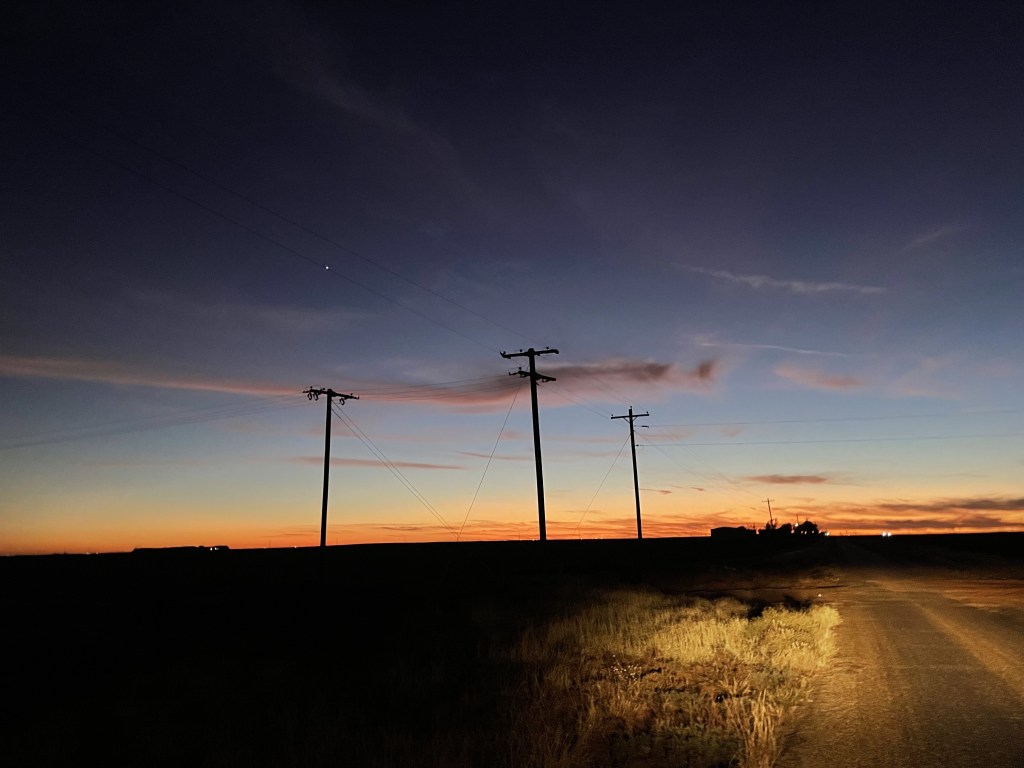
He pulled up to the last highline pole and let the four-wheeler idle. It had a slight bend and the creosote had begun to fade. Jacob took the hammer from his loop and hit the wood just above the pale red dirt then higher, higher, as high as he could reach, and back down in a spiral pattern. All good solid thwacks.
He pulled his shovel from the rack and dug a foot and a half down all around the base. There was no visible rot but still he took his drill and bored down into it, feeling out the resistance on the way in. It was an old pole but still strong. He backfilled the hole and tamped it down. He got the last aluminum tag and nail from his pouch. He drove the nail with the four precise blows he always did. The rhythms of the job came as natural as breathing.
He paused there, studying the wobbling line of tags up the pole, each bearing a year. The first went back twelve years. His son wasn’t quite born then. He tried to remember putting that first tag up but could not recall it. Too many poles on the edges of too many cottonfields.
The light was fading, a dark blue ocean in the east flowed and eddied into the pinks and golds and lighter blues in the western horizon. That stark divide his grandad had called “God’s Two Screen Drive-In.” Three bluish streaks ran overhead, all the way from the last explosions of light in the west until they disappeared into the swelling darkness. He closed his eyes and breathed the November breeze deep into his nostrils, the single-cylinder engine thumping beneath him. He saw an archangel flying off to do battle with the evils of the night. It was a notion he dismissed but nonetheless took as a good sign.
He opened his eyes and checked the time. He’d be late if he didn’t head back for the truck now. His sister had her own kids and worries and she was doing more than enough in keeping the boy after school. Jacob loved his son more than anything in his life. But still, as the cold night overtook the plains and he gunned his four-wheeler down the caliche topped road with no lights, he wanted to go anywhere but home.
Wyatt creaked the work truck’s door shut and slung his backpack in the floorboard. Jacob turned the radio down. Some old George Jones song faded into a gentle background whine.
“D’you eat?” he asked, shifting into drive and waving at his sister in the yellow porch light.
“Nuh uh,” his son replied. “Well Aunt Raych gimme some string cheese. But I’m still hungry.”
“Whatcha want? Taco Villa?”
He nodded. Everybody was out driving, accustomed to the early dark now and zipping around to the grocery store and the Mexican restaurants and the new Allsup’s glowing like a spaceship on the main drag. For as much as the town had shrunk since Jacob’s childhood, you couldn’t tell from all the oilfield traffic. They idled in line at the drive-thru, and Jacob pulled a styrofoam cup from the door pocket and spit out his dip.
“How was school? You still liking your teacher? Miss what’s her name? Lozano?”
“That was fourth grade. I’m in fifth grade now. It’s Miss Beatty.”
“I know what grade you’re in. Beatty. That’s right. Well, you still like her?”
The boy shrugged. “She’s alright.”
“Wyatt, don’t gimme that.”
Wyatt turned and looked. His big hazel eyes glowed like river stones in the menu light.
“I know. Your mama was better at this stuff. But I mean it. Something wrong, you tell me.”
Wyatt looked out the window at the headlights going by and scratched at his jeans.
“Miss Beatty’s fine. It’s just—there’s this kid.”
“Somebody giving you problems?”
“Not really. Not me anyway. But he keeps messing with Isaiah. Twists his ears when the teacher ain’t looking. And today he smashed gum in his hair. Miss Beatty had to cut it out with scissors but Isaiah was too scared to tell her who done it. I should’ve told her.”
Jacob frowned. “You can’t solve other people’s problems for them. That boy does it to you that’s another story. You stand up for yourself, hear?”
Wyatt nodded.
“What’s this boy’s name?”
“Jordan Balderas.”
“Victor Balderas’ son? Well, no wonder. His daddy’s meaner’n hell. You keep your distance from him.”
“But what about my friend?”
“What about him? Maybe this’ll toughen him up.”
“I ain’t gonna just let him do it again.”
“Well you do what you see fit, but know there’s consequences.”
“I know.”
“Alright.”
“Welcome to Taco Villa. May I take your order?” a voice warbled through the battered speaker.
He called out their regular: two combination burritos for him, a bean and cheese for the boy, and Sprites. They both preferred Coke but caffeine this late was liable to cause trouble. They drove out south of town in silence, eating in the dashboard light.
They turned off by the cotton gin, entering into the dust and clamor and gilded-blue halogen light. The gin manager leaned against the brick wall of the office. He took a drag from his cigarette and waved when they passed.
There were many things to do before bed. Jacob made space for the boy at the kitchen table, pushing unpaid bills and grocery sacks and supplement bottles aside. While Wyatt worked on his math homework, he fed the dogs and did the dishes from breakfast and wrote checks for the bills he could cover now. He lingered in the pale fridge light, staring at an untouched six pack. He grabbed a fudge bar from the freezer instead and sat down in front of the local news.
“Need any help?”
“No. Almost done,” Wyatt replied.
He pulled the footrest up on his recliner and ate his ice cream. The white-haired anchor spoke of a shooting in the city that left two teens dead over images of strobing police lights outside a rundown house. He worried about the boy. He was a good one, softhearted yet no pushover, but he’d been more and more withdrawn since his mother died. Children can grapple with cancer and death, painful as it can be. But the unraveling of his mother’s mind, to see her become erratic and sullen, that was too much. And now with the night terrors starting up again.
Wyatt handed his father his homework to check and plopped down on the couch. Jacob looked at the problems, the multiplication of fractions. His son had gotten them all correct but one.
“Look at this one again,” he said and Wyatt trudged over. He stared at the numbers and his tongue worked its way out of his mouth, along his upper lip.
“Oh,” he said and kneeled, using the end table to write on. He handed it back to his father.
“That’s it. A whole number you have to put over one. Just a careless mistake.”
Wyatt nodded.
“That all you have tonight.”
“Yessir. Can I watch TV?”
He glanced at the time. “Sure. For a little while.”
The boy put on some cartoon with talking animals that he couldn’t stomach, so he got up and went to the spare bedroom. He pulled the light chain in the closet. There were boxes on the floor full of his wife’s old photos and yearbooks and journals. There were a few of her clothes, still carrying a trace of her scent, hangers pushed to the back. And then there were her books. Several milk crates full of them. Classic novels and poetry collections and photography books she once treasured. But his eye was drawn to the crate at the back, full of the books she’d been interested in during her last years. Books about angels, demons, apocalypse, metaphysics, prophecy, the supernatural world.
He’d considered taking them to the thrift store, then burning them out back, but never could do it. A lukewarm believer himself, he dismissed any value in the books and associated them with a time of deep confusion and pain. And he wasn’t much of a reader anyway.
He picked up a weathered green hardback. An illustrated commentary on the book of Ezekiel written by some Catholic monk. He opened it to the bookmark—a laminated drawing of tulips and a blue sky their son had made her for Mother’s Day. The black and white illustration on the page was like nothing he had ever seen. A winged creature, not quite human or animal or monster but carrying elements of each, rode in on storm clouds. Beside it was an object composed of intricate wheels, which seemed to move like giant gears. In the rings were human eyes, locked into tormented focus, staring right into him while his own vision danced among the multitude of them, bearing flames and bolts of light.
There was a little man at the bottom, tiny against the epic scene in the sky. Even in silhouette there was such detail: unkempt hair and beard, tattered clothes, bony arms outstretched. A lone traveler looking into the heart of divine devastation. The caption read: “Angels appear to the exiled prophet Ezekiel.”
He peeled away from the drawing and began to read the passage on the opposing page. It spoke of the possibility of prophetic visions in dreams. Seeing the unseen world, the writer said, was a gift from God, truly awful, liable to encounter angels and demons alike, but a gift nonetheless.
When his son’s night terrors first started his wife spoke of spiritual warfare, of God allowing demons to enter his dreams, of a special purpose on the other side of such suffering. Jacob didn’t want to hear it. They were bad dreams. They would pass. And when they didn’t, they tried cutting out TV, processed sugar, red dye 40, video games. The night terrors might fade out for a while, but they always came back. It was a truly sick and impotent feeling, being awakened to the screams of his son, those tortured primal noises, and running down the hall to his room, finding him covered in sweat and gasping for air. Amy, barely strong enough to wheel her IV over the carpet, against Jacob’s protests, would stroke the boy’s hair and soothe him until the crying stopped, for as long as it took until he finally slipped into the shallow dreamless sleep that followed.
By then the cancer had reduced her body to something Jacob barely recognized. And her mind, once full of joy and humor, was gripped by delusions. She slapped her tea off the kitchen table because she saw the devil in it. She shouted “witchcraft!” at prescription drug commercials on TV, the ones full of happy people riding bikes and eating ice cream cones with the grandkids while an actor rattled off trademarks and devastating side effects like black incantations. He could almost see what she was getting at there, but no—it’d been best not to encourage it.
The dogs barked out front, and Jacob was shaken from his trance. He put the bookmark in its new place, and returned the book to the crate. He peeked out the blinds at a module truck rattling down the road to pick up another load. Its taillights showed trails of pale dust that soon settled back onto the earth. He glanced at his watch and the dread cropped up.
He sat with his son in the living room, watching the last few minutes of his show, both of them not wanting it to end. But it did. They started the bedtime routine. Wyatt pulled back his John Deere sheets and started to crawl in.
“Wait a minute,” Jacob said. He didn’t know what he was doing but got down on his knees anyway. The boy followed along. His wife used to pray like this with him. She spoke often of God and overwhelming love and still waters, natural as breath to her, and though Jacob had his doubts he didn’t mind. He hadn’t felt much like praying since she got sick. Elbows resting on the twin mattress, they prayed. He asked a God he wasn’t sure was here, there, or anywhere to give his son a night undisturbed by troubling thoughts, bad dreams, and wicked schemes. He figured it’d do as much good to tell his problems to the washing machine.
“Amen.”
“Amen.”
He tucked his son in and swept back his hair. The boy’s pupils were big, just a thin ring of gold and green around them, holding both fear and a trust that Jacob didn’t think he deserved.
“It’s gonna be a better night,” he said and walked to the door.
“Goodnight,” Wyatt said.
He cut off the lights. “Goodnight.”
The bedroom TV churned out muted sports highlights. Jacob hadn’t realized he was drifting off until he heard the screams. They reached him first in his own dream, where he was lost on a vast plain, dead shortgrass in every direction. A coyote appeared, threw back its head, and let loose an ungodly shriek. It sent an electric pulse through him, the doubt of ever finding his way again turning into a cold steel certainty. And finally, the heartpunch that made him bolt upright in bed. He knocked over a glass of water trying to turn on the lamp.
His son howled like a victim of the fire tortures of old. And part of Jacob, as he did each time, thought that maybe it was real this time, that Wyatt was hurt. He was dying. He threw back the covers and sprinted down the hall.
He burst through the door and the shouts grew louder. The boy’s eyes were scared and savage in the moon glare. He looked at his father with no recognition and no hope. His legs scrambled under the covers until he was pressed up against the headboard, holding his skinny arms up for protection. Dread saturated these moments until they were heavy as lead, like something deep and vile could pull them both under at any time. Jacob had flashes of violence and death laid over what his eyes could see. Like some evil old as time was in the room with them.
“Wyatt,” he said and put his own hands up. “Wyatt, it’s me. It’s dad.”
He crept closer, speaking softly as he’d done to jumpy horses. The panic finally went out of the boy and he began to sob. Jacob sat on the bed and put an arm around him. He cried for awhile and his body gradually relaxed.
“What did you see?” He didn’t know if asking would make things worse but couldn’t keep from it.
Wyatt shook his head. “I don’t know. It ain’t like a regular bad dream. When I wake up, I already forget it. I just—get this bad feeling. Like it’s been waiting on me. And when I’m asleep, it’s gonna drag me into this deep dark place. Where you don’t come back.”
Jacob sat there, hurting for his son, ruminating on something Amy had said. “It’s spiritual warfare. That’s the truth. People have always understood there were forces in this world we can’t see with our eyes or hear with our ears. But they’re there. The good and the evil. We can comfort the boy but we can’t help him. Only God can do that now.”
It had been easy to dismiss her. She was sick, haggard, at the end of her losing fight. And he knew she deeply wanted Wyatt’s problem to resolve before she passed on, for him to find peace. But that didn’t happen. The terrors came and the terrors went. And her preaching seemed of no consequence at all. But now, those words bubbling back into his mind filled him with fury. He clenched his teeth and cursed. There was no greater plan. Only degrees of suffering. And they were on the wrong side of the line.
He chased half-thoughts and brittle daydreams through the Friday meeting. He had been with the electric co-op fourteen years now, had a fair amount of leeway, but was expected to speak up even when it wasn’t his week to lead. But the specifics of pole inspections and ice storm contingency plans didn’t have any room in his head that morning.
“You alright?” Cody asked.
“Yeah,” he answered. “Didn’t sleep well. Another cup of coffee and I’ll be alright.”
Cody looked him over and then nodded. “You still south of town?”
“Yep. Should finish up easy today.”
“Should be a short day for me too. Let’s catch a beer later.”
“Cain’t,” Jacob said. “Got plans with my boy. Next time.”
“Next time.”
Jacob parked his work truck on the flat caliche pad with the big tank batteries. He put in a dip of Skoal and slipped on his sheepskin gloves. The sky was overcast, the breeze cool and steady from the northeast. He walked around the back of the trailer and pulled the first pin. He kept his hand on the heavy gate and scaled to the other side and removed the second pin. He stepped off to the side and let it down gently onto the pale earth. He checked the oil and the tires on the four-wheeler and let it idle a minute before backing it down the ramp.
He found some solace in his work that cool gray morning. It wasn’t until he ate his ham sandwich that the night caught back up to him. He couldn’t shake the thought that demons were at work. It felt childish, foolish, even as a backsliding Baptist, but pestered him nonetheless.
It wasn’t just nightmares. He’d had those as a boy. Dreams containing some escaped killer or monster from TV. Terrifying, but once he’d figured out the vampire wasn’t real, that his imagination had just carried him off the screen and into his head, it soon passed. But his son, he never watched anything remotely scary. Not anymore. And he didn’t eat sweets too close to bed. And he didn’t have many problems at school. He wasn’t sullen. He had friends. He wasn’t staring at a screen all day. Even his mother’s death, which Jacob knew weighed heavily on him, didn’t seem to directly influence the night terrors. They started before she got sick and didn’t seem to increase in strength or frequency after she died. They just came and went as always.
They tried therapy for awhile. He and Wyatt both hated it and no progress was made. He took the boy to sleep specialists, and they brought him in at night and hooked him up to all kinds of machines. They tried it four times, but he never had a night terror. Nothing abnormal in his sleep patterns, they said, and suggested trying again and again. But insurance didn’t cover it of course, and his savings were low after the burial. The doctor finally suggested a mild sedative, and that was that. He wanted Wyatt to sleep well, but the thought of getting his eleven year old started on tranquilizers made his stomach turn, and he could almost hear his wife sounding alarms in the ether.
Her book had a chapter on dreams. Referencing scripture, ancient philosophers, and Jungian psychology, the writer made the case that the soul has its own life at night. That in fact our souls must be restored to our bodies each time we wake. And in the meantime they may go on fantastic adventures, or cross surreal patchworks of memory, or into the very maw of blackest hell. And the writer didn’t make the case that you could change your dreams, or should even desire to, but that dreams exist for instruction, a chance to grow and develop the spirit.
But what did an eleven year old boy need to learn about the outer darkness? Wasn’t that a lesson for his father to bear? Men who lived long lives of cheap comfort and learned neglect deserved such dreams. Not a child. He picked up a rock and slung it. It clanged against the tank battery, throwing echoes into the still afternoon.
He met up with Cody for that beer. And then a couple more. Just the whisper of a buzz walking out of the Mexican restaurant. His father used to joke that they were German enough to handle their beer and Scots-Irish enough to not be able to handle their whiskey. He drove to his son’s school and found the pickup line empty. He cursed himself and went up to the glass door. Wyatt was sitting in the hallway reading with his backpack on. Jacob motioned, and he came outside.
“Thought I was gonna have to walk home.”
“Be a long walk.”
“I could do it.”
“I know you could.”
They drove to the house and swapped the work truck for his Dodge. They loaded up the poles and tackle box, the tent and propane burner, the cooler and a change of clothes. They headed east on the two-lane highway, diving off the caprock into the mesquite-addled pastures. Scattered buttes, outliers from the age when the flatlands extended this far, sat on the horizon. This arid land had always required many acres to run cattle, but he could remember a time when you’d see many white-faced Herefords on your way through. Now you were as likely to see whole solar farms as a couple small herds.
They had to drive an hour for decent fishing. When he’d lived back east awhile, there were lakes and ponds and rivers. Pick up a rock and you could toss it into water. Out here, back before cities and piped water, you had to know the land well to survive. You listened to it closely, you cherished its secrets. He often longed for such times.
Darkness climbed the eastern sky and the faraway caps dimmed and the lights of town burned meekly across the expanse. The highway bent around the base of a steep butte. The clouds almost sitting on its chalky flattop like Mount Sinai in the smoke. Jacob had been reading the Bible more. Though he figured he should read about Jesus, he was drawn to the Old Testament, stories of blood and sacrifice, shofars and miracles in the desert. He’d heard the abridged, sanitized versions of the stories way back in Sunday School. In full they were strange, violent tales. God’s people ordered to slaughter whole cities of the wicked. Abraham binding his son and holding the blade above him, heaving his fear of God up and receiving a reprieve from on high. He knew he didn’t have a faith that strong, didn’t even know if it was possible in the age of satellites and psychology, but the mysteries persisted in his mind.
He glanced over at his son, reading an illustrated book on constellations. His many interests, his sense of wonder, his discerning hazel eyes, he got all that from his mother. He was devoted to the boy from the first time he held him, all pink and splotched with pale biofilm and softly crying, but the bonding took time. It was natural for his wife, who’d carried and borne the child, who fed him at her breast. But for Jacob it had come with time and experience and seeing not just his hair and ears on Wyatt but some of his own idiosyncrasies, his particularness and independence of will. And now that the woman was gone, it often felt like a volatile sea separated him from the boy, like his wife had been the isthmus tying it all together. But thinking that way didn’t help things.
They pulled through the unmanned entrance, put five dollars in one of the envelopes, and dropped it in the slot. They made camp at dusk and built a small fire. They took foil packets of German sausage and vegetables and potatoes from the cooler and cooked them on the coals. A slash of clear skies came through the cloud cover. They sat and ate and stared into the fire, then up to the narrow streak of stars.
“Dad. I think it’s getting worse. The dreams. They feel so real. Every time it’s closer to getting me. Like one night I won’t ever wake up. Do you think that?”
He looked at his son, fire dancing in his dark eyes. “No.”
The boy nodded and looked down.
“I can’t tell you when it’ll stop or how bad it’ll get. But I do believe you’ll come through this. Stronger. And I can’t change your dreams, but you go to bed knowing you’re safe. The dogs’ll raise hell if somebody so much as jiggles the door handle. And your daddy might not know much but he knows how to shoot.”
Wyatt tugged at the strings on his hoodie and grinned. Jacob stirred the coals with a stick and put another chunk of mesquite on.
“That boy in class, that was picking on your friend?”
“Yeah.”
“Every battle isn’t worth fighting. You’ll learn that. But some are. That’s all I can tell you, alright?”
“Yessir.”
“You want s’mores?”
“Sure.”
Wyatt licked chocolate off his thumb and stared up at stars slowly fading back into the clouds. Jacob banked the fire and they turned in for the night. In the morning they’d fish for blue cat. They said their prayers and got Wyatt situated in his sleeping bag. He stroked his son’s brown hair and then left the tent. Clouds had settled in like a scab over the gash of stars. He did not know what to do next.
Wyatt had said a prayer humble and wise beyond his years, touching something deep in his father. It was pure and borne of suffering. He wanted to foster this in his son, knowing it was bigger than he—but didn’t know how, not seeing the light himself, he could lead the boy to it.
He looked over the mesquite to the road, electric poles barely visible against the night sky. Power humming along into houses and schools and pumpjacks and roadlights. You push a button and expect it all to work. The glow from another campsite cut a narrow path across the turbid water. He watched the golden ripples until the source was snuffed out and it was just him and the sovereign dark. Jacob was tired. He held out his disbelief like a meager sacrifice. He asked to be shown the way. And the screams poured out of the tent into the vacant night.
Travis Burkett is the author of An American Band (TCU Press, 2024). He writes and farms cotton in West Texas.

 High Horse
Leave a comment