
Harris was a kid in my neighborhood. We were at his house playing video games during the summer when his dad called from his office to remind him to go feed another neighbor’s cat. His dad was an intimidating guy, like most of ours were. Tall and barreling, they all seemed to have beer guts and cell phones attached to their belts and drove around in big cars with shiny hubcaps and tinted windows. They worked for the same two or three corporations that had regional offices nearby. Middlemen in retail or energy or the telecommunication sectors. The neighbor with the cat was a colleague of Harris’s dad. Childless, unmarried, he’d gone out of town to visit a sick parent. He lived right behind my house, across an empty creek bed, but I’d never actually seen him before. Maybe he moved to our neighborhood recently, or maybe years before my parents did. It was hard to keep track of who came and went around there. Under a brick on the guy’s back porch was a key and on the counter was a note addressed to Harris’s dad, giving him instructions on how to feed the cat. He was supposed to mix some medicine into its food to treat a bladder issue. Harris, he was careful to follow the instructions to a tee because he’d probably get beaten if he didn’t. The note also mentioned the cat most likely wouldn’t come out of hiding, and he was right about that—the whole time we were there, the cat was invisible.
We wandered around downstairs, glad to be out of the heat. Although the house had plenty of windows, it still seemed dark, with a mildewy stench. On the walls was the absence of any framed photos or cheesy paintings. Just wood paneling, popcorn ceilings. The living room was empty of furniture except for a couch, like he moved in only a few weeks ago. Somehow the whole downstairs confirmed to us how sad it was to be middle-aged and alone. A fate we’d all try to avoid at any cost, even if it meant clinging to a loveless marriage like our dads did. Upstairs there was a game room which only seemed to be dedicated to one game, what I’d later find out was the only game worthy of having a room dedicated to it, the game of immortals, where each person who plays it must confront themselves in a battle of concentration and stillness, a game derisively and commonly known as ping pong and historically referred to as table tennis, but which I’ll call only the game.
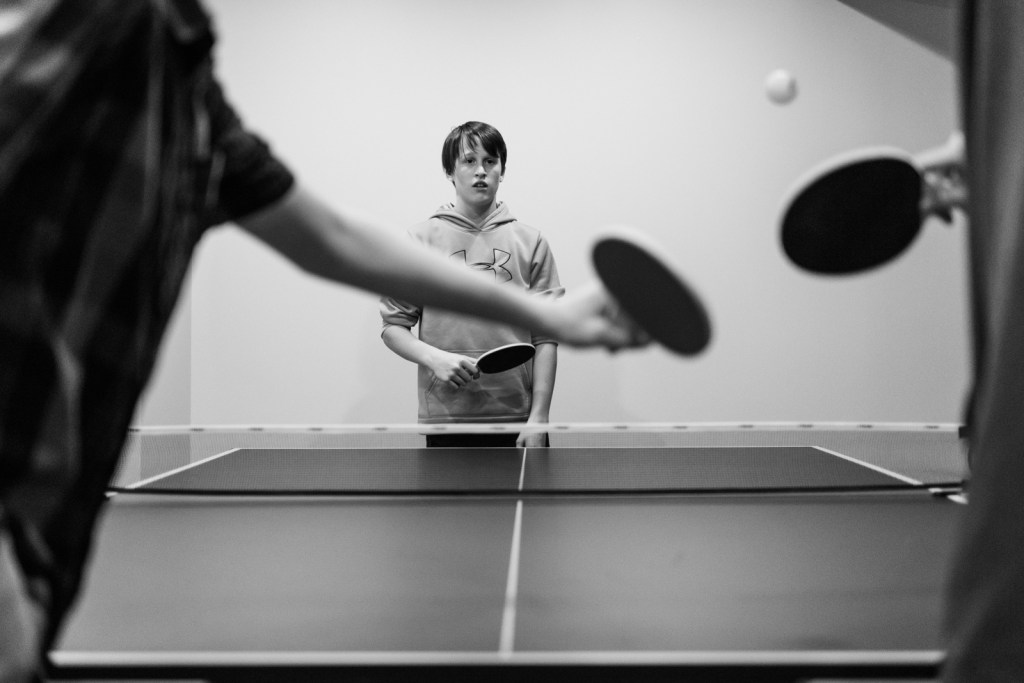
Unfolded in the exact middle of the room was the table, dusted clean, unscratched. Throughout the house you could see cat hair balled up, floating, except for on that table, an immaculate 9×5 ft. throne with a skylight above it of almost the same dimensions which washed out the green tabletop in a pale glow. Behind it was a bookcase lined with medals, plaques, certificates, all with the same name, Stuart Olmasy. On the bookcase was a framed photo, the only one we ever saw in the whole house—of a kid, maybe our age or older, holding a paddle in one hand and shaking Richard M. Nixon’s hand with the other. A beaming smile on their faces. In the drawer beneath was an array of paddles in a felt-lined case, each marked with the image of an eye in wavy thin lines, like Ra’s eye from Egyptian hieroglyphics. The rubber padding was perfectly intact. Polished handles.
Everything upstairs was clean and bright. This was where he came to escape the stress of working for a company that was slowly suffocating him just as it was making Harris’s dad angrier at home. Because of the way his dad was, Harris was worried about us playing, not that he had a choice, but we were convinced we could avoid leaving any traces, as if we wouldn’t track dirt on the carpet or streak the countertops. Bass, another kid in the neighborhood, was already bouncing the ball on the table, spinning a paddle in his hand.
“This place is crazy,” he said to Harris. “Why were you hiding it all this time?”
The other kid there, whose name I’ve forgotten, started to play against him. None of us had ever played before, although we played the video game, Pong, or at least I had, at a doctor’s office downtown, part of a test of my coordination skills when I was younger. He was the same doctor who told my parents I had a learning disability and prescribed me Ritalin back in its early days. Any hope the drug would help me was dashed pretty quickly when I played against Bass. I might’ve been able to focus more because of the drug, but I didn’t have any skill, not like Bass, who played as if those medals in the bookcase belonged to him instead. Stronger and bigger than us, he was destined to play high school football in a few years. He was also a bully, which is why Harris couldn’t do anything to keep him from smacking the ball so hard it left a white streak across the table.
I must’ve still been playing Bass when the nameless kid found her in the closet next to the bookcase. Kept like a trophy in one of those garment bags where our fathers kept their suits, a body of plastic, slightly deflated, with two moist openings, long blonde hair, catatonic eyes. We could all agree she was beautiful, but none of us had any idea what that meant. She just needed a name to make her more believable. Maybe we could name her after a girl we knew from school or the bus, but none of us could think of one worthy of sharing her name. We thought of the sitcoms we watched and the female characters on them, but unlike them, she was non-judgmental, serene, besides being more real. Most of all, she looked at us with complete acceptance, like nothing we did could upset her, even when the nameless kid put his finger inside her mouth—the more respectable orifice of the two—then let us smell the fluid dripping from it, a smell none of us would ever admit we recognized.
“If y’all want her so bad,” Bass said. “Let’s play a game for her then.”
His idea was that the best player would win a chance to be alone with her. I was the only one who volunteered and embarrassed myself, getting beaten 10-2. Even if by some miracle I’d beaten him, he’d still bully me into acknowledging that he won—he’d never admit to losing. Bass was of frontier stock, hardscrabble homesteaders and cattlemen who once prowled the plains and who would triumph over tornadoes and Cherokee raids. Maybe he’d also run for local office one day, open up a car dealership off the interstate after his football heroics were over. He’d become like his own dad, replace him seamlessly, move into a big house down the road with a circle driveway and signs in his front yard honoring his own son’s athletic feats or his chosen candidate’s bid for reelection.
Harris, on the other hand, he was a country club kid with skinny legs and golden hair who didn’t seem too disappointed in losing her—which went a long way towards confirming the rumors that followed him later on. The nameless kid, he also didn’t seem to mind losing and started hitting the ball against the wall when Bass went into the closet with her. I got tired of hearing him in there and went downstairs, walking down a long hallway to Olmasy’s room, its door closed. Inside was a bed perfectly made, no other furniture. On the bathroom counter, a small, locked case with that same ornate eye on the lid. I could hear the nameless kid’s footsteps pressing on the ceiling while he played, moving in a way that I would later learn was improper form because a player is supposed to shift their weight like a surfer and stay rooted to the ground, the immoveable pivot. Before I went back upstairs, I unlatched the window in the living room and later that night, after my parents went to bed, I dressed in black and returned to free her—Christy, Sarah, Alice, whatever we decided to call her—although I didn’t know what I’d do with her, I just knew I had no interest in doing what Bass did.
The house looked completely different at night. There were rooms off the hallway I didn’t remember from before, an island in the kitchen, a dining room with flower wallpaper. Upstairs, I walked past the table, streaking my fingers across it to test its cleanliness, then went into the closet, flipped on the light, and saw his cat, a grey one, licking at a stain on the carpet like it was a puddle of fish sauce, voraciously, not even looking up to acknowledge me until I reached for her on the rack—it hissed like it was her protector now that the master was gone. The cat even swiped at me, but when I grabbed hold of the hangar, it went back to licking the carpet.
My hands were shaking when I took her out of the bag so she could breathe again. She still had that same look of pure acceptance, no less confused. Whatever it was Bass had wanted to elicit from her, she didn’t give it to him, and if I touched her, how could I touch her in a way that was different from him or the nameless kid with their sweaty hands? I’d be no better, trying to pry myself into her plastic heart. She seemed more deflated after Bass manhandled her, so I looked for a pump and found one in the drawer of the bookcase and inserted it in the hole under her armpit. Soon she was restored to her voluptuous self, her arms stiff by her sides, her legs spread out farther than before like she was caught somewhere between resisting and welcoming me. I didn’t know what she wanted, what I could do to rescue her from the memory of Bass, her open smile and her eyes glazed over in terror, waiting for me to say something to reassure her.
From downstairs I got two beers and put one next to her. Since she was staring at the table, it seemed like the most obvious thing to do was to play. Maybe she wanted to be entertained after spending most of her life in that bag, but her reaction didn’t change that much when I started playing. If anything, she was getting more bored, like she was used to watching a championship player. I hit the ball harder, trying to impress her until the skylight started turning blue, then I put her back in the closet and headed home before my parents woke up, not sleeping the rest of the day, only thinking about getting back to her. Once my parents’ door was closed, I snuck out again. To her credit, while I played for her, she never looked away from me. She seemed to be judging my form and approach, comparing me to her master maybe—her empty eyes would never follow the ball, just fixate on me and nothing I could do would change her expression. The only way to impress her was to get better at playing. The books in his bookcase were mostly about engineering or paperback bestsellers. One was called Fatal Vision and was about an army guy who supposedly murdered his family in the 60s.
The only book I could find about the game was called On the Art of Table Tennis, by Lt. J.H. Mackleston, of the British Imperial Navy, recipient of the Victoria Cross. On the title page was the stamped crest of an opened eye. It was a treatise offering a pathway towards mastery—the drama, how to gain strategic advantage, pacing, how you have to understand your mind before you can become a competent player.
I started reading it to her and for the first time her expression seemed to change, something different than her usual vapid smile, like she wanted to be more than a spectator, wanted to play the game herself. The book’s author, Mackleston, was credited in the introduction with spreading table tennis to China in the late 19th century, although he claims in the book that he first saw the game performed by monks in the Jiangsu province during the Opium Wars. He wrote that the miniature version of tennis preceded the “mature” one and may be “the origin of all table games, the primordial pulse striving for escape, release into flight.” Only later could I see how much he was peddling watered-down Chinese philosophy, not a seasoned sinologist by any means, but a career soldier marooned in a defeated empire while wearing the regalia of the world’s preeminent one, traipsing along the canals of Suzhou with his burnished navy blues and pet macaw on his shoulder. As a soldier, he scoffed at grand Napoleonic strategy, wanted instead to return to the true source of battle, two arms squared away, at the ready, across a verdant field, primed for bloodshed—no distance, no cacophony of cannons, or screaming mutineers—his christened domain, and he commanded it with speed, focus, anticipation of the enemy’s attack, balance, precision, ideal attributes he took from being a student of naval combat and just as he was once ordered his men to mind the cannonball bearing down on their ship, he urged each player to respect the paper mâché orb.
Eventually, his wartime experiences and the hectic pace of the game left him in need of a different kind of relief, a numbing slowness most conveniently found in opium dens. One hit and he sank into the heart of his enemy, let his body spill across the floor in blessed dreams. In the remnants of the Qing dynasty, where no gods stood and a severity of spirit ruled the most feverish celebrations, he became an addict, dependent on the same drug his home nation (where it was deemed illegal) was fighting to push onto the locals. From those halls where he played, where velocity was prized, he strayed across town to places where every man was a sleepwalker chasing after hungry ghosts. Eventually, one space would take precedence over the other and what passed through his pipe slowly diminished the skills he needed to compete with even his fellow dope-fiends. In the dens, he was known to regale everyone of his exploits as the best player in the empire, describing matches in great detail between himself and monks or other sailors or against two or three players at a time. As the drug took control, he narrated the perfect match, an imaginary one, listed each type of hit, the numerical harmony of a specific tally. In his fantasies it was waged over a vast empty plane where the ball slowed down so much that whole lifetimes would pass between one volley and the next.
In Suzhou he founded a school, using it as a base to give lectures before disappearing in 1858. Various theories have been put forth as to what happened to him: 1) he embarked somewhere to the interior provinces in search of his fix because the Qing officials had effectively burnt the remaining stockpiles along the ports, or 2) was kidnapped by British spies and tortured to death for betraying the East India Company, or 3) was killed for a gambling debt or for fixing matches or both. The book was assembled by his more dedicated followers from various notes and diaries he’d left in the desk at his school and published by a British expatriate press in Hong Kong in 1882. It was short enough that I could read it all the way through before the morning, a ritual I repeated the rest of the week until one night I went upstairs and found the closet rack full of empty hangars. Someone had come in, stolen Olmasy’s greatest prize. Harris or the nameless kid never would’ve taken her. Bass probably wanted more time alone with her, to stifle her cry with his pillow, her rubbery skin wrinkled and deflated under his touch. Soon, she’d need some air, but he wasn’t the type to be compassionate.
Before I left Olmasy’s house, I took one of his paddles, figuring he had more than a dozen of them in the drawer and wouldn’t miss it. I wasn’t going to let Bass beat me and corrupt her again like that. I had to get better—it was the only way I could get justice for what happened. The rest of the summer I hit balls against the back porch, only coming indoors to have dinner. Even when I wasn’t playing, the game dominated my thoughts—during those long bus rides once school started, or when I sat in class, or while I was in bed, staring at the ceiling, which was reshaped into a field of play with the ball attached by a string to the light fixture. With the fan turned on, it swung over my head in unpredictable directions. I tried to never lose sight of it, like I was practicing self-hypnosis, entering another state of awareness, somewhere in my opponent’s heart, the ball soaring at ridiculous speeds, my arm outstretched from the sheet, responding with blocks, loops, an occasional smash to quiet the crowd and right when my eyes started to close, the ball evaporated into the blades of the fan.
Sometimes it appeared in my dreams, swinging overhead like a pigeon or a planetary body. I carried it with me in my pocket, holding it tighter whenever I got nervous or angry. The feeling of it pressing against me was comforting, but once the other kids found out about it, they started calling me ball boy or ball sucker, but I still kept carrying it. As unobstructed as a ball by air, I’d float through every obstacle, either within the game or out of it. I had to improve as a table warrior, for her sake. It was one thing to return what the wall dished out—whether I closed one eye or stood on one foot to challenge myself, I still hadn’t played against any real competition. The only person I could think about playing against was Bass, but I wasn’t ready to face him, so I invited Harris and the nameless kid to my house.
Neither was much of a challenge. Same with some other kids from school. I joined a club at the YMCA and quickly went up the ranks there too.
One Saturday my dad agreed to take me to this abandoned airport hangar outside the city, Wurzer’s Hangar, a place that’s long been sold off and bulldozed for tract homes. It was one of those clubs dedicated to the game that opened up throughout Texas back in the 80s and 90s. Some were in back yards, some in barns or garages. The only requirement you needed to play was competence in the game. If you lost enough times in a row, you wouldn’t be allowed to play again without having to serve a probationary period. This was supposed to keep the battles fierce. My first few times there, I walked around, not playing, just watching, trying to imagine how Mackleston would respond to the scene—would he see the players as hopeless amateurs (the apparent ‘best of the best’ in that part of the state) or as proudly carrying his cherished game into the next millennium, through the century of speed, where the drugs had changed from opium (“which steals away the purpose of wrath” as Thomas De Quincy, a near contemporary of Mackleston’s, wrote) to ones that make us more alert, determined. Maybe the pace would be so accelerated for him that he probably wouldn’t even recognize his dear game anymore. It was no coincidence the Hangar also once housed an aircraft that broke the sound barrier a few decades earlier. The place’s history might explain why the players there were fixated on mechanics—they thought if they only put their feet in the right position or held their arm at a certain angle, they’d bring home trophies or a mahogany paddle hand-carved and initialed by old man Wurzer himself, retired and residing in a house on the edge of the airfield.
Mechanics were important, but it was the mind you had to take apart and reexamine if you truly wanted to improve. Why would it matter how fast you swung if you couldn’t actually see what was coming straight at you? If I asked a question like that of the guys there—calibrating their finger weights, doing calisthenics—they’d probably kick me out, and for good reason. I’d be accused of overthinking, unpardonable in those parts.
In those first games I got crushed handily; it didn’t matter who I played. I had to remind myself not to react to losing with a greater determination to win. Like Mackleston wrote: “To commit to bettering your skill is to pose a question whose answer may devastate you.” I had only myself to battle against. You’d be amazed how easy it is to trick yourself into feeling reborn with each game. At night, I followed the ball swinging overhead, closed my eyes, imagining it as a passing comet, a train veering off the rails, one errant firefly drunk on darkness. A few weekends later I was winning matches here and there, picking up victories against other kids like me, green ones, so impatient to improve they ignored the ball in front of them. My dad kept taking me there on weekend mornings while my mom picked me up at night. Both were probably just glad I didn’t have a more expensive hobby like ice hockey or constructing model airplanes. If I wasn’t sleeping, I was bouncing the ball somewhere, sharpening my coordination and reflexes.
My parents, if they were worried about me, they didn’t say anything. Besides being glad my hobby wasn’t expensive—they were just grateful I had one. Before I started playing, I was anxious all the time, and angry. I broke things, had outbursts. That’s why they took me to the doctor who warned them that I had to get treatment or otherwise I’d turn my anger against myself or others. The doctor believed my new hobby was a good thing even if I was eating and sleeping less. My training demanded that I dispense of distractions as I would an inferior foe. I had to follow what was outlined in the book, and even if Mackleston never advocates starving oneself or inducing meditative trances in one’s closet or feeling the ball’s contact at all times against one’s body, he regards anything less than complete dedication with disdain. Instead of doing homework, I was reading the treatise, memorizing whole passages the way other kids at my school memorized Bible verses. It was my path towards salvation. As my grades suffered, that’s when my parents started worrying. I’m sure to them I had this glazed maniacal look in my eyes while I rambled on about the purifying effects of the game, bouncing the ball off the kitchen floor, but they knew if they banned me from playing, I’d revolt and run away, leaving our house in a pile of ashes behind me.
I also started to fake certain symptoms around that time—losing attention in class, talking over others, nervously shaking in my chair—so I’d get prescribed a higher dosage of Ritalin. I wanted the game to slow down even more while my reflexes and focus got sharper. Maybe this was what the lieutenant was searching for in those opium dens, a drug that would achieve contradictory results—quickening the mind while dulling the pace of the world. I was getting closer to his ideal, a quantum approach to the game: the ball flattened out, widened, slowed down so that the grooves and marks on it were visible as it got closer. I’d become his apostle in action. Soon, I went from losing every match to moving up the hangar’s ranks and eventually beating old man Wurzer himself (10-2). Other players started asking me if I sold my soul to the devil to get so good so quickly. No, I wanted to say, I sold it to J.H. Mackleston.
As the champion of our club, the other members surreptitiously signed me up for the statewide tournament which happened to be hosted at a hotel downtown that year. Wurzer, nursing a cigar in his office where there was a calendar of the top 12 best paddles ever made behind him on the wall, told me I wasn’t ready to compete on the same level with professionals, but I was close, and that was the important part.
He said I had about two months to get ready and decided to train me himself and although he had a different style of play than what the Lt. preached, he was also a veteran of more than one war and brought the same military discipline and stubbornness to training. As for my own habits—like tying the ball to the fan at night or focusing away from the ball while playing to extend my field of awareness—he called them “hippy cheats.” He was of the modern school that believed a player was an athlete first and foremost, a combat warrior, not some “dirty kook.” The balance between my two teachers was good for me. I could see the ball like it was passing through a viscous liquid, see every rotation and change of direction, but when it finally bounced on my side of the net, I could pummel it home with absolute intention. Next thing I knew I was lifting those same finger weights, running laps around the airfield, jumping rope, etc. All weekend long I was at the Hangar, sleeping on a cot in the office, eating meals with the old man and his family. I started getting rides there after school, not from my parents, but from Wurzer’s nephew, who was always asking me questions about my training and how I got so good so quickly. When the tournament finally came around, he drove me downtown to the hotel where it was held. The old man himself didn’t go because he believed if he ever left his property, the government would promptly kidnap him for some “covert shenanigans” he was up to after the war. At the sign in table, we learned that if you made it through the first day as a player, the tournament sponsors would put you up in a suite free of charge. The purse was a sizable amount too, enough to cover maybe a few years of college, as if I was planning on doing anything else with my life besides playing.
Here I was, ready to escape the fog of distraction, step into the great hall, popping my favorite drug from a Pez dispenser, looking at all the players around me through the eyes of a dope fiend warrior with his honor held firm. The nephew asked me if I was nervous: “You got some of the best players in the world up there,” he said. “Squeaky Clements, the Indominable Joe Alicante, and the legend, Danny Chou, they’re all pretty old now, but they still could give you some heat….” What he didn’t know—and how could he?—was that I could call on the treatise at any moment to ward off an unexpected bounce or a tenacious spin—this was what separated me from other players. Some of them might’ve been familiar with its more famous lines, maybe had it in their bookcases at home, but none of them had the kind of intimacy with it like I did. They probably still thought they were playing a respectable table pastime, a quaint summer camp activity, however much it resembled a miniaturized version of another game, whereas I tended to subscribe to Mackleston’s belief that as players we were conducting a war which violates the accepted laws of nature, a celebration of excess and an almost monastic allegiance to perfection, a concentrated assault on boredom, passivity, deceit, banishing them from our consecrated space where the tables, all lit up under panel lights, reminded me of Olmasy’s sacred throne, where our lives were undone, bodies rendered motionless, strung up along the nets and pilloried by the final judgments of children and men.
The judges, they checked our paddles for weights and thankfully left our blood untested. The other competitors looked like they were wading through formaldehyde, wearing shoes filled with lead and played like clumsy mannequins, each of them, their joints rusty, losing their grip, reeled back into no man’s land to a volley of whistles from on high—who were these supposed “professionals,” as Wurzer called them, all fixated on the ball with the same fast determination, their veins protruding? If these professionals were dragging themselves around like tired dogs after bones, I was hovering on paperthin wings, sightless, lethal, scoring on each serve and almost on each return. With my blade glinting, I had a dream arsenal of flipside loops and smashes that were cataclysmic—down, top, side spins alternating at time warp speeds.
Before their brains could register that a serve was coming their way, the ball had already bounced into the stands. They argued with the umps, claiming I pulled some magic feat to play the way I did. Didn’t you hear the ball!—I wanted to yell at them—you’re lucky it zipped past you instead of knocking you on your ass. I had a duty to educate them, to honor Mackleston’s vision or the profound lack thereof—their weak wrists, their overeagerness and hesitation were the least of their faults.
Word was going around that I was close to breaking the record for the most consecutive points ever scored in tournament history while someone had clocked the speed of my serve at levels never seen before outside international competitive play. If I wasn’t careful, the judges, they’d come after me, accuse me of cheating, maybe test me for drugs, so I conceded a point here and there to set them off my trail. I also had to show some flaws to garner sympathy from the crowd—no one likes an effortless winner—and purposefully swung over a sharp bounce or dragged my feet to slow my return.
The last match of the day was against the legend, Danny Chou, who I disposed of in short order to an almost embarrassed silence in the hall although as a true professional he took his defeat graciously, with a handshake, slightly tilting his head out of respect. Everyone knew he would’ve beaten me in his heyday, but now he couldn’t offer any competition, mostly because of his age, but with the rest of them, it was like I was practicing against the wall on my pack porch. They all lacked imagination, confidence. I don’t know how many of them I beat—ten, twelve, before the first day came to an end. The nephew and the rest of them said I should celebrate for advancing to the second round, get some beer and climb up to the hotel rooftop, but I had to take the lieutenant’s words to heart: “Win one match, and you’ll be unbeatable. Win a thousand, and you’ll capitulate in a straight set.”
The organizers put me up in a suite with a view of the interstate; all the cars were passing without a sound behind the glass. I didn’t drink or eat anything. What I wanted was a shower and some darkness. I also hoped the next day’s competition would be a little tougher, at least just for entertainment’s sake. In my room, lying in bed, with the window open, I stuck to my ritual of tying the ball to a string and following it around before I fell asleep.
For most of the next afternoon I was in some kind of trance and barely remembered who I played against. I remember there was an older woman in a leather jacket who had a noticeably powerful serve, but that was about it. For lunch, a banquet was flowing. Some kids were asking me to sign their paddles. I was being heralded as the successor of the great Swedish player, Waldner, maybe only because of my blonde hair. A projection screen was lowered from the ceiling that showed a short promotional film about whichever corporation was the main sponsor, then the overhead lights turned back on and a table was rolled out while the announcer took stage and listed all the sponsors again, thanked the players and “this great city” which hosted the tournament and “this spectacular hotel with its state-of-the-art facilities.” He continued: “…Now, are you ready, ladies and gentlemen, for the 1988 Southwestern Regional Table Tennis Pro-Am Championship Finals? Because I know I am…alright, without further ado, let me present a lifelong player who’s joined us again after a sorely missed absence due to an unfortunate setback, the former national champion, the Texas Tornado, Stuart Olmasy.”
I’d only seen him in a photo from 30 years ago, when he was about my age, the sparkle in his eyes beside Papa Dick, an avid player himself who believed the game could serve as a mode of soft diplomacy with China during his rapprochement. He looked at my paddle, or his paddle, in my hand, with Ra’s eye staring back at him. The one in his hand was different, the classical design with the forest green padding that matched the color of the table so as to confuse his opponent. He spun it in his hands, befitting the nickname he was given as a prodigy of the Cold War era, the Texas Tornado, confident in his powers, since he’d also familiarized himself with Mackleston’s words and had no reason to doubt he’d destroy me too.
My reflexes might’ve been quicker, my wrists more nimble, but he owned that book for who knows how many years and had already applied its secrets to his game. His copy wasn’t as highlighted and dogeared as mine, but it did bear his insignia on the cover page, the same eye that adorned my weapon of choice, now staring back at him. If he was angry at me for stealing it, he didn’t show it. He seemed more pleased to be battling me, even had a sly smile, a ploy meant to intimidate, pretending not to be concerned even if I’d just broken many of his own records in my first tournament. Turned slightly away, his shoulders slumped, so that I only saw half his face, he seemed to be demonstrating Mackleston’s advice “to disregard your opponent so that their presence can come more into focus.” Through his mind the same precepts plunged, what I’d repeated to myself for months, a concentration driving inward, to dispose of all entanglements, let the mind succumb completely to what the ball delivers. He may have been reborn, a once great player now great again, only to discover that his current opponent—the single obstacle between him and victory—was a pre-pubescent thief, ready to usurp him, returning his blinding serve, which he’d delivered with more force than I thought a man my father’s age or older would have left, and for a second I saw the child he once was, the one from the photo, a former champion, who might’ve beaten some genteel farmer from Nebraska with a mean spin game, but who was now battling to save his legacy. Youth versus experience. I could only leverage one of them. If I could keep the rally going, he’d eventually tire and lose focus, so I had to keep the match going until midnight or later, keep the ball low, my eyes open.
The crowd was so quiet that besides the ball, all I could hear were the cylinders buzzing from the light panels, his thick rubber soles squeaking as he tried to stay apace my spins. Already, he was out of breath, red in the face, his own focus narrowing so that he only followed the ball dancing between the squares. His grip loosened, and he missed a smash. My next point came when his elbow hit the table. Somehow, he got his serve past me by mustering all the strength he had left. Then a rally turned against him. You could tell he wasn’t used to being down in the last stretch—he was obviously frustrated, like he was exacting vengeance on the ball, an approach the lieutenant warned would only steal joy from the game and lead to a lapse in focus.
The ball dribbled across the table, sometimes barely reaching my half, clipping the net and spinning backward so that my return was an easy blast. I could see us playing in his game room on the second floor, his war chest exposed behind him, the pillaged urns and jewelry, bleached in the skylight, immortal foe, the one obstacle between me and victory, which wasn’t about the award, but about getting some justice for the crime of trapping her in a closet for however many years, hanging from the rack like a tattered uniform or cut of frozen beef, not to “win” her back, because I couldn’t, but to redeem her.
I was one point away and considered letting a few bounces slip by just to increase his frustration when he finally did lose and give the crowd more drama, because as much as I was a messenger of Mackleston’s words, I was also an entertainer. I just couldn’t give him the satisfaction of getting another point past me.
He had to know how much more dominant I was, how in our game youth always triumphs over experience. As our rally got more intense, he faced me head-on, no longer smiling or trying to fake a level of confidence he never had. Now was time for me to smile back, gloating, something our common master would also discourage us from doing. I couldn’t resist showing him how little I feared his counterattack—all those awards amounted to nothing but testaments of his deflated mastery. It would’ve been sweeter to beat him in his inner sanctum, instead of here, in a hall of strangers, that’s true, but now no one would doubt who was the victor. The question was how much longer he could keep it up. I could already see his grip slipping. He was practically leaning over the table to stay upright, then he made a risky hit by lofting it overhead and before I could answer, he reached up to the left side of his face and pulled out his blue eye with his thumb and forefinger like he was removing a strand of hair from his soup. Instead of swinging back, I heard that sound he made, that horrible popping sound when he enucleated himself, leaving behind a flap of gray skin in his socket. He held the glass eye overhead, tossed it up, then served it like he was one point away from winning, a spike to clench it, like our roles were reversed, and I would be the eventual loser. It shattered against the table and spliced my field of vision as shards sprayed—the hall turned white, then some hazy shape stood over me, my opponent, who said: “So was it worth it? The price of victory is paid in tears.” Wurzer’s nephew and some others lifted me up to a quiet room where a light was shone in my eyes. I could taste blood and heard a doctor say the word ‘blindness’ though gradually I regained my vision over the next few days, with the colors returning one by one.
A nurse at the hospital read to me from the treatise. She was near retirement, a smoker, and often coughed and cleared her throat while she read. Listening to her I could easily picture Mackleston’s plane, the one he visualized while high on opium, illuminated from underneath by a soft glow and divided into intricate geometric shapes by lines drawn in ash and lime.
Later, they showed me pictures of my cornea and said what a miracle it was that I’d fully recovered. By the time I could see again, they brought a big cardboard check into my room, took photos with the organizers and corporate sponsors of the tournament. Officially, I won on a technicality, which to me amounted to the same as losing. By hitting his glass eye like that, Olmasy had forfeited the match and conceded victory. Some people in the crowd were injured by the glass, but none serious enough to file charges against him. Since I was a minor, I had no legal authority to prevent my parents from suing him for temporarily blinding me. They won a settlement, which also went into my college fund and paid for a new car for them. Whether or not I wanted to go to college didn’t matter. Once I turned eighteen, the money would be mine on one condition: as long as I stopped playing the game.
“You were spared something terrible,” my dad said. “Don’t tempt it again.”
I made a compromise. I’d stop playing competitively if I could still play on the back porch every once in a while, except this time, I bought a proper table and racket with the prize money. Wurzer and the hangar crew said I was welcomed back whenever I wanted—they’d throw a celebration in my honor, maybe the old man would take out his bi-plane, set up some smoke flares on the wings and do some tricks. Wurzer also said if I wanted Olmasy to be “taken care of,” then he’d be glad to make a phone call for me. It seemed everyone else hated the guy and wanted to see him punished. His real victim, on the other hand, sympathized with him. If I thought someone stole her—whatever name was worthy of her—from the privacy of my home, who’s to say I wouldn’t want to hurt them too, although what he did to her was still inexcusable. To his credit, he never accused me of breaking in his house and stealing his personalized paddle even though it might’ve bolstered his defense if he had. He did claim that the eye manufacturer guaranteed that their product was unbreakable, a claim that was refuted by an expert witness in optical prosthetics. Later, Olmasy was forced to sue the manufacturer to try to offset his losses and settled for an undisclosed amount. Because of his “outburst” at the tournament—a story which made the local news—he was fired and soon moved away.
About his long pause in competitive play before I faced him, I was later told that it had to do with an incident that happened while he was still in high school, not long after that photo was taken. Apparently winning all those tournaments as a kid wasn’t enough for him. He wanted to hit the international circuit, make Papa Dick proud by at least holding his own against the Chinese players. He thought by enucleating himself, he’d lose his depth perception and see the ball more clearly as it bounced towards him as if it’d be free from ambient distractions and permitted to float at a snail’s pace through an unworldly medium. No one else understood that he was probably (and tragically) misinterpreting a line from Mackleston (p.16) where he writes, “Depth, as we presently interpret it, is an impediment to reaction. What you neglect to miss still outpaces your attention.” After that, he was institutionalized for a number of years. Rumor has it he was the undisputed champion at the hospital where he was admitted.
For Christie or Heather or Sarah, prisoner of desire, serene, accepting, who listened to us without judgement, I never had a chance to get justice by beating Bass. Once the school year started, he stopped taking the bus. In the cafeteria, he seemed different than before. More withdrawn, confused. He stopped bullying other kids and didn’t sign up for the football team that Fall. I heard his parents were taking him to some doctors downtown to do tests. Maybe they diagnosed him with the same learning disability I had and prescribed him the same drug. By the next year, he was taken out of school altogether and moved out of Texas soon after that because his father was relocated.
What happened to him was only obvious to me—he was punished because he stole her away from her home, betrayed her trust in us. She was a prisoner, but the closet was where she belonged, what she knew. Having a half hour tryst with her didn’t seem to be enough for him, and now the hungry ghosts who protected her had visited their vengeance. Mackleston doesn’t shy away from warning us about this when he writes, “To betray the game’s rules will turn them against your better nature. Whether one is playing in the desolate Gobi or on the shores of Macau, a judge oversees, marks the line, decides in favor of one player or the other.” He probably got tired of her lack of expression after a few weeks and was too ashamed to face her again. Soon, she was fully deflated, probably folded up by him like a sheet or flag and buried in his backyard. For such a blatant dishonor, he’d met his punishment.
Watching the ball swing from the fan at night, I’d close my eyes and sometimes hear those sounds he made in the closet with her after he beat me, displeased, grunting noises, like someone trying to fit into a costume tailored for someone else. Under his weight she must’ve been like a balloon waiting to pop, although more durable than any balloon we ever saw, more durable than the table or the ball that pounded it, both of which had scuff marks on them whereas she was immaculate, unbreakable. We all had our moments of disgrace, but he was allowed to have more because he won. All I could do was try to ignore what was happening to her, but what any player will notice after hitting the ball for a while is how faint the sound becomes—a sphere of the utmost levity, like a seashell, and instead of hearing the waves inside it, I could only hear an empty house, empty rooms, rustling from the closet, a voice coaxing her to accept him with more than just her usual fake satisfaction….That hollow tone ricocheted everywhere, like a firefly you can’t catch, in the light, unconsolable, and the hangers rattling, her body against the door, relenting under his sweaty hands until he stepped out of the darkness without her.
Lee Tyler Williams has published a novel, Leechdom (New Plains, 2015), a novella, Let It Be Our Ruin (Arc Pair, 2020), and many stories in magazines, some of which were nominated for a Pushcart Prize and the Wigleaf Top 50.
His story, “Scorpion Season” was the winner of our second T Paulo Urcanse Prize for Literary Excellence!
 High Horse
Leave a comment