Will Mountain Cox is a writer from the Northwest of the United States who has been living in Paris for the better part of the last decade. He has been writing and cultivating a community of poets and artists. WMC has released a novel that is immense in its brevity. He does so much within less than two hundred pages. The sensitivity to the human experience that he creates with a small cast of characters is quite a feat for a young writer. The city and the space that the characters occupy also have life of its own and become an important part of the story.
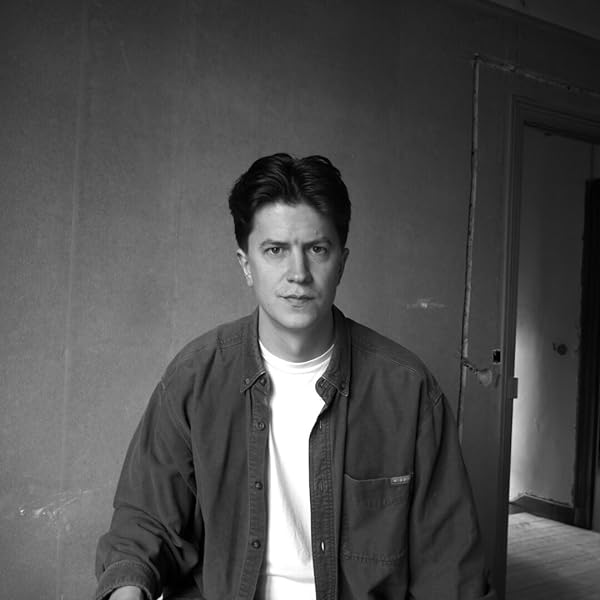
(writer's photo for Roundabout)
I met Will in Madrid at a reading one night. I heard him read from Roundabout and talk about the book before I had experienced it in its entirety. He was thoughtful and the reading was memorable. We stayed in touch and he was gracious enough to answer some of our questions about his process, the people who were instrumental in its creation, and what he was chewing on while writing Roundabout. Released by Relegation Books, Roundabout is a special novel that writers should read and study. They might learn something about writing for a young audience in our ever-changing world. They may come to realize that some of humanity doesn’t change much at all. Here is Will Mountain Cox in conversation with the High Horse:
Roundabout explores issues of space: corners, angles, edges, circles, copses, turning; distance. It explores how the spaces people occupy perhaps influence their relationships and treatment of others and themselves. What is the significance or importance of the quote by Georges Perec at the beginning of the book? As someone who studied City Planning, What made you want to become a writer? Are there any other books in this vein that were influential to you?
WMC: What I love about space, particularly urban space, is that it is the container of community, and as such, for humanity on a scale we can see clearly and understand personally and also play an active part in.
The epigraph for Roundabout is from Perec’s Species of Spaces and Other Pieces: “In short, spaces have multiplied, been broken down and have diversified. There are spaces today of every size and every sort, for every use and every function. To live is to pass from one space to another, while doing your very best not to bump yourself.”
I love that quote because it feels timeless. Times are always changing. There are new changes/fears/traumas/gripes, for every generation, which we are forced to adapt to, blindly, without much actual precedent from the past. Contemporary generations have the newness of the internet to contend with, but there have been mind-boggling changes before us. We’re not THAT special. Basically, we turn corners, arms outstretched, trying to make sense of it all. And if we are being kind to ourselves, the best we can do is be present and aware and adaptable enough not to turn a corner and run smack into our old selves.
One of the reasons I love the roundabout, the real one where the book takes place, is that people are crossing in all directions, on foot, car, moped, and often bumping into one another.
I actually wanted to write before doing Urban Studies. I’d moved to Paris and started a literature mag and was teaching myself to write on the side. Most of my writing seemed to go in the direction of community and people in cities and so when I decided I wanted to go back to school, to better understand communities and cities (also, I needed a visa or I was going to get kicked out of France and so I applied for a scholarship to get a Masters at a French university on the cheap), I found the topic perfect for developing an understanding of what I wanted to write about.
Plus, in France, if you’re a student, even a foreign student, you get access to rent subsidies and student cantines: three-course meals for around €3,50. It was a good way to get by and keep writing when I didn’t know how to write.
My favorite book in the field is The Death and Life of Great American Cities by Jane Jacobs. I’m very into Participatory Budgeting, and that book is the one for learning how to source urban solutions from street-level knowledge and from average community member genius.
Fiction, there’s tons, but some are Milkman by Anna Burns, Joyce for sure (Dubliners, Ulysses), Preparations for the Next Life by Atticus Lish, Winesburg, Ohio by Sherwood Anderson, The Waves by Virginia Woolf, and Another Country by James Baldwin.
Paris itself almost seems to have transmuted into a character, it lives and breathes and has a perspective outside of the friendship group haunting the bric a brac bar. Reading Roundabout, one can imagine Paris putting on a scarf and boots and walking off the page, into a rainy night.
You and Hemingway are writing about a place nearly a century apart from each other, and yet, the ancient romantic feeling lingers. How does a city like Paris differ from an American city? I’m wondering what Roundabout would’ve been like if it was set in Portland, say.
WMC: When I first moved to Paris in 2013, it was very heavily informed by the reading and the cliché love of Hemingway, along with the other American stars of the Parisian 20s and 30s (Fitzgerald, Stein, Miller, etc.). I would be lying if I did not admit to knowing his and their works deeply and that I didn’t come here wanting to LARP the Lost Generation.
And the city does deliver. Paris is, post-Hausmannian 1880’s reconstruction, visually timeless. The iconic apartment buildings don’t change. And though a lot changes in the city, below the surface, the surface is visually reliable. To live in it is to have much of the same visual stimulus when writing setting as those writers had a hundred years ago.
Further, I sometimes feel haunted by that Hemingway, Lost Generation love. When I first moved to Paris, I was given a paper lunch bag full of books, all of which were books signed by Hemingway, French translated copies of his short stories, which I learned were intended for the executor of the Hemingway Estate, who I’d been asked to give them to at the bookshop where I’d been working at the time. One of the inscriptions said, “If you don’t like the ending, I’ll change it.,” which I found cute. All that to say, the cliché was stoked by fateful moments, but which felt like a test: stay obsessed with the past or move on and become your own person.
But regardless, I’m grateful to have had heroes at a young age and to have idealized a romantic history surrounding good literature and the search for intriguing communities of literary productions past. Every generation of writer lives and then fades away and I think we each have a responsibility to both write well and create lore, the lore attracting people to the production of books, stories, poems, etc. We have to hope that the people who are there only for the lore and the fame from the community fade away quickly and that what gets left for the future are a few dozen great books. I think the production of those great books requires hard work and avoiding an addiction to the adoration of the community. Right now, I see a lot of adoration-addicted literary peers building their lore by trying to make themselves gurus. Trying to tell others how to live. Being very prescriptive. But that’s also the narrative of the moment. Prescriptiveness. YouTube coaches and Mindfulness meditators and biased news sources and one party, one issue voters. People are in your pocket and in your headphones advising you how to live, rather than helping you be analytical, rather than helping you be yourself. I don’t like art or literature that mimic the power structures and the control organs of the times. So I’m trying to avoid that sort of writing. I’m trying to avoid those sort of writers like the plague. It scares me. They scare me. Prescriptiveness scares me. And much of our contemporary lore building is tied to it. But I guess those sorts of writers serve a purpose. They build the lore.
Anyway, a few things are at play regarding Paris. My early reading as a young person, and also the city of Paris and its built environment.
I do not live in the Latin Quarter, where much of the Lost Generation Paris fiction is set. I live, and have spent the majority of my ten years in Paris in Belleville-Ménilmontant, in the northeast of the city. They are very different places, but they both have big hills, and small winding streets, and places to hide and get lost in, little alley ways to duck into and kiss in, beautiful views and an iconic park (sub out Luxembourg Gardens for Butte Chaumont). So yes…there are lots of reasons, both biased and objective, that there could be similarities.
I’m happy you think that Paris becomes a character in Roundabout. That was very intentional and something my editor and I worked very hard to highlight and get right, namely giving the roundabout, which is a real place in the neighborhood, the ability to speak and to describe what it sees on a daily basis.
And if Roundabout was set in Portland, where I’m from…I hope it wouldn’t be much different. Maybe some of the language and phrases of dialogue would be different. But ultimately, I think that the story of a Parisian friend group versus a Portlandian friend group would both show similar narratives of people getting older, changing, wanting their lives to be different while nothing changes too much. And both would suffer under the weight and anxiety of our times, trying to avoid the divisiveness of our current culture, both trying not to be ruined by the fictional, anti-human, anti-communitarian dialogues endemic to globalized life in the 2020s.
The drug section is the most visceral chapter and I wonder how much research you had to do to really get the feeling right in that section?
WMC: “Research,” lol.
If I can claim any “research” on the subject, I’m probably pulling from my life in London many years ago, where English people do the drugs in question in that chapter with a certain panache that Americans can’t seem to achieve with uppers. There’s a quote in Tender is the Night where Fitzgerald says something like, Americans can’t comport themselves, that they’re always doing something with their hands or their eyebrows or their mouths. I felt very seen by that quote. I feel like I’m always picking my nose or taking something out of my ears. And it’s like that with Americans and certain drugs, basically.
Anyways, there were many nights when I lived in London where I researched and rode a journey through the night, seemingly above the city, always finding myself in new places, other parts of town, without knowing how I got there. We would lose friends and find them, neighborhoods away, tucked in doorways, having the most interesting and civilized conversations, though gurning their face off. And then we’d be in some stranger’s backyard, lying on a concrete lawn, staring up at the stars. And then we’d be on a night bus, watching out the window as women did yoga on the side of the road at dawn. It was all very confusing and beautiful and floaty.
In Roundabout, the friend group take those sorts of drugs at a time when they haven’t taken drugs in years, and they are probably too old to take drugs, but their friendships are failing and they need something to free them of themselves and let them reset so that they don’t fail, because they’re not allowed to fail. That’s one of the rules of the novel. The friendship group cannot die. I had to fight to make sure of that while I was writing the book.
Eli might be my favorite character because there is so much left to know about him. I enjoyed the commentary from the other characters while Eli is telling his story. It gives us glimpses of these young men and how they are haunted by moments when they became cowards when faced with real substantial danger. What really happened to Eli that day, was he sexually assaulted by the large man who was following him? What is the significance of King Lear in this section?
WMC: It would be no fun for me to tell you what I think happened to Eli on his trip to Dover. But it would also be impossible for me to say, because what happened is Eli’s secret, which he has never told, which becomes clear in his chapter. So I don’t know.
And that’s not to be a Dork about it. I think the novel has to function this way, as a true fictional space, where the lives feel real as possible but they are trapped in fiction. What you read is all there is to know, because that’s where fiction’s responsibility stops, and it’s your job to decide what happened, happens, or doesn’t happen. This novel is not autofiction and I am not pulling from my life. Eli is a character I invented. In that the book is based on a group of friends who assess one another constantly, I tried to consider anything I included in the text as coming from that place. So Eli knows and we don’t and that’s the point, for me at least.
And in regards to King Lear, I’ve never read it. But Eli has.
Can you talk about the male characters in your book and how they deal with their masculinity in Roundabout. How does masculinity play into you rendering your male characters…
WMC: Writing/talking about “Masculinity” in fiction, now, feels very confusing and like a minefield.
I guess what I can say is that I’ve found it funny/sad how short-lived the exclusion (read: reduction in preferential treatment) of men/masculinity (*from the male author’s perspective) from literary publishing and its overarching conversation has been. There were what?, 5-7 years there where men and masculinity were put to the side, in order to make space for underrepresented voices/subjects, only to have “Masculinity” get a new moment now, from the same tired perspectives that were just put to the side, only now allowed back under the guise that they (male writers) are literally considering “Masculinity” when they are writing their stories.
I’ve had lots of conversations with boring boys saying they are going to write a great book about their “Masculinity” only to do a big reveal in it about how they kissed another boy once.
I’m not into politicizing fiction. I think I’m very libertarian/laissez-faire when it comes to what should or shouldn’t be published. It’s a business at the end of the day, and the reader will decide what is good. It’s up to the writer to write something great. For the publisher to be brave enough to find a way to sell it. The marketing/pr to be creative in how they tell the story of a book. I think a lot of the dialogue about “writing masculinity” comes from the fact that a lot of guys were
writing boring books, total snoozers, and that male writers need to write better and find ways forward in what they are writing about. Blah blah blah.
I think, with all the worries about “our unprecedented times,” one of the coolest developments is how good the average person has become at sniffing out authenticity/inauthenticity. We are like truffle pigs for the inauthentic. In Roundabout, I tried to write real characters, that readers believe, who have true faults that we can love and hate and pity. Some are men and some are women. Some of the men have better grips on their masculinity than others. Some do fucked up things while others don’t.
I guess that might be why I decided to write Roundabout in the 3rd person. Because our relationship with the “I” seems very confused and prescriptive at the moment, while our relationship with the character analysis of others is very honed in right now. So rather than feeding junk to our worst habits of the “I”, it felt more interesting to try and think up a range of characters and let the reader judge what they think masculinity is.
Talk about the idea of utopia and the last story…? I think everyone can relate to this. Why are ideas like this doomed?
WMC: In the last story, one of the couples of the friendship group buys a house in the countryside and hopes that all their friends will move out there with them and live on the land together in little huts, using the actual house as a shared space. As they imagine it, it all goes to shit.
One of my favorite failed utopias are the Perfectionists from the Burned-over District of Western New York, circa the early 1800’s. (These are the ideas that Mormonism was born out of). They believed that because they were created by God, they could not sin, and so guys like John Humphrey Noyes started utopias with really kinky bylaws that allowed for wife swapping and various other illegal and debauched ideas. Talk about “Masculinity.” Like in Roundabout, though far more wildly, it fails. Now that Perfectionist branch of failed utopias makes some of the best forks and spoons in all the world. It’s called Onienda Flatware.
I think ideas like these are doomed because the difference between two humans’ hopes and dreams, limits and wishes, hates and loves, are so volatile and change so much across a lifetime, that it takes incredible labor to keep them running on a single path. Unions fail 50% of the time in two-person marriages alone. Trying to keep people together for a prolonged period of time is a shitshow.
Can you talk a little bit about being a poet and an artist in general? What made you attempt to write a novel as your first offering? Is there a poetry collection of yours floating around Paris or Portland?
WMC: Roundabout was not my first attempt at a novel. I’d written one novel, dozens of short stories, and hundreds, maybe thousands of poems prior. Most of which were not good. Roundabout came after I failed to get a much bigger, longer, more complex and probably not very good novel published. In that grief, I tried to decide what to do next and an idea for something shorter, tighter, more open-ended had been knocking around and that felt manageable in the grief of not achieving what I’d set out to do the first time. And that shorter, tighter, open-er novel was Roundabout.
As for poetry, there are definitely enough out there to make a collection. I guess I write poetry in between fiction projects, as a way to be more free, and to train new directions for prose styles I want to do in the next novel. It would be a dream to publish a collection some day. I would love to publish a collection of love poems.
And as for being an artist in general, I don’t really know what to say about that. I like to get up early and write in the morning and then try to figure out how to make money to pay rent in the afternoon.
Tell me about your association with Relegation and Dallas Hudgens? How did you two cross paths?
WMC: I was introduced to Dallas Hudges by Lauren Cerand (see below). We first met in 2018 when we decided to work on a book about art. He wanted to publish a book that was linked to a community and I wanted to produce a book that highlighted Parisian artists living, now, and what sort of things they were making, and what if any themes were defining contemporary art coming out of Paris in the late 2010s. That became the book “With Paris in Mind.”
Dallas does something very magical in that he is simultaneously very supportive and very hands off. He sets interests and ideas that he wants the projects he produces to be founded on, then lets you interpret and take those interests/ideas in the direction you see fit.
He is a writer and musician as well, and I think that informs how he handles his authors. There are very few deadlines and very little pressure, but in leaving so much space and providing so much support, there grows this self-induced pressure to make your writing as good as possible, because you’ve been given all the tools you’ve ever imagined needing to succeed. To fail or produce badly would be your fault alone. It’s a very pleasant and interesting pressure compared to what I hear coming out of other writer-publisher relationships.
You have dedicated Roundabout to Lauren Cerand and Giancarlo DiTrapano. Then, on a separate line, you write “and always for ï”…
Who is Lauren Cerand? What was her relationship to this book and to you?
WMC: Lauren Cerand is my friend. She has also been the publicist on both my books, in that she works with Relegation Books. She has been a literary publicist since the early 2000s.
Lauren and I met fortuitously. When I moved to New York in 2014, for a year, I had lied my way into becoming a waiter at a restaurant that was competing for its first Michelin star at the time. It quickly came to the manager’s attention that I wasn’t a very good waiter and so I was relegated to the day-time lunch shift. I had been hired, I think, because the owner was involved in the publishing industry and liked that I ran a lit mag. They would trot me out when they had literary people eating lunch and tell them I was a young publisher.
That is how Laruen and I met. I waited at her table, and we chatted while the appetizers got cold on the pass (hence bad waiter) and she invited me to a party at her house and we hung out a couple times, but I moved back to Europe shortly after and we fell out of touch. Then I moved back to NY in 2018 while I was trying to pitch a few different books I had written and we got back in contact and have been friends ever since.
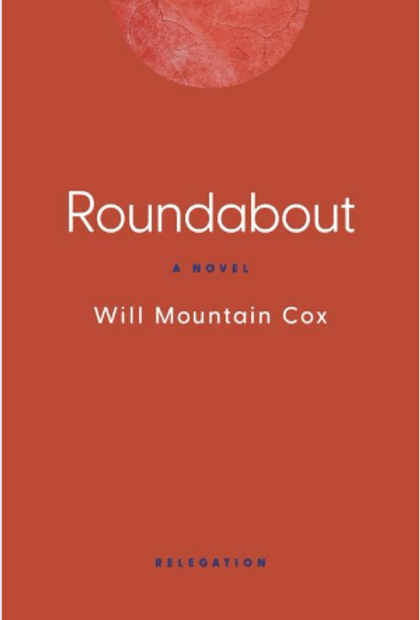
In regards to Roundabout, she is solely responsible for the look and feel of the book. She wanted to take the book in a simpler, 70’s/80’s direction: clean covers, big author photo. She also wanted to cut all blurbs and pre-publication reviews to remove the nepotism and favor-peddling that everyone is aware is inauthentic. That was a scary notion, but I have found it very freeing and the book to be simpler and more beautiful because of it.
Who is Giancarlo DiTrapano? What was his relationship to this book and your relationship to him?
WMC: Giancarlo is the late publisher of Tyrant Books. I met him in 2018 when I found myself staying at his house in Sezze for 10 days, on my way back to Paris, invited by Lauren, who was Giancarlo’s friend and worked on many of his books.
I came to literature late, through the European context, and was not very online, so I didn’t really know who Giancarlo was, except that I was a fan of Scott McClanahan’s writing. So I knew him that way.
I had just signed the deal for my first book, so I was working on that during the days. And Giancarlo was working on the release of Babak Lakghomi’s Floating Notes as well as the cover for Megan Boyle’s Liveblog. He was very excited for both. He kept having me stroke the different Liveblog cover proofs, while he promised that it would win cover awards.
We didn’t really talk about books or writing at all and really just sat by his saltwater pool at night, making friends, singing Stevie Nicks, giggling, making “Fleetwood to the Max” jokes.
But one day we all took a boat ride from Latina out to Ponza and the islands around it. And at one point we pulled up to an island that had this tidal cave and Giancarlo said, “we gotta see that cave” and told me to follow him. We jumped off the boat and swam for the cave. We chilled out in the cave for a long time as the tide was coming in and the water level was rising, which Giancarlo seemed to think was dangerous and cool. And in the cave he told me all the secrets of writing: how characters should be, how style was the top top thing, what he thought of agents, how a writer should treat themselves, etc. Then, just as the cave was filling with water, he laughed and took a last deep breath and swam out of the hole like a mermaid and I followed, a little nervous about drowning.
Obviously, I was smitten. And decided I would write a book for Giancarlo one day. Which was my goal for Roundabout. To impress Giancarlo and get him to publish it.
I sent Roundabout to him three years later, in early 2021 and he wrote back asking for my phone number and then I didn’t hear from him for a while until he texted me saying “this is the FEDs” and then he texted some really incredible things he thought about Roundabout, and the ideas he had for it (mainly that he wanted me to focus more on Eli and take it in his direction). Then he said we would talk about it more when he got back from NYC where he was getting ready to launch Sean Thor Conroe’s Fuccboi. And then he never came back.
So I was heartbroken, for his family and his friends because it sounded like they loved him so deeply, and for me some, sure, but mainly for the whole game. Because Giancarlo was a beacon that we could follow. And also that he was so cool that “cool” didn’t matter to him, so cool lost its power and he was simply able to publish what he thought was good. Without him, it feels like cool has become dangerous in the publishing world.
Anyway, I couldn’t touch Roundabout for at least a year. But I also couldn’t write anything new. And that sucked. But one of the things Giancarlo told me in the cave was that “a writer needs to sit down and shut the fuck up and write.” So, eventually, I got in contact with Dallas and he helped me get past the blocks.
We didn’t take the Roundabout edits in the Eli direction because that was Giancarlo’s direction and I didn’t want to go that way without him.
But I’ve held on to the messages and emails that Giancarlo sent me about Roundabout because they make me feel like I impressed him, and that was my goal since the mermaid cave.
Who is ï?
WMC: ï has to be written lower case and with the umlaut. ï is the love of my life. The truest person I have ever met. ï is better than any character I’ve read or written. I dream of writing a character as good and complex as ï, but I know I won’t be able to, but I’ll try.
Lauren, Giancarlo, and ï form the holy trinity of Roundabout becoming a book. And Dallas is Paul, spreading the word. Lol. Jesus. Sometimes you have to laugh at yourself for how lame you can be.
I also find the ï with the umlaut to be a very poetic character.
9. What were you reading / Listening to / digesting while you were writing and editing this book?
WMC:
-Lydia Davis
-Greek tragedies (I wrote the first draft during lockdown, so I had lots of time) -Breece D’J Pancake
-Hill William by Scott McClanahan
-Virginia Woolf
–Cassandra at the Wedding by Dorthy Baker
-How to be Both by Ali Smith
-in our time by Hemingway
-Closer by Denis Cooper (during the editing specifically)
-All the news about Covid online.
-I was drinking a lot of red wine and smoking a lot of cigarettes.
-I had just met ï, so I was also falling in love.
 High Horse