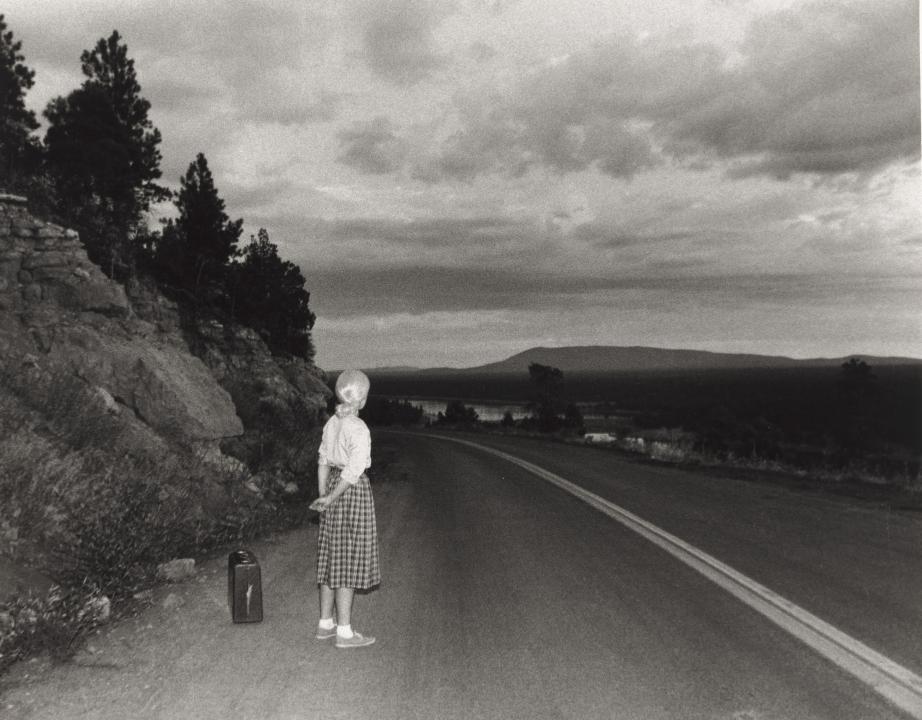
(Cindy Sherman Untitled Film Still #48)
After three decades of reading almost exclusively fiction—often American, mostly experimental—I devoted my 2024 reading time equally to poetry and prose. To make up for years of neglecting the poetic medium, I immersed myself in an inordinate amount of scouring: micro presses, Substack pages, and small mags. The online poetry community is staggeringly vast, and although the task initially felt overwhelming, indie magazines with reliable editors and impeccable taste have made it remarkably accessible—High Horse, of course, but also No More Prostitutes, Expat Press, Swamp, Spectra, Annulet, Antiphony or Blue Arrangements among others. Below is a selection of my favorite chapbooks/short collections from young poets whose work has circulated from pub to pub throughout 2024.

Francesca Kritikos, Sweet Bloody Salty Clean, Feral Dove, 2023.
“I’m easy / to take blood from // I make only / expensive mistakes // I’ll kneel / for the bruises // I’ve never lied / less than this”
Editor-in-chief of Sarka, one of the most exciting online journals, Francesca Kritikos stands out as one of the most compelling young voices in online poetry today. Her work, both as an editor and poet, is defined by its rawness and its uncompromising engagement with the flesh. Her poems are the literary equivalent of striking a match at a gas station—dangerous, yet irresistibly alluring.
In Sweet Bloody Salty Clean, Francesca Kritikos demands a pound of the reader’s flesh in exchange for a pound of her own. This collection tells tales of a body repressed and mistreated, navigating the delicate line between ripe and rotten. At its core lies an insatiable hunger. Contradictions bloom within the dark, threatening void of what could be a form of unleashed womanhood.
Through poems that echo the fragmentation of 21st-century social structures, Francesca Kritikos challenges readers to find solace within a fractured human community—one that condemns women to a life of restraint, fearing the uncontainable, untamed freedom they might otherwise embody.

PJ Lombardo, Hate, Dance, Bottlecap Press, 2023.
“I open the sun And the pain pours down / Like a sallow wince in the grim midwestern / City after all the factories evacuate A ghost town / Crowds flash like knots of teeth I open elevator doors / The sun the pain pours down a curl in / My heart pleads for silker pasts Millions”
Hate, Dance was the first chapbook I read this year—and it set the bar astonishingly high. PJ Lombardo is one of the poets I use to measure the quality of an online magazine: if they’ve published him, they probably have great taste. Lombardo is also the co-editor of Grotto, which has showcased poetry by great voices such as Tamas Panitz, Jenkin Benson, and Mike Bagwell.
Hate, Dance is a hallucinatory journey into poetic ecstasy, frequently flirting with the sublime. Lombardo’s invitation to “peer inside the swamp” is as enticing as it is disorienting, drawing readers into a landscape brimming with vibrant sights and sounds. The poems ricochet off one another, their repetitions transforming into secular prayers to life’s grand nothingness. Here, poetry becomes the most intimate form of language—the only medium capable of articulating excess, whether carnal or philosophical.
Lombardo’s poems challenge us to engage with them, to chew them over and spit them out before they consume us. Amid trash cans, frenetic cities, “dilapidated beaches,” and mud paths, his work unfolds as a dazzling visual and sonic carnival—a chaotic, electrifying, and unforgettable experience.

Léon Pradeau, Snow of Snow, Bottlecap Press, 2024.
‘I went back home — that means, travelled back to familiar things / there is no French for “home”, but I stayed long enough to feel / the texture of the word —,’
I bought Léon Pradeau’s Snow of Snow after meeting him at the Parisian release party for Transat’, the bilingual journal of poetry in English and French that he founded, last June. I was immediately intrigued by this young poet’s bilingual writing practice and his distinctly bicontinental mindset and work ethic. I devoured the chapbook on the metro ride home—feeling, in that moment, as though I truly made his acquaintance.
Reading Snow of Snow is like witnessing Léon Pradeau becoming the poet he is today. Readers familiar with his linguistic experiments in Vaisseau instantané/instant shipping (les murmurations, 2024) and This Is It (Antiphony Press, forthcoming in 2025) might be surprised at first by the chapbook’s opening pages. Its rather traditional—though compelling—form and content initially contrast with the boldly experimental style he is known for. Gradually, however, as the eponymous snow saturates the poetic space in the form of blanks and silences, Pradeau begins to weave sound and visual games that blur the boundaries between flesh and machine. In doing so, he shapes a poetic language that I now recognize as uniquely his own.
An ode to the bittersweetness of fragmentation, Snow of Snow is captivating and serves as a perfect introduction to Léon Pradeau’s evolving body of work.

Corey Qureshi, What You Want, Dead Mall Press, 2023.
“What You Want / is put through / a set of compromising, / cringing scenes, / an assortment of degradations / that only you know about”
Corey Qureshi is the editor of Boxx Press and the author of three chapbooks. His brash poetic persona and discerning editorial taste mark him as one of the most intriguing voices I’ve encountered online.
What You Want is his latest chapbook and his most accomplished collection. It brings together his fascination with the absurd and the mundane into a unique brand of obsessive poetics. Qureshi delves into reported speech and raging monologue with a stance that is both grave and comic, echoing back the alternating significance and emptiness of words exchanged with peers, bosses, and neighbors.
His keen attention to pacing and mastery of the clipped verse—a form many poets attempt but often fail to make impactful—stand as testaments to his purposeful engagement with contained rage. Yet, when that rage explodes, the tongue accelerates, trips, and fractures with a terrifying, deliberate force. Elsewhere, however, the line is tender, inviting, serene—offering both poet and reader a moment of reconciliatory stillness.

Ulyses Razo, Murders & Other Poems, Ghost City Press, 2024.
“and my hair feels like a tongue / on my forehead. now my finger / does what it wants with your lip”
Ulyses Razo’s poetry has been everywhere in 2024. It has appeared in nearly all the indie magazines I read regularly. His work is heartfelt and raw, yet always elegant. His latest prose poem, “Mariana Trench is a Beautiful Name for a Baby Girl,” published in Dreamboy Book Club, is a topical and impactful meditation on displacement—a deliciously meta depiction of loneliness expressed through a Gen Z stream of consciousness. His voice drifts in and out of society’s slumber, rebelling with a steady, subdued whimper.
In Murders & Other Poems, Razo writes about love with remarkable delicacy, imbuing his poems with a sense of suspension, a floating quality. Yet this softness never veers into naiveté or, worse, feigned ingenuousness. His poems are pared down—language and metaphors honed to the point of submission. By substituting one word for another, he disrupts easy metaphors, forging images of greater power and complexity.
Razo’s poetry is deeply embodied, rooted in the minutiae of an existence spent in feeling. Even when he writes about writing, he does so through the lens of lived experience rather than detached reflection. This gives his work an authenticity and weight that are impossible to ignore.

Sam Robinson, New Age of Self Help, Bottlecap Press, 2024.
“Beauty -feel- supply / fourteen heads innawindow / nine on the other side & headless / torso— hollow, graal, instrument, boat / glided over the face of the waters— conscious / vessel, ship, emptying, cup”
I first encountered Sam Robinson’s writing through his “Affirmations,” some of which are featured in this chapbook. Today, I take pride in having read most of what he has published, and I delight in seeing him emerge as one of the most striking voices in the young indie scene. His poems are ecstatic meditations on life, ambition, and creation, written in a passionate, emphatic language that draws as much from philosophical essays as from his own vernacular.
In New Age of Self Help, Sam Robinson challenges the constraints of the page with a kaleidoscopic ode to life and language. He exploits every potential of his lexical choices to craft polysemic addresses, commanding the reader to engage fully with his words. Scarred by knowledge and nourished by the rotten core of life, Robinson’s poetic persona radiates excruciating power and beauty, delivering an intoxicated and intoxicating dialogue with Nature.
His affirmations, infused with philosophical proclivities, become true performative reckonings against enclosure—favoring instead the open expanses of the road or the ocean. There is an elemental force that escapes from Robinson’s poetry: an overwhelming compulsion to articulate desire in its purest, most embodied form. Through sound, rhythm, and verse, he captures this urgency, forging a language that feels both primal and profoundly intellectual.

Lana Valdez, I Rot, Filthy Loot Press, 2023.
“I want to tell her / that she’ll be far away before the sky pours fire / and ash onto our heads, / that the highway will one day crumble and / make a bone graveyard out of our taxi drivers / but she is already gone”
I was introduced to Lana Valdez by Hank at High Horse and could hardly believe I hadn’t encountered her poetry online before. A “naive poetess,” as her Instagram handle proclaims, Lana Valdez is a kind of anti-John Doe, writing womanhood in blood letters, with all the urgency and immediacy of Californian youth.
In I Rot, she explores the terrible and beautiful things young America is capable of. Ageless in many ways, the poetic voice in this collection recounts tales of loss, (self-)hatred, and a melancholic longing for a golden age that never was—and never will be. Valdez’s talent truly shines in her prose poems and short fictional fragments: visceral, coming-of-age vignettes set against the backdrop of seemingly comforting communities that rapidly become threatening.
A dark, violent thread runs through the collection. Lana Valdez’s girls bruise easily but strive to mask it with dignity, even as they’re haunted by the ghosts of what they once were and of the monsters hiding under their beds. And then, in the quiet spaces of her poetry, they begin to rot—slowly but inevitably.
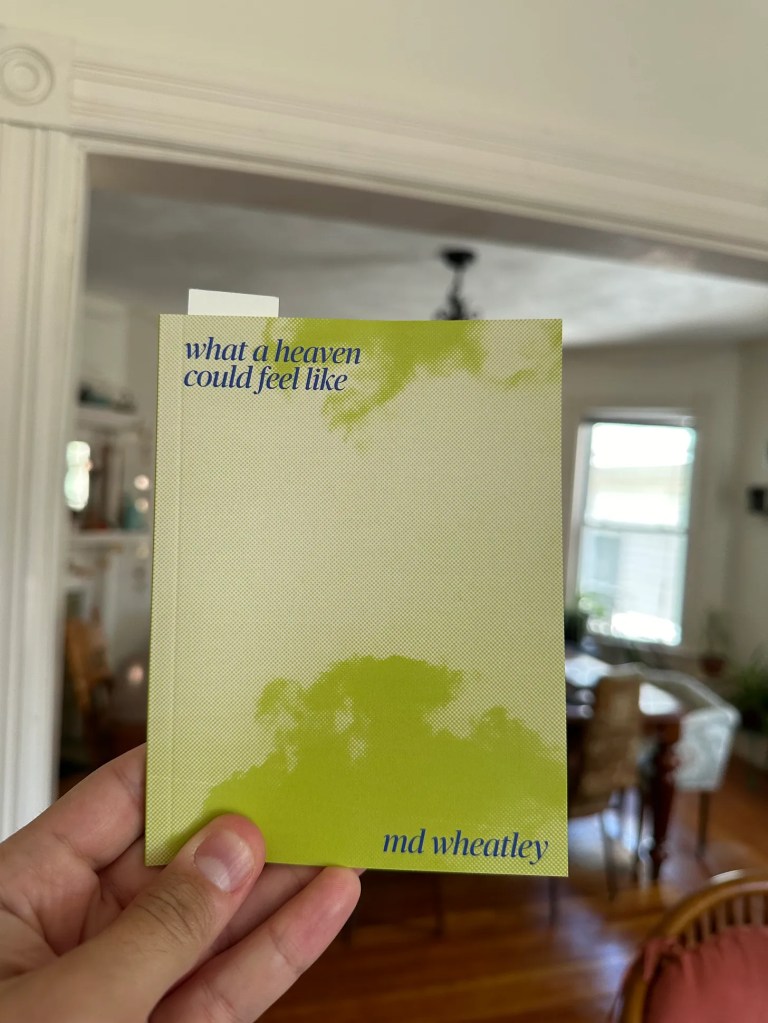
MD Wheatley, what a heaven could feel like, love for sale, 2023.
“thumbnail sketch the overall feeling / and i’ll teach you how to drown too / i want to know exactly how you felt / with no discrepancy in the shade of blue”
MD Wheatley’s what a heaven could feel like, a 35-page collection, is the most compelling short book of poetry I’ve read this year. I first encountered him as a fiction writer and admired his stories, which always seemed to teeter on the edge of danger or insanity—leaving you with a lopsided grin and a host of questions. His fiction often revolves around young men inhabiting American spaces—stories about their skateboards and their strange, precarious lives.
Wheatley’s poetry is unmistakably in dialogue with his prose. Comprised of haikus and other very short forms, what a heaven could feel like is a poignant exploration of growing up. Bittersweet and unflinchingly honest, the collection examines the multifaceted nature of change through the dynamic potential of poetic rhythm. As the poems progress, their imagery becomes increasingly abstract, inviting us to confront the pains of adulthood in all their raw intensity.
What makes this collection a luminous reading experience—despite its exploration of loss and grief—is Wheatley’s extraordinary ability to hold space for intense emotions. His poems, pared-down yet brimming with resonance, colloquial yet profoundly delicate, offer readers a quieting, almost healing experience. They allow the reader’s own subjectivity to echo within the text, providing moments of catharsis and reconciliation with the self.
Maud Bougerol researches and teaches contemporary experimental American literature in Aix-en-Provence (France). More of her writing can be found here on High Horse, Antiphony and at Dancing on the Palimpsest on Substack. She will be one of the two 2025 guest editors for the poetry journal Transat’. She lives in Marseilles.
 High Horse