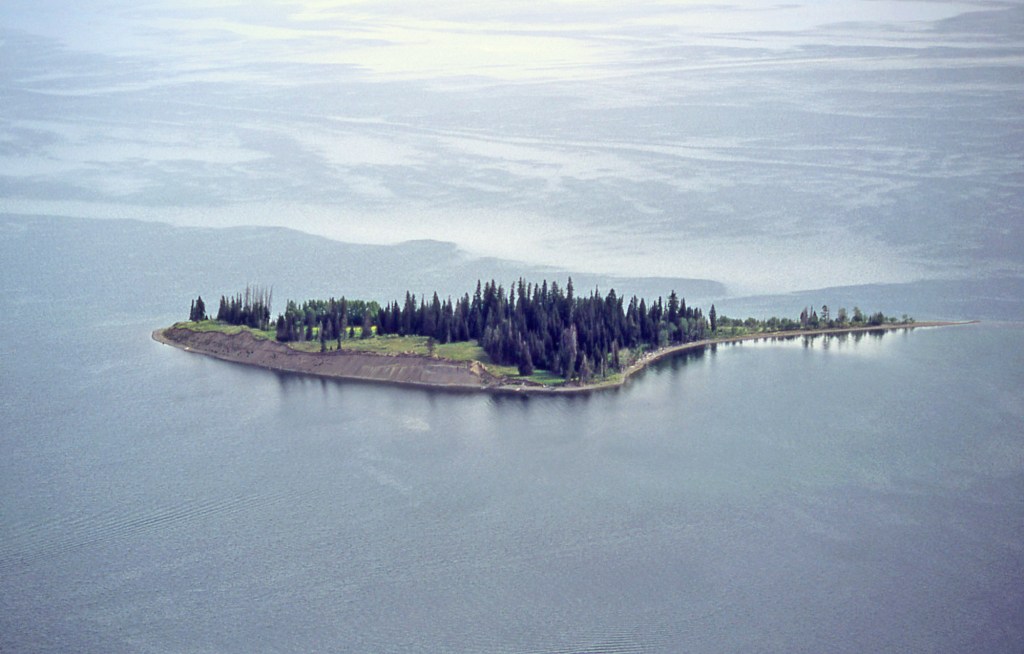
The island should have better security. It’s a cozy dollop of granite and spruce in the middle of Drunken Dragoon Lake, in the shadow of some suitably jagged peaks, not far from the village of Alaric, Wyoming. The nameless island is supposed to be haunted by the gentlemanly ghost of the lake’s eponymous drunken cavalry officer, which of course only adds to its charm. Money recently sloshed out of Jackson Hole and built a ridiculous hotel on this island. The hotel is gravely Japanese in its design, and expensive enough not to show up on your travel booking portal. I suppose they didn’t bother to secure the island because it would be absurd if, for instance, I were to moor a boat here so that Gloria could do what she has taken to calling Plausible Deniability.
“So you’re sure there aren’t any guards who come out to this dock?” I say to Gloria as she leaps ashore with enviable grace.
“Yes. I got a junior manager absolutely hammered. He told me everything. They don’t do patrols. They just have some kid who hangs out at the front desk and usually falls asleep. And the security system malfunctions all the time—as it will tonight—and no one cares.”
“And if you see the famous ghost?” I say, hoping I sound jocular.
“Then I will ask his blessing for my mission.”
Gloria flips up the collar of her bomber jacket against the late-spring chill. If she’s nervous, it shows only in the chiseled edges of her rehearsed monologue.
“So, 15 minutes?” I say.
“Probably less,” she says.
“But that’s the time limit?”
“Limit? Do you have somewhere to be?”
I shake my head with false ruefulness. This is how we’ve always bantered.
“If anyone asks—which they won’t—I’m just visiting a client,” she says.
“You know this guy.”
“That’s right. And that’s already more than you should want to know.”
“Plausible Deniability,” I say. “You don’t need my help.”
“You’re doing more than you know by waiting here with the boat.”
She doesn’t kiss me before she turns and walks up the path to the hotel. We’d been on-again, off-again for a while. Now it seems as if we might be forever off. But we remain dear friends. Gloria is my ideal drinking buddy. The older I get, the more I appreciate how hard such a friend can be to replace.
Soon she’s invisible against the silhouette of the hotel, an indigo rectangle set against the spruces. The midnight sky is cloudless and resplendent with stars.
What I want to say is, There was a time I imagined we’d have our honeymoon at some stupid place like this. But that would be too much to say out loud even when I’m all alone. Instead I say, “I wish I could do more.”
I stand in the gently bobbing boat and light a cigarette. I feel rather cool in my black overcoat, wool ballcap pulled low, taking drags. The night wind is exactly strong enough to feather the tails of the coat and pull away the smoke without threatening my ember. If I position my feet to stand firm yet nonchalant against the sway of the boat, and if I exhale my smoke with calibrated insouciance, maybe I can be the right man to ferry Gloria to and from Plausible Deniability.
“So you’re not going to help the lady? Some gentleman you are.”
These words come from behind me. I almost tumble into the lake.
“My apologies” the voice says. “I do forget that my footfalls are silent.”
I compose myself into what I’m meant to be tonight. Then I turn and regard a tall, straight-backed male stranger. In the moonlight reflecting off the water, the dark mustache against his pale skin is as thick as a wolverine’s pelt. As is his tassel of longish hair. He wears some kind of black or dark blue hipster getup with elaborate tailoring and metallic buttons down the front of the coat. He smiles with the self-assurance of a man who knows what he’s doing. I try to match his posture before speaking.
“She doesn’t need any help,” I say.
I immediately regret acknowledging there even is a ‘lady.’ Gloria would not be pleased.
“I’ve found, in the course of a long and, if I may declare, storied career, that those who most evince a lack of need for help are often also the most grateful when help is skillfully given.”
“You don’t know my friend.”
The stranger’s accent is unmistakably American yet still alien. Raspy yet luscious. It reminds me of some East Coast archaism you might get in a movie featuring Daniel Day-Lewis.
“So I’ll tell you what we’re going to do,” the stranger says. “We’re going to help the lady.”
The stranger extends a foot clad in a high leather boot and lopes into the boat with an agility that would shame even Gloria. I consider telling him off, but as he enters the boat, the sheathed saber at his waist rattles, announcing itself as a threat. The stranger sits aft in Gloria’s seat. He grins.
“I assume,” the stranger says, “that, being a gentleman, you are armed and prepared to do what is needed?”
The arrival of a ghost doesn’t excuse me from helping Gloria. Having had too little responsibility in my life thus far, I now take satisfaction in discovering the calming powers of performing your duty to someone else. It turns out to be easy not to be afraid when you know what needs doing.
“Who are you?” I say. “And ‘we’ aren’t going to do anything. I am going to do what I’m here to do, which is stay with my boat.”
“Forgive my rudeness,” the stranger says. “I’m Captain Edgar Haldercotte, lately of Auburn, New York and the United States Cavalry.”
He extends a gloved hand. I take it and feel nothing except a vague tingle.
“Derek,” I say, “of Bridger, Wyoming. So you’re the ghost of the cavalryman that haunts this island, I suppose?”
“You’ve got the right of it,” the cavalryman says. “Your acuity assures me that you’re a man of action, capable of doing what must be done. So, will you join me in aiding the lady, or not?”
“Her name is Gloria,” I say. “The ‘aid’ she wants is for me to wait here, and to drive the boat when she’s done.”
“Why couldn’t she manage the boat herself, if that was all she wanted?”
“‘One less thing to think about’—that’s one of her favorite phrases.”
We both turn as a light flicks on in the hotel. A single window on the upper floor, a melted-butter yellow coming from behind blinds. Is that a faint sound of something heavy being dropped? The night quickly returns to silence as the light flicks back out.
“Come on, my comrade,” the cavalryman says, “we dawdle.”
The cavalryman draws his sword in a graceful arc. The blade glitters in the moonlight. He turns to me, sword raised, his grin now carnivorous. He raises one boot onto the dock and prepares to lever himself up. He will be expecting me to follow. I imagine Gloria when she sees this mawkish ghost storming into Plausible Deniability with his sword drawn, me tailing behind like a helpless pup.
Right as the cavalryman springs from the boat, all his weight balanced on his shoreward boot, I yank him backward by the tails of his blue coat. The coat feels like eddies of warm air against my fingers. We tumble into the boat in a din of curses and sloshes and creaking moorings and clattering blade. The cavalryman sprawls weightlessly on top of me. It’s as if his body is only an electrostatic charge coursing over me.
“Scoundrel!” the cavalryman snarls as he levers himself up. He positions his sword for a downward thrust into my abdomen as I lie prone on the deck.
“I don’t believe you’ll do it. Maybe you can’t do it,” I say.
I’m unsure where these words come from. Perhaps I just don’t accept that I could be murdered by a needy ghost.
The cavalryman pulls his sword hand back a tad farther, as if to call my bluff. Then he stands and lowers his blade. He looks gray and flimsy, as if all the vitality he had to tried to conjure into being by summoning me to acts of bravado has drained and left him a spectral husk. Perhaps this is how he usually looks. Perhaps he needs suckers like me to embody his ephemeral grandiosity.
“Do you see this?” he says as I scramble to my feet, nodding at his drawn blade, which gleams in the moonlight. “I have killed 17 men with this blade.”
“You expect me to believe you killed 17 men with a sword, and the blade never chipped or broke?”
“I did have it replaced once. At Fort Laramie.”
“And these 17 men, were they all Lakota or Arapaho?”
“Some were. Some were rebel Sesesh. One was a renegade Mormon.”
“I don’t believe you killed 17 grown men in a fair fight, with a sword or a gun or anything else.”
If it’s possible, the cavalryman looks even more wan and insubstantial, as if he’s flickering into two gray dimensions.
“What would you know of it?” he says in the tones of a sulky child.
“I don’t really have any ambition to kill anyone.”
“Is that what your lady is pursuing in there? Is she killing someone?”
“She’s not ‘my’ lady. And I don’t exactly know what she’s doing. That’s why she and I call this little excursion ‘Plausible Deniability.’”
“Your brief existence on this mortal earth is slipping by faster than you grasp, without you even understanding what’s happening around you—let alone taking the reins of your own fate.”
“That’s some grandiose rhetoric. Did you hold the reins of your fate?”
“I did my level best.”
“The story, if I recall it correctly, says you tried to slash a brother officer with your sword over your gambling debts, while blind drunk, and were shot for your trouble.”
The cavalryman sits. He doesn’t contest my history of his demise. He simply folds into himself, looking smaller, almost elfin, his sword dangling limply at his side.
“You are correct. I can’t kill anyone anymore, in this phantasmal guise, without the help of someone like you. If, however, you take my sword, you will find that, in your meaty hand, it remains suited to purpose.”
The cavalryman stands with a flourish, brandishes his sword, and then dexterously flips it so that his gloved hands grip the blade. He offers the hilt to me.
“Take this,” he says. “And go assist your lady.”
I grasp the hilt mostly so I can learn what a ghostly sword feels like. It’s solid and heavy as the cavalryman lets go. The leather of the grip is appropriately oily and worn. In spite of its heft, the sword seems well-balanced. It’s easy to imagine swinging it with the passable grace with which I once wielded a tennis racquet. It’s tempting to believe a blade like this could make me more than I am.
There was a time when being bidden to heroic feats by a dashing ghost would have confirmed that I was special as I hoped. I would have taken the gleam in the cavalryman’s eye, and the pleasing weight of his sword, as all the indication I needed of my interesting place in the narrative weave of the universe. Holding this sword, I realize for the first time I no longer need—want—to be that character in my own story.
“If I storm in there with a sword,” I say, “I won’t be of any use to Gloria. Grand gestures may appeal to a cavalry officer, especially a long-dead one, but my life isn’t about grand gestures. Not that I even know what it’s about. But tonight, I’m doing what’s needed, not some fantasy of what makes for a great story. That has to be enough.”
The cavalryman curls his fists at his sides, as if he might strike. He fumes out a breath that quivers his mustache. I level the blade at him in warning. Can any blade, even his own, harm this ghost? He ponders the sword as if encountering it for the first time.
“I happen to know that Gloria believes you to be a lily-livered milksop. And I also happen to know that she’ll be favorably impressed if you do as the ardent-hearted cavalry officer before you urges.”
Because I have so often feared that Gloria finds me weak—and insignificant, and many other emasculating maladies besides—I have an urge to strike out at the cavalryman with his own sword. I also have an urge to run after Gloria and prove a point I couldn’t even articulate in words belonging to me. But I do neither. The most generic fears don’t need to be mine. I steady my sword hand and grin at him thinly.
“You can’t even wield your own sword properly without me. You’re just a silly old story. To react to you would only be to give in to my own stupid fantasies.”
The cavalryman gulps. The faintest apparitional sweat forms a moonlit sheen on his brow. I’ve already done him a great courtesy by taking him seriously enough to mock.
“If you won’t seize the reins fate has put in your hands,” he says, “perhaps you have the courage to run me through.”
The cavalryman lowers his gaze in a plaintive gesture of defeat. I half-expect him to begin opening his coat to give me a better target.
“Are you serious?” I say. “Will this blade even do anything to you?”
“Nothing to be lost in the attempt. Though I couldn’t say, since no one else even got to the stage of pointing my sword at me.”
“So that’s the real test, huh?”
“Thrust with all your strength. I can join my dearly missed horse, Appomattox.”
A man’s voice cries out from somewhere in or around the hotel. The cry is so brief that it could plausibly be any number of other sounds. Another light flicks on, in a different room, and just as suddenly flicks off. Then a yapping bark from near the same place, as if from a small dog. Or perhaps a fox, if they can swim out this far.
“You’ve missed your chance,” the cavalryman says with dour satisfaction.
The smudge of Gloria is trotting toward the boat and growing more distinct. She moves quickly but without panic. I decide to do the same.
I toss the sword overboard. It makes mercifully little sound and disappears right away beneath the inky water. The cavalryman gives a stricken groan. He dives in after the sword. He shimmers out of existence without disturbing the surface of the lake.
“Let’s go,” Gloria says, leaping into the boat.
What I need to do couldn’t be clearer. I undo the moorings and start the boat and take us back toward Alaric with decisive yet unharried speed. Gloria sits aft with her usual poise, which tells me that the night has gone perfectly. There will be plenty of time, once we’re back home, to tell her about my amusing dream.
Connor Wroe Southard is a writer based in his hometown of Laramie, Wyoming. His fiction and non-fiction have appeared in Typebar, Blood Knife, Victory Journal, The Outline, Splinter, The Awl, and many other outlets. He writes the newsletter A Lonely Impulse of Delight.
 High Horse
Leave a comment