
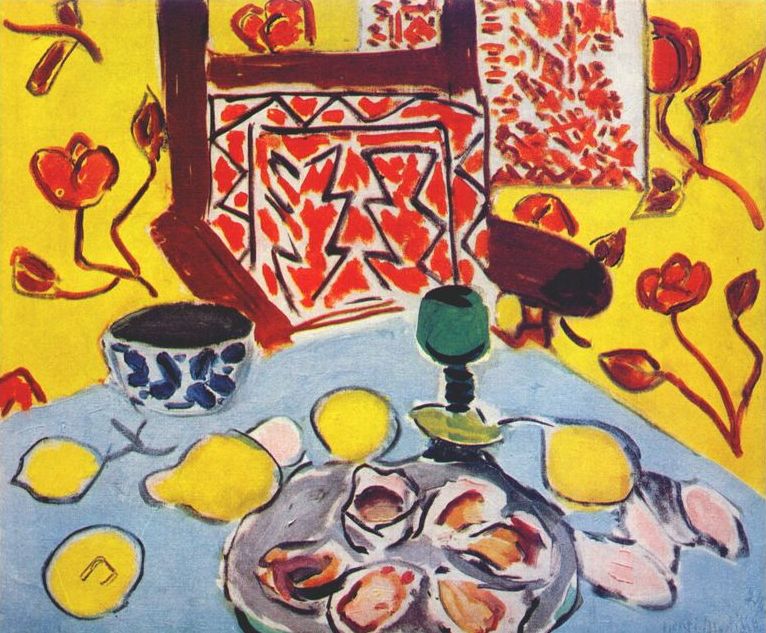
Matisse, Oysters and Wooden Armchair, (1943)
A painful, and rather fungal condition has made its way to my nail beds. The constant exposure to citrus, all that lemon squeezing, is wearing away my cuticles. I imbibe a lemon seed floating in my opaque container filled with icewater.
But there is no time to examine cuticles. I’m not examining Zach’s buttcrack either, just seeing it unsolicited. He is hunched over the perforated floor mat with his head inside the chamber of my lowboy refrigerator, depositing oysters on my behalf, into the fryer.
Flour and liquid, when mixed, creates a new, clumpy material. This is something an oyster can do. The oysters are drawn out of a deep third pan of seasoned buttermilk into a flat fishtub of dredging flour, half rice, half all-purpose, seasoned with salt and cracked pepper. Too much liquid in the dry and there is no coming back. They don’t tell you–
when hired, how fast you have to be. I studied at an art school in Brooklyn, where I worked on the same few centimeters of space for days, attending to an overworked surface or the flatness of a mismeasured value contrast. (My thesis painting last spring was called, Get Out Of The Road, and the work was an immersive, large-scale simian countenance revealed in the tire track of a run-over gas station cup. After I laid the whole, desaturated blue base layer, my advisor and I agreed that I was still tip-toeing around the paint. I wasn’t pushing brush into idea, he said, a timidity you wouldn’t expect someone to be able to perceive from just the base layer..)
Now Chef seethes over at me. The vasculature in his face protrudes. Behind his squeaky, bald noggin, I can see an archive of small white paper rectangles accreting, in linear fashion, along the stainless steel ticket holder that spans the overhead length of the pass. There is a back wall between our service kitchen and the dishpit, where the clock hands angle to 6:58.
Zach is older than me, fruit shaped, and laconic. In a few weeks he will just not show up one day, after stealthily clearing his locker and furtively packing his knives. That’s the life of a peripatetic line cook, I guess. Moving from kitchen to kitchen until all have been run through and you relocate. Or something. With a far away look in his eyes, he talks sometimes about the meditative pleasure of stirring big pots of broth in the middle of the night.
And a submarine disappeared. It went missing from the radar of a private submarine-tourism company. Something about touring the ruins of the Titanic at 12,500 feet deep. Chef is pretty up on the news story too, and he is going around the last two days speculating to dishwashers and the fish-filetting guy. He thinks the sub has lost power and is floating somewhere on the surface of the North Atlantic, out of range and slowly losing oxygen. He presents this theory to Raul and Pauline as though they have a different theory about what happened to the sub that they would like to propone, but the dish washer and the fish fileting guy offer a confused smile, a fake laugh, and ask if Family Meal is up yet. I’m not sure they share our nationalistic attachment to the Titanic or niche wealth-gap accidents.
Neil, the Friday-Saturday night bartender, is insisting it was an inside job.
“There is no sub,” he said last night, as I waited for my second Presidente.
His back was turned and he was rinsing out a coupe glass full of bruised mint in the hand sink. When he became inaudible under the automated crashing noises of the bar dishwasher, I could make out only parts of his monologue re “epic distraction,” and “rapidly widening chasm between us and the billionaire class” and, “The Revolt.”
The restaurant has been assigning me dishes at difficulty levels of which I am not currently capable. Only a few weeks ago, I was still dropping chicken parts out of a plastic bag into the fryer at Feathers, a casual slice shop with fried chicken as its angle, conveniently located on my corner. Before that, an art-handling gig went sour when a gallerist told my supervisor I was redolent of “bar.” (I was in the process of moving into a new apartment, and had to wear the same clothes to work the next day, despite the fact that Soren, the poet, spilled his white negroni on my pants.) What followed were a few misaligned nights with a dissociative anesthetic in the new apartment and a sinking realization that I wasn’t going to be able to afford studio space and rent. I hadn’t eaten either, and there was an intoxicating burnt cheese aroma that, once I regained my composure, I followed toward the corner.
Feathers had unlimited ice from the ice machine and a pizza oven like a shelf in the wall. The manager, Hugo, taught me that brined poultry hasn’t actually gone bad until it takes on an emetic effluvia. And, with an eye towards all known and possible gradients of golden brown, I came to see the act of frying as luridly aesthetic, and went looking for what else I could impart on, at institutions with higher hourly wages.
I remembered having an imperiously priced “purslane salad” at Cello, during a date with a seraphim who slipped through my, then, intact fingertips. I’d been intrigued by how seriously it took itself, Cello, and recalled this, when I stumbled on their listing for the “garde manger” position. I had not been aware this meant salad guy, before I’d committed to all that fine dining entails.
Last night my apron was stained all of these colors. A round gradient of purple within green streaks and yellow-green accents and yellow hues. Gradation moving with speckled pinks from a central focal point. An impasto of herb residue and beet braising liquid from something that had sprayed. Downward scumbling in farm-to-table chroma, towards the hem.
Zach is dropping three orders of oysters for me, although he is grill tonight. There are six orders of oysters, but I’m in the middle of three tuna crudos, and I have to gently agitate and plate four watercress salads for the rib eyes. I hate to say that I also owe the chef two flourless chocolate cakes. He is growing sort of aphasic as the printer exudes paper and clunky, geometrical sounds. He calls out new dishes to me, adding to my accruing debt of dishes, but he is becoming less accurate with numbers and more urgent, in like a life or death way.
The soup tonight is charred carrot with fennel. You’d think orange but it’s a toffee hue because of the heirloom carrots, which are white, actually. Technically, they are called Scarlet Nantes, grown specifically for Cello by a farmer in western New York who is a well known ballerino, in some upstate circles.
There is no vegetable here that is regular. In fact, Cello’s owner, Robert Tello, is a painter like myself. His hair is January white, always slightly wet. He only wears Swiss chore coats, but in every pigment. Over the foam of his double espresso, he has seven children. Or maybe it is six, but they have many regal little friends. His wife, Calendula, I think she may be a bit younger than him.
By the time Zach drops seventeen neatly dredged oysters into the fryer for me, I have finally finished plating three crudos. The tuna loin, a raw cylindrical slab of freshly caught yellowfin, I am slicing to order as thinly as is afforded with a ten inch Kiritsuke yanagiba. Eight slices to an order, obliquely laid over just as thin, translucent kohlrabi. In between the skewed, round topography of tuna and kohlrabi, I position segments of pickled green strawberry and irregular, pointillist groupings of mustard seeds. Beyond that, chervil is applied, a delicate, ineffectual herb for visual flourish. You can imagine the time this might entail. Chef wants it “yesterday.” Zach is between us, bent forty five degrees forward over a sliced, pink pork chop. Drizzled agrodolce from the height of a well-made spoon. Chef becomes shrill when threatened. It’s not just the crudo he needs, it’s the oysters, it’s the Scarlet Nantes (soup). It’s the ramekins of celtuce aioli and a few orders of a really tasty black radish salad with Godminster Vintage organic cheddar, capers, clotted parsley, and a lot of fresh lemon juice that’s corroding my nail beds in a clinical way. Really, the oysters could be going to the same table as the crudo. Or one oyster could be on its way to a table with no other apps. Or, I imagine a table could be waiting for the black radish and cheddar salad, coursed between an oyster and a soup. Waiting and waiting. And waiting. And they’ve dropped a salad fork onto the clever tile floor. I suppose no oyster is on its way anywhere at the moment though, as I haven’t turned around yet to face the fryer.
My station is a square zone. A lowboy refrigerator against the front facing wall has a long white cutting board that latches onto the refrigerator’s stainless steel counter with divots and holes. Under a closable steel lid, the lowboy has open, refrigerated compartments where I store fussed-over ingredients in stainless steel containers of various sizes. A long third pan of watercress tangled like green hair, a six pan of intrepid, dull black radishes (sliced to order), a six pan of stiff Godminster cheddar and the microplane I use to administer it, three rows of three nine pans each one holding something precious or confounding. A six pan of lemons that have been halved and cored so they are seedless and gushing with citric acid further withering my cuticles. There is a white brick wall to my right with a small hole through it, revealing the low-lit part of the dining room.
It’s 7:05. I put my eye up to the hole in the wall and see three two-tops, all adorned in the same specialty blends of natural fibers, gesticulating, in one way or another, regarding the fate of the OceanGate’s Titan submarine, with its crew and five, prodigal passengers, bubbling somewhere at the surface of a black, unchartable Atlantic, unfindable. Unless one of the crew members, in a mentally ill rampage, cut the radar signal from inside, taking the others down in a complexly, deep-sea murder suicide. I shudder as a cherubic server with golden ringlets returns from the dining room with an uneaten plate of dry aged carpaccio and sets it in front of Chef, who says something out of earshot and dumps the whole thing, plate included, into the dishpit trash can.
I don’t understand how we, collectively, decide what is important to save. I breathe in fryer air and lift the basket of oysters up and admire that they are not too oscuro but rather ochre. I flip the fryer basket upside down and let the fried oysters plop into the concavity of a handsome, metal bowl, like I’ve seen other guys do, with fried things. With a pincered thumb and index finger as far above the bowl as I can lift my hand, I aim an arid waterfall of kosher salt over the hot blobs. Onto a ribbon of smeared aioli, pebbled with ultra-fine shallots, the oysters are settled, decorated with chives, shoved into The Window, a metal shelf underneath a hot-lamp, where a server can reach them. Every time the kitchen doors swing open, there is a roar of voices, cutlery, laughter, and curated background music. Sounds coming from a place that could not be further away.
My real problem here is what the oysters and all the buttermilk they’re floating in, is doing to the limited flour dredge they must be tossed in, pre-fry. I’ve been injudicious with some of the wetter items getting in the dryer ones. Cavalier, Zach and our chef would probably say. I would prefer rushed. The more oysters I have on order, the faster I am flailing oysters and buttermilk into my dredge. The wetter my flour gets, the less dry stuff I have available to toss them in. And soon there will be nothing left.
The last I heard, over continuous, meandering printer-machine noise, and intermittent dining-room-roars and sort of poorly hushed invectives, was that I have five radishes, seven oysters, (after a pause to count over about fifteen printed white rectangles) eleven crudos, two soup, four chocolate cake slices, and two desserts that, earlier, the pastry chef instructed me to plate as though it were a sylvan municipality of pudding and puffed moss. I repeat all of these orders back to Chef, as I am supposed to, although no one particularly wants to hear it. As my cuticles pulse with citric needles, I sense a momentum of undeniable, group-level unraveling for which I am getting the sense that I may be being.. blamed.
“… and carbon fiber hasn’t been tested at that depth —-” exclaims an extra drunk voice from the dining room, through a momentary opening of the swinging doors.
An oyster slowly sinks toward the bottom of the fryer and explodes.
Tepper BT is a baker in Hudson, NY and the founder of CIRCLES.


Leave a comment